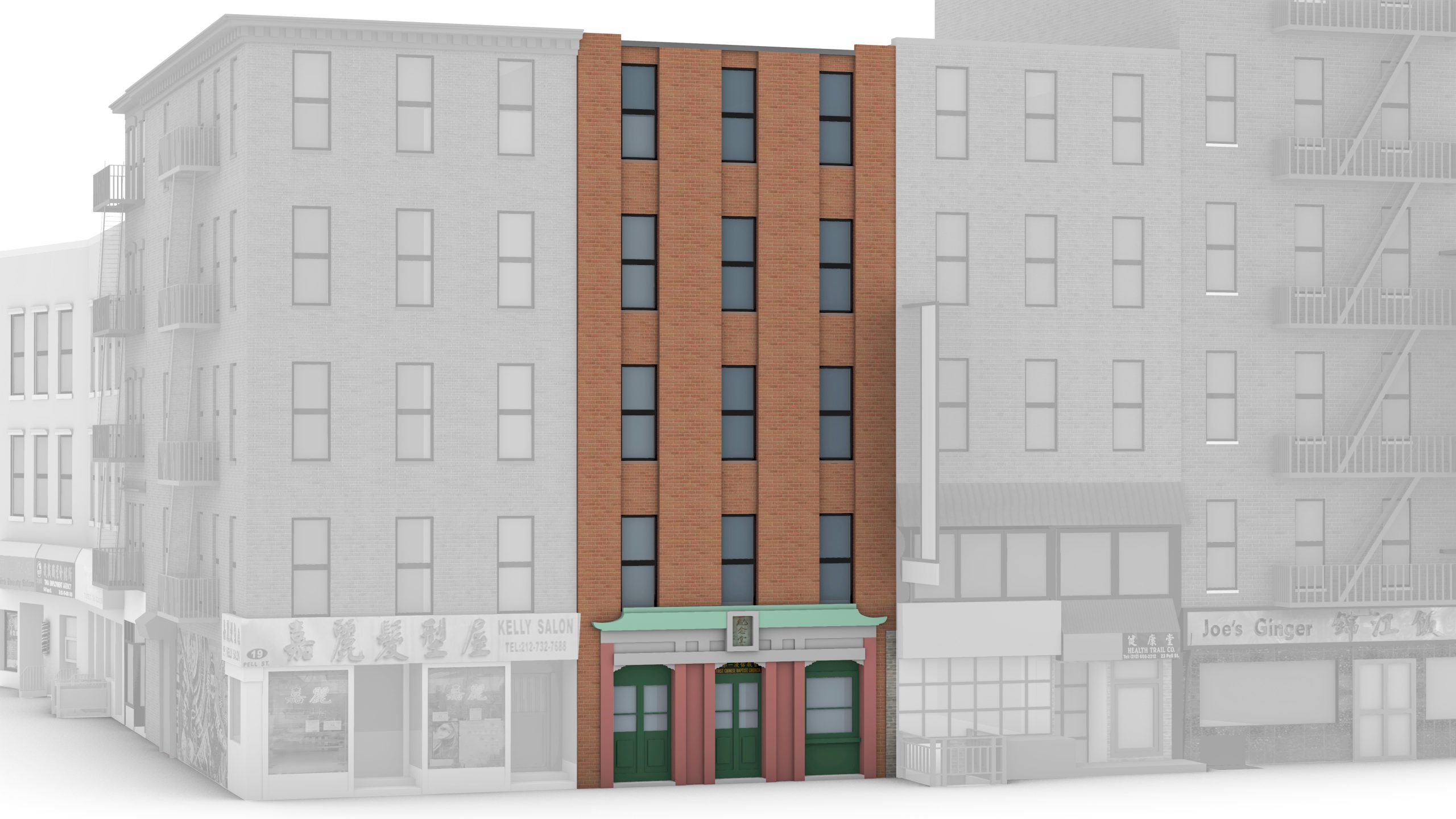
21 Pell
The First Chinese Baptist Church
Built in 1935
2024
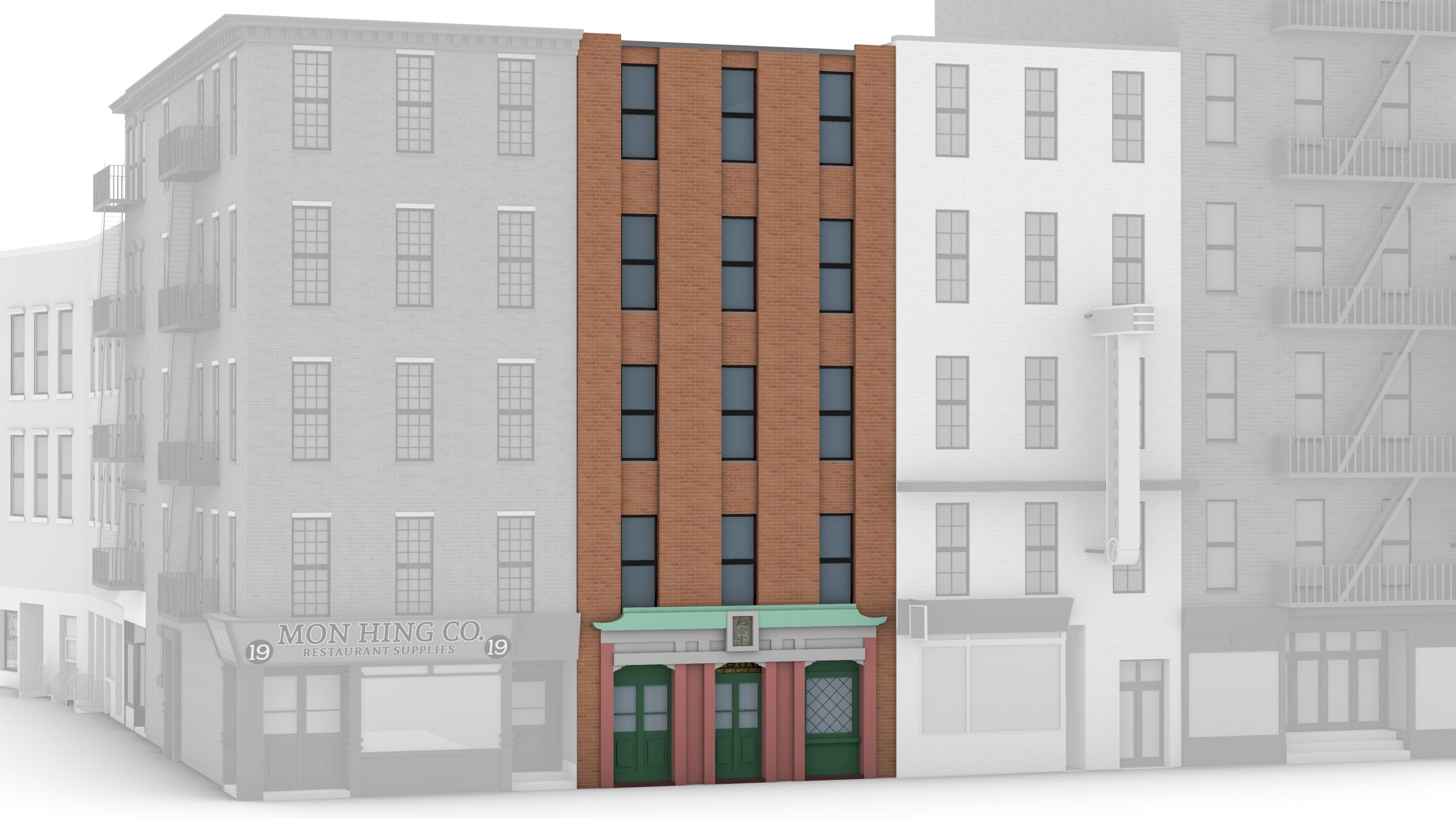
21 Pell
New York City Baptist Mission Society / Chinese Seaman's Club
Built in 1935
1940s
Interview
WITH ROBERT GEE (BUILDING TRUSTEE OF 21 PELL)
Interview conducted in March 2022.
+ Tell me your family’s story.
I grew up in Queens. I was born in Manhattan and raised in Queens. I was the youngest of six. Five of the six kids were born in the U.S. My father immigrated in 1937 at the age of 15 from Toishan. The typical business model was to send the young men to the United States first, to earn a better living than in China during the Japanese invasion, to support families back home. They would work 20-30 years and after, they would retire in China; but with the change in regime from the Republic of China to the People’s Republic of China, they felt like their round-trip ticket wasn’t there. Many folks came to America with expectations to travel back. That was that generation. And so they had to either join the military services and through the GI Bill, would go back and marry women and bring them from China to the United States. Many stories I heard about were that was the way of life and to support generations of families back in China.
Their Sundays would be off work— they would get in their Sunday best suits, their Stetson hats and polished shoes and just come in, hang out and meet other fellow immigrants, or go to family associations, or to churches such as the first Chinese Baptist Church at 21 Pell. And if you search on Getty Images for photos with men standing on the corner of Doyers and Pell, you will see men all dressed up in their Sunday best. So post 1936, this church has been part of the fabric of Chinatown until this very day.
My father lived with my paternal grandfather in the Upper West Side — my paternal grandmother was still in China. My father went through that in Chinatown. Along with my cousin, my uncle’s father, William Gee, they worked in a laundry there, together with all of the men and their young sons, who had just immigrated to help them out with duties at the laundry while going to school during the daytime, and were doing odds and ends types of jobs as they got older. My father went to night school all through high school. Then he went back to China in 1947 to find a wife. They met casually and got married through an arranged marriage. My sister was born in 1949.
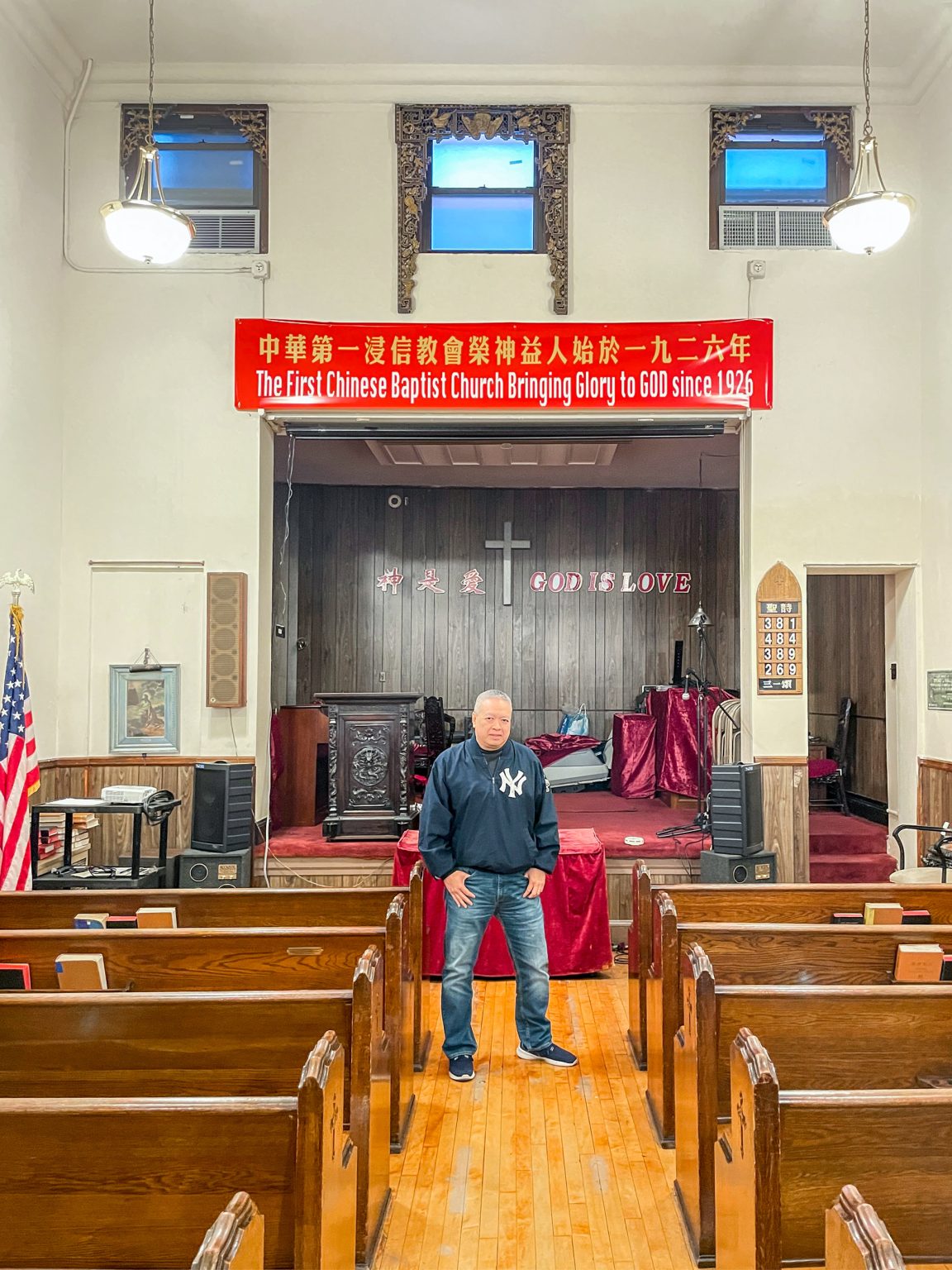
Rob photographed at 21 Pell, March 2022.
My father came back to the United States and petitioned for immigration for my mom and my toddler sister, my eldest sister; by 1949-1950, they were able to come. And so they came and they lived at my grandfather’s laundry in the back of the laundries. You couldn’t afford an apartment and a business, so they lived in the back.
At the time, he was coming on and off into Chinatown but focusing on his academic studies. One of the customers who came into the laundromat said, hey, you know, you’re a hard worker. Why don’t you apply for a summer job at Western Electric? This was one of the divisions of AT&T at the time. He said: Hey, study hard, and we’ll help you get a full-time job there. And sure enough, after he went to night school, he secured his degree in electrical engineering, and then he received an offer to work for AT&T or Western Electric in 1952. He had four daughters, three daughters, and then the fourth came along. He was working a white collar job at the time, which was unheard of in the day.
+ Did he encounter racism?
Sure. I mean, there was definitely the glass ceiling, or the flagrant racial discrimination of being passed over, as hard as he worked. And he shared that sense of – yeah, it’s horrible. He shared that sentiment with me. And it happens to this day.
+ How did you and your family come to be connected to this building in Chinatown?
In the late 1950s, 1960s, he came back to church on a regular basis to help out in paying it forward for his successes in his academic career and his professional career. He had come here to 21 Pell Street to learn English in 1937, in the late 1930s.
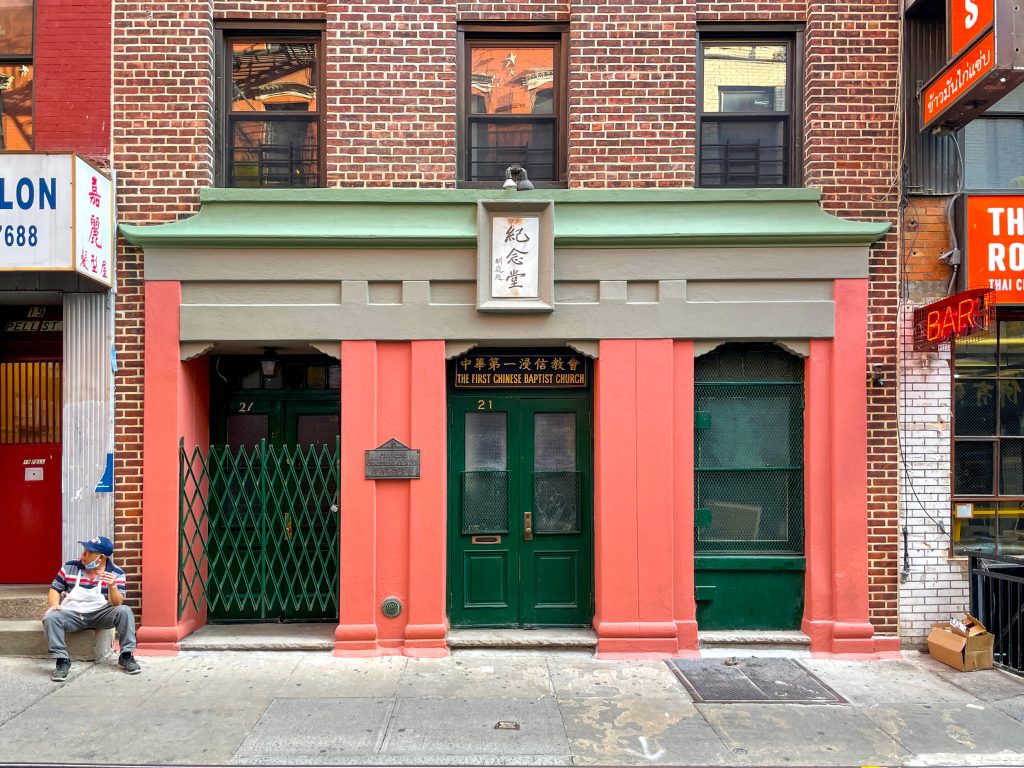
The exterior of 21 Pell, 2022.
He traveled across the Pacific, went through Angel Island, and went through the whole interrogation process. He went under the paper name as Mah. At age 15, who would have thought that he would be able to navigate past immigration services and get through with the paper name? They would interrogate: Which village are you from? And what’s there in this village on the way to your village and who else is in your village? He had to pass that interrogation and spent a week’s time being detained at Angel Island in these barracks. As a young child I went with him to Angel Island, which was a national state park at that point in time. He said – it was never this beautiful, it was like a slum area where a lot of immigrants were staying.
He crossed the continental U.S. by train for a few days and arrived at Penn Station where he met up with his father, who he had not seen for 10 years because his father had left China to come to the United States to work. But he took the long way around: he went to Thailand and tried to be a shoemaker, and when he failed at that because the business was so tough during the depression, he went over to Cuba and worked as a longshoreman lifting cargo for ships. And he said – this is way too hot to be lifting 50 pound bags of rice and then he migrated to New York City.
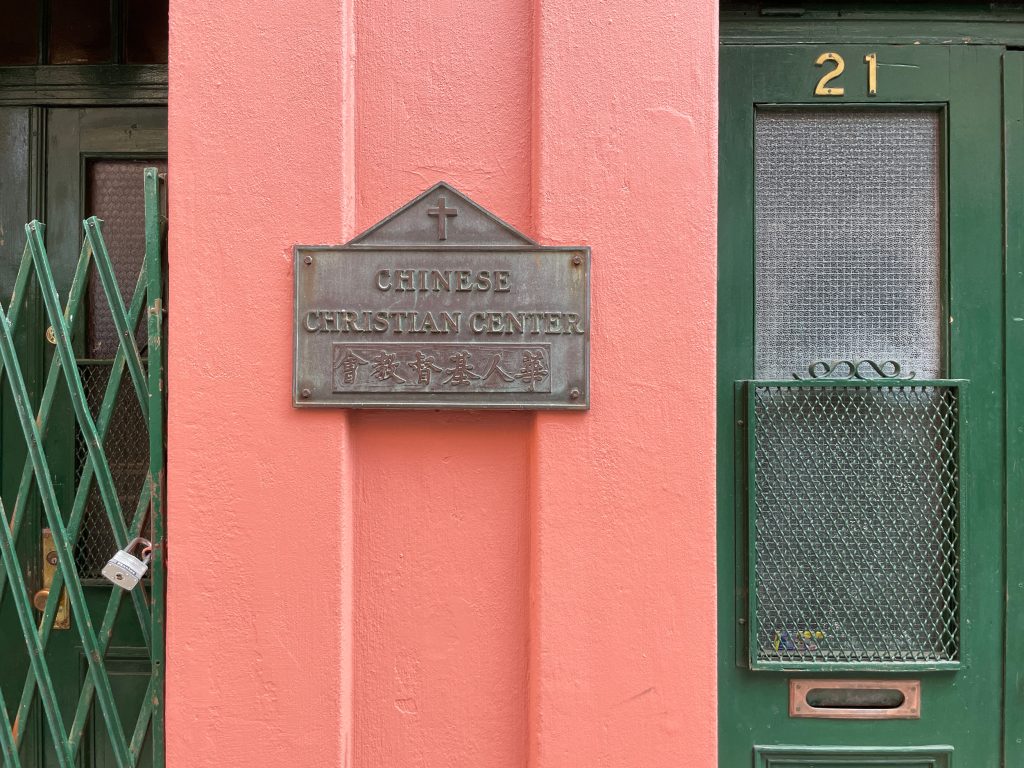
The church’s plaque on the building exterior, 2022.
And so my father met up with my grandfather at Penn Station… he said, he looks like my father but not sure if it is and they had to re-introduce themselves in life.
After he and his father met, they came here to Chinatown to this restaurant – I believe it was called Bobo’s, a fairly famous restaurant. After having the meal, going down the steps, my grandfather told him that tomorrow he would come here [to 21 Pell] to learn English. So my grandfather had a plan as to how to get him acclimated here in the United States and to be with his other cousins like William Gee. And this is where this story comes full circle.
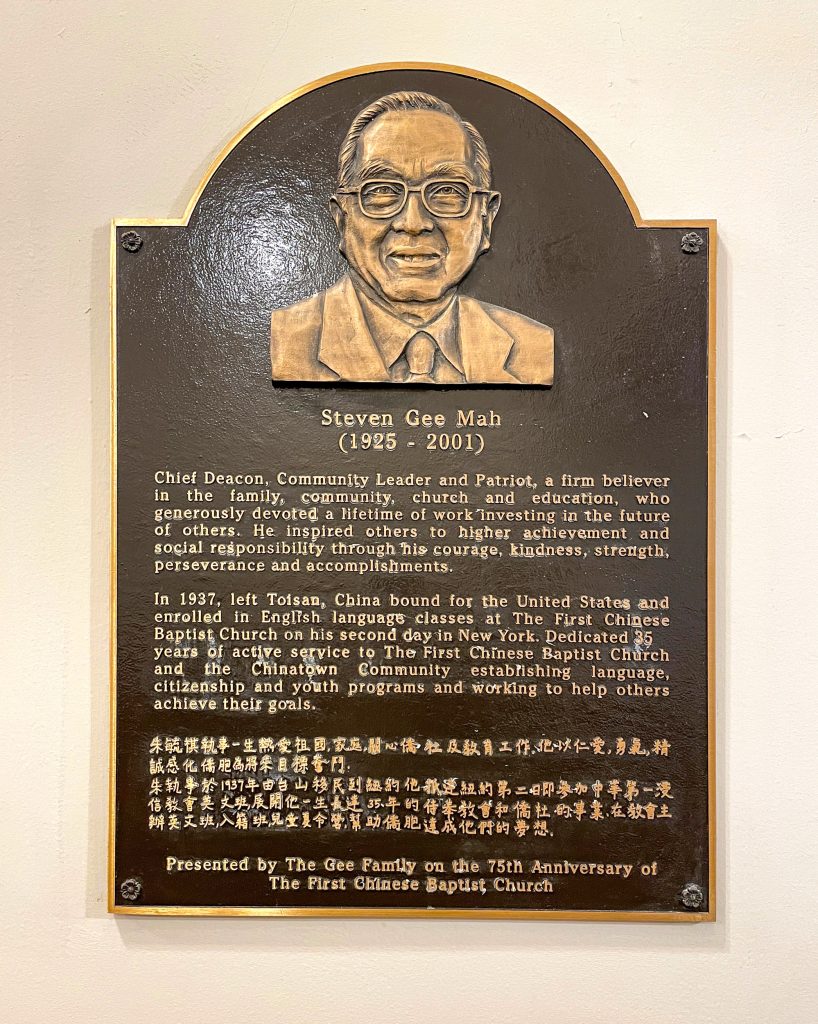
An homage to Rob’s father, Steven Gee Mah on the ground floor of 21 Pell.
So my father came back in the 1960s and became active in Chinatown. He spent time as the president of the Gee Poy Kwok Association (on Canal Street between Elizabeth & Bowery) and then became a deacon of this Baptist church at 21 Pell. He felt that it was important to give back to the community and Dr. Mabel Lee was still leading the church at that point in time.
But then, in 1966, Dr. Mabel Lee passed away unexpectedly. The five deacons in charge had to make sure that the state didn’t commandeer the property and assets that Dr. Mabel Lee had built in the 40+ years she was at the helm. In this year, my father and these four other deacons had worked to their very last day in their very last breath in leading the church to protect the assets and fiscal responsibilities as well as the spiritual offerings of the church.
As part of that, the church offered Sunday church services and Chinese classes. As part of that in every Tiger Mom, Tiger dad type family, you were supposed to go to Sunday school at church as well as learn Chinese. There was a Chinese class on Mott Street at the Chinese Consolidated Benevolent Association (CCBA) or at 21 Pell. We held the Chinese class to offer our services to congregation members to take care of their kids for a few hours, so that they could go buy their groceries and the kids could learn Chinese.
Today, I am one of three trustees of the building. My responsibilities include financial management, community outreach with 21 Pell’s monthly events, upkeep as well as running a children’s mentorship program — teaching math, Cantonese — that my father started in the 1970s. After a hiatus in the program, I resurrected the program with my father in 1986. The mission of the program is to provide role models for young students to build an academic foundation. I’ve been in partnership with my father and we’ve run it for over 36 years.
+ What was Chinatown like in the past decades?
In the 1960s, the landscape of Chinatown started at the bottom of Mott Street and Chatham Square and stretched to Bowery, Doyers and Pell.
Many restaurants and retail shops catered to Chinese immigrants that migrated to the U.S. It gave them a location to buy key ingredients needed during the week. I remember trading companies selling cakes of noodles stacked up high on Mott Street in crates and boxes, and sacks of rice coming in and out… There were 1-2 roasted barbecue shops. Where Big Wong [restaurant at 67 Mott Street] now is, there was the main barbecue shop next door at the Shanghainese restaurant. There was no Hong Kong Supermarket then —you walked up two steps and this is where you got your roast pork. Next door would be the places to buy your noodles and rice. Up and down the street, they had the essentials needed. Some would travel from Boston or upstate New York, Pennsylvania or even as far as Virginia to come here to buy their essentials. There were Chinese herbal stores up and down Mott Street and Bayard Street. Across from 69 Bayard, where the boba shop and bakery currently are, there was a drug store. In this pharmacy was a white woman named Suzy who prescribed meds without having to see a doctor.
There was one doctor/pediatrician named Dr. Leung, who had an office across the street from the Transfiguration Church. She probably delivered about 90% of the babies in Chinatown in the 1950s and 1960s. She delivered me and my siblings. We were born in the New York Infirmary (which is now the Long Island Jewish Hospital on 1st Ave between 15th and 16th Street.)
And the banquet halls… the main ones were Port Arthur at 7-9 Mott, along with China Lane by 24-26 Mott. You would enter and walk down a few steps and be in the foyer with the bar. There was another banquet hall across from the Leung Fong bakery, where The Lee Association is now [at 41 Mott Street]; all of the wedding banquets were held there in the 1960s. The community had gatherings at Port Arthur, and Sun Yat Sen had his rallies there too.
Chinatown in the 1940s, the 1950s and the 1960s was the place to congregate for many folks. There were lots of associations. That was a way to assimilate together. You would meet up on Sunday, or use it as an excuse to play cards. You went to Sunday school while the parents were shopping for groceries to prepare for the following week. You’d also be spending time at the family association. It was a place where they felt like they were at home because many of these folks lived in the Upper East or West or parts of Harlem, in their laundromats. But this was their day of rest.
Folks did get dressed up to come down to show that hey, I’m doing well. I’m here in America and wearing my suit.
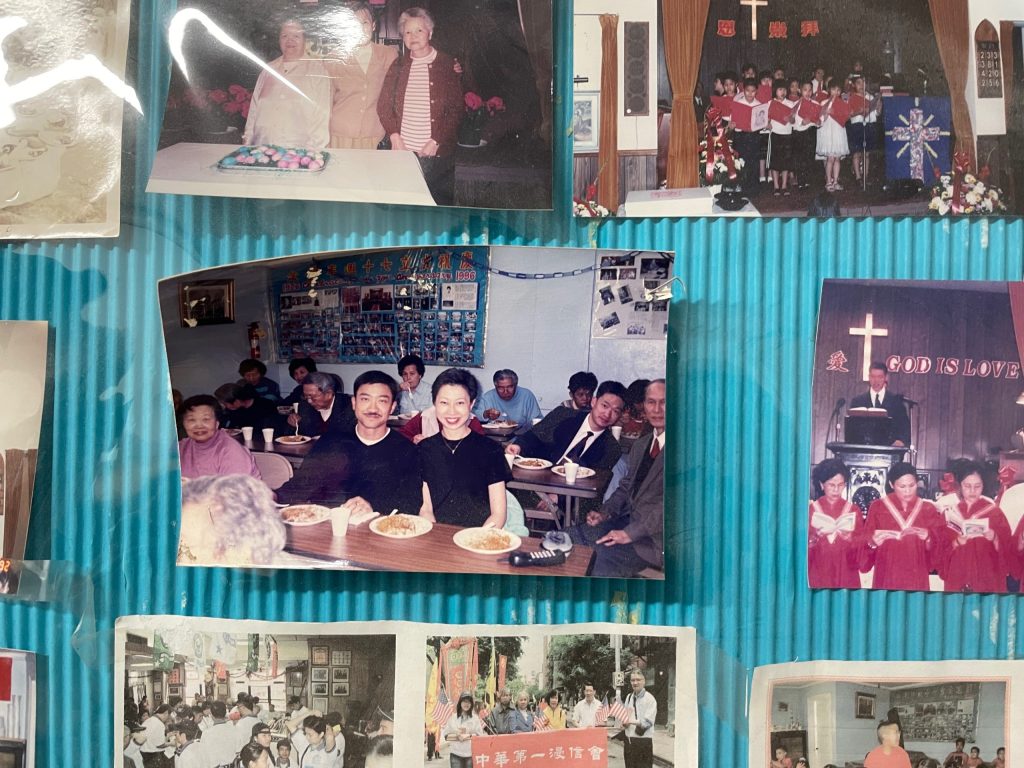
A photo of photos displayed in the church, 2022.
+ Who are the current users and visitors of this building?
In the 1960s, this [building] was a huge space to congregate in and to get childcare help.
Today, we’re seeing the migration out of New York… coming to Chinatown is more for nostalgia and doesn’t provide for the same needs as in the 1950s and 1960s. Even the associations are dealing with decline in membership.
Chinatown is encountering: what happens next?
Now, we have an older congregation. The fabric of Chinatown has definitely changed. There are lots of old timers but [building and business] operators are losing control… it’s hard to make a profit now.
What is going to happen for us to reinvigorate that booming 1970s/1980s feel?
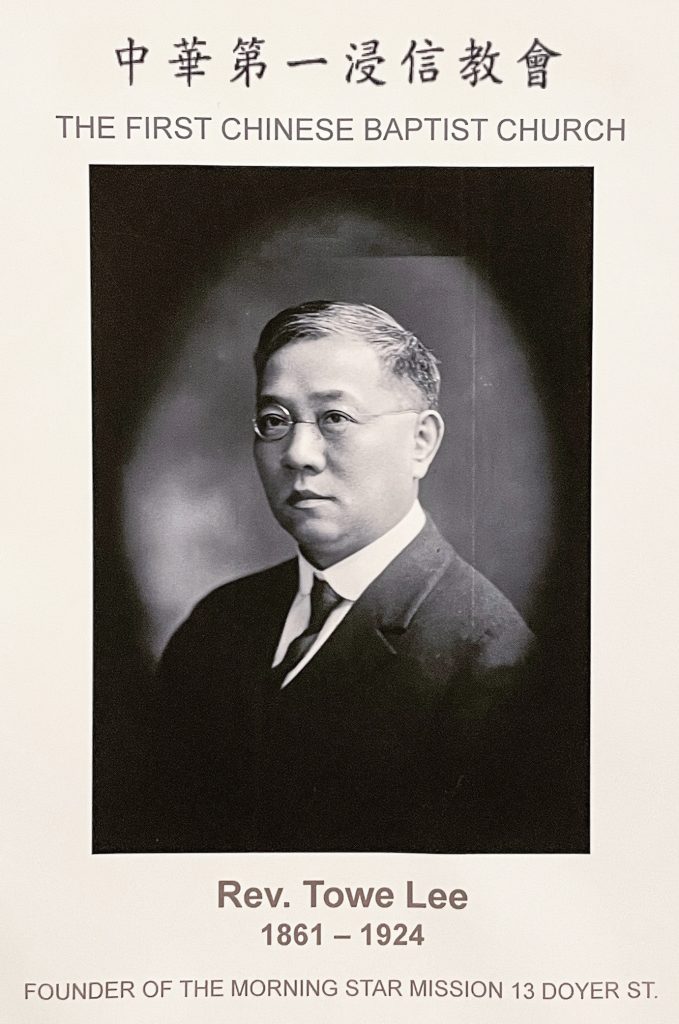
Reverend Towe Lee’s portrait is prominently displayed in the church.
+ When was this building constructed? Who is the architect for this building?
Tell me about the building’s history and its past lives.
The building was purchased in the early 1930s. It took about five years to raise the money and renovate the building. It was originally a 5-story residential walk-up with retail on the first level.
We are sitting on the second floor that was the balcony — they opened up the flooring to make high ceilings within the chapel. The stairs were probably wooden stairways, and to bring them up to code, they were made into steel and cement-reinforce staircases.
On the second floor is a balcony classroom. The third floor has an open floor plan – it’s a big communal space for classroom teaching. The fourth floor is partitioned. Maybe it was residential space for a reverend or for Mabel, who may have lived here for a time, with a place to shower. The fifth floor contains the administrative offices for the church.
There is a uniqueness of the interior. The basement has multiple showers installed, following the Morning Star mission for young men to learn the Gospel and English, to have a place to shower and have a nice, warm meal. There was a kitchen in the basement too. they would prepare large Sunday meals. There would be real china — plates, cups, saucers — like they were ready to feed an army.
The third floor would have a lot of larger area for meals. There was a large dumbwaiter to bring the food up — we used it up until the 1980s — and we’d have holiday dinners with turkeys baked in the oven all morning long. After afternoon service, they would be eaten at Thanksgiving dinner.
They weren’t mainly Chinese meals; they were more western meals, to provide the experience of having Sunday meal after service. Turkey, stuffing, cranberry sauce and gravy… and baked hams. Dr. Mabel Lee was very traditional in that way, to expose American cuisine to young Chinese immigrants and families.
+ Do you know of any major renovations or changes to the building since it was first constructed?
Since it opened up and was renovated in the 1930s, this building has been the same, with the exception of central A/C, LED lighting, wall paneling and a fresh coat of paint.
Interview
WITH BAYER LEE (PASTOR AT THE CHURCH AT 21 PELL)
Interview conducted in March 2022.
+ Tell me about the history of this church we’re standing in now.
See that plaque over there? That’s Rob’s [Robert Gee’s] father. He was instrumental in salvaging… if it wasn’t for him, the archive could have been in the dump.
That [other] plaque is the father of Mabel Lee. So the building type is really a memorial hall for me and the church is a part of it. Funds were raised at the heart of the Great Depression. Reverend Lee Towe passed away in 1944.
Some history about Reverend Lee Towe: They didn’t have a son. In fact, she [Mabel Lee] was sort of brought into the family. The way she honored her father is interesting. When you read about her, it’s often in the narrative of women’s suffrage, where the male is not the primary, but ironically, as far as I know, this is probably one of the only buildings in Chinatown where she built a building to honor the legacy of her father. This was in the 1920s and 1930s. This is very significant. Not only does she honor him in this memorial, but in the Chinese Benevolent Association, in 1959, she donated a large amount in honor of her father again. They called it the Lee Towe Memorial Library.
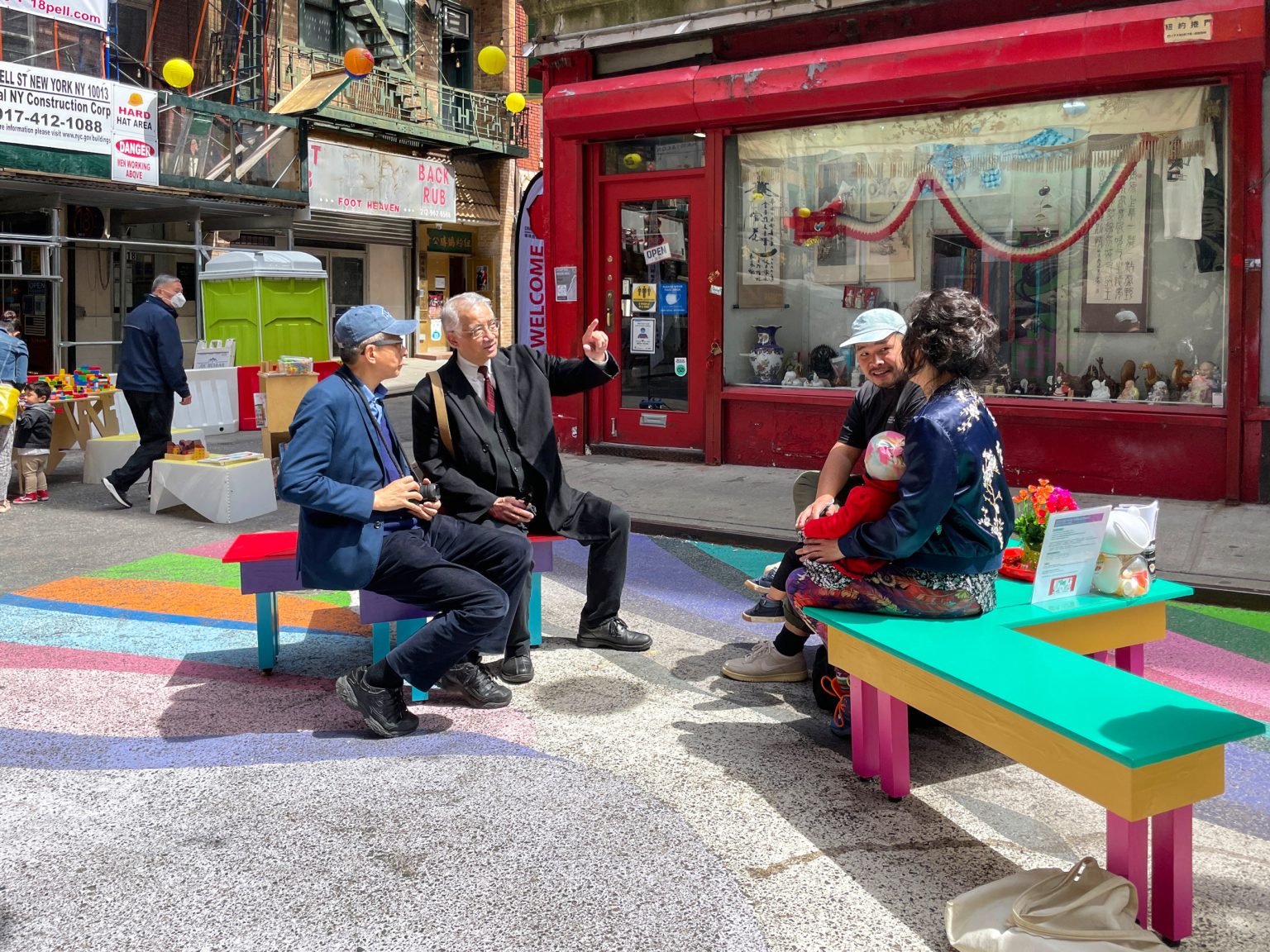
Pastor Lee (second from left) recounts stories about local Chinatown buildings at one of the REFLECTIVE URBANISMS community storytelling events on Pell Street, April 2022.
+ When did you come to New York?
I came to New York in 1962 from Hong Kong. I was 12 years old. My mother sponsored me and my stepfather. The first time I came to Chinatown was 1962 — it was quiet.
When I was a child, I came to visit Chinatown every Sunday to shop, buy groceries from the Chinese grocery stores and we’d have our meals during the week. I remember my stepfather would buy a whole case of oranges and we’d have this big case of sweet, juicy oranges. I can tell you where I hung out, right on Bayard and Mulberry in the little grocery stores. My parents owned a Chinese laundry in Far Rockaway, so for six days a week I was with Jewish, white people. When I came to Chinatown, it was very fascinating. This was a very bizarre place for those of us coming from Hong Kong or other parts of Asia.
So in 1962, I lived in Far Rockaway and would come on Sunday. I’d be walking around this place – it’s old! It’s got a smell of ancient things that I didn’t see in Hong Kong, which was very interesting. Hong Kong was constantly being renovated and buildings were always getting demolished, but here… My first year in Chinatown was fascinating, [it seemed] ancient and European. It wasn’t really “Chinese, Chinese-looking”, unlike San Francisco— It didn’t look like what I thought Chinatown would be. It was more commercial than “Oriental.” We connect to the memory of space.
And now I come [to Chinatown] because of the church. I help out with different churches, but this is the main church. It’s been since 2005; almost 20 years!
+ Do you remember what Chinatown was like back then? How has it changed? How did you become connected to Chinatown?
I was initially an outsider… [but had] the curiosity of being Chinese because I grew up in Far Rockaway at that time.
I came [to Chinatown] when I was 12-13 years old and then I lost interest during my junior high school years and didn’t come down anymore, until I went to college. When I was 15-16 years old, I wanted to be part of the white community. I hung out with my friends who were Jewish, white guys and some Italian guys. We used to play basketball, football. I was going to go to Pratt to be an artist but my mother said, “No, you’re not going to starve. Go to an affordable program like architecture.” So I signed up at City College in the very progressive architectural program in the city. It was very experimental.
That period of coming to Chinatown feels like business – It’s sort of an interesting place, but I have no connection to her. My mother took me to some of the churches, the one on Henry Street, the Presbyterian Church. My mother took me to Marinis Temple in Chatham Square — and Trust in God Baptist Church (5 Elizabeth Street) as well. These are very historical churches.
During high school, I began to hang out with my friends and on Sunday I didn’t go. She tried to get me to go with water guns – “Get up, get up!!” I wouldn’t go. What’s in Chinatown? Chinatown to me was really backward at the time – this was in the 1960s before the immigration law changed things in 1965.
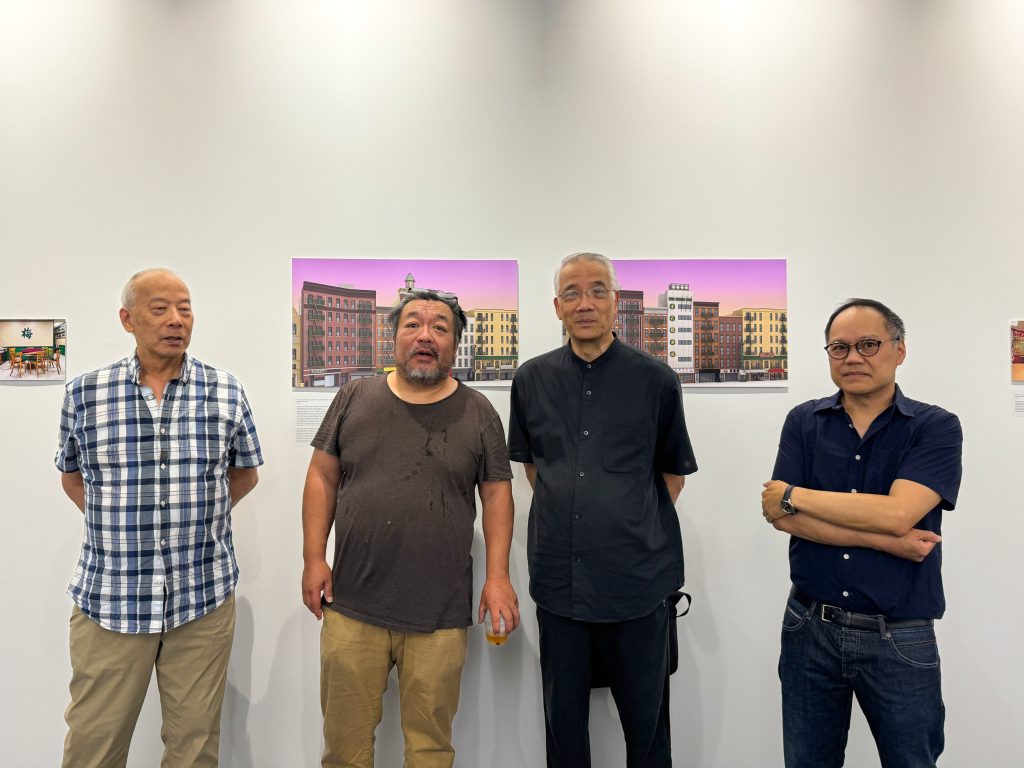
Bayer Lee (second from right) with other Chinatown community members in front of architectural renders from this project, exhibited at St. Francis College Art Gallery, July 2024.
So how I got back to Chinatown was this: I was in Flushing and went to a church my brother-in-law started. My brother-in-law is also a link, because he came later. He also worked in the laundry in Far Rockaway, but he didn’t think that was going to be long-term, so he came back to Chinatown to work as a garment factory worker. On the weekend, he would preach in churches as a minister.
Out in Flushing, around the late 1960s before ping-pong diplomacy, I observed the social change there. In 1971 when Russia was bombing China, more than 50 years ago, we [China] extended a relationship to Nixon. Most people think that Nixon reached out to us but it’s the reverse situation. Flushing became a hotbed of immigration by Taiwanese people. Because once they heard about this normalization, they went into Flushing and bought property and then many of them came to the Flushing church. That’s when I was there in Flushing, traveling between the Chinatowns in the late 1960s, early 1970s. Somebody who knew Mother went to the church in Flushing, and then I got to know her and she invited me to Chinatown. She happened to be a member of the Flushing church my brother preached at and she happened to go to City College as well. She said, “Come to a Saturday fellowship.” I thought she was interested in me. But she wasn’t – she was just doing evangelism!
So how I got back to Chinatown was this: I was in Flushing and went to a church my brother-in-law started. My brother-in-law is also a link, because he came later. He also worked in the laundry in Far Rockaway, but he didn’t think that was going to be long-term, so he came back to Chinatown to work as a garment factory worker. On the weekend, he would preach in churches as a minister.
Out in Flushing, around the late 1960s before ping-pong diplomacy, I observed the social change there. In 1971 when Russia was bombing China, more than 50 years ago, we [China] extended a relationship to Nixon. Most people think that Nixon reached out to us but it’s the reverse situation. Flushing became a hotbed of immigration by Taiwanese people. Because once they heard about this normalization, they went into Flushing and bought property and then many of them came to the Flushing church. That’s when I was there in Flushing, traveling between the Chinatowns in the late 1960s, early 1970s. Somebody who knew Mother went to the church in Flushing, and then I got to know her and she invited me to Chinatown. She happened to be a member of the Flushing church my brother preached at and she happened to go to City College as well. She said, “Come to a Saturday fellowship.” I thought she was interested in me. But she wasn’t – she was just doing evangelism!
I went to the church on East Broadway next to the Chatham Square Library at 29 East Broadway. That was the first time I hung out with Chinese who spoke perfect English. No accent. I said, Where did these people come from? Because most of us, our experience is [that] Chinese speak Chinese. This was the first time I met an American-born Chinese in 1970-1971. Again, I felt that I was not a part of it because I spoke English with an accent.
I began to transfer between Flushing Chinatown to Manhattan Chinatown: the morning 11 o’clock service in Flushing, then I would come to the three o’clock service in Chinatown on East Broadway. At that time, everybody went to City College, Brooklyn College. A few got into Cornell, but by and large, most of us were not wealthy.
We did not have a sense of Asian-American history, an ethnic awareness in the late 1960s. It started with the African-American movement, with Martin Luther King Jr. Many churches in Chinatown are still not connected with this Asian American history, because it’s not for them. For me [at the time], I came to Chinatown to go to church, to hang out with other Christians. All of a sudden there was a lot of activism going on, like Chinatown Basement Workshop. I was not part of it. I was not aware of that kind of cultural agenda. It was a different world. So how did I get involved? Part of it is because when I was in Flushing, I realized I needed to help. Somebody asked me to give a talk.
I was doing architecture but I got more and more involved in church because of my brother. He asked me to help start an English ministry, for the English-speaking kids… and in 1976, I committed myself to being a minister. They sent me to Hong Kong. In 1976, with Nixon opening the door to China, the interest in China came from both businesses and mission work. I wanted to be a missionary to China; but you had to go in as a tent-maker with a different profession. Ultimately I went to a seminary.
For me [at the time], Chinatown was a dump. As an architectural photographer, I had no photographs of Chinatown. The event that changed my radical shift was when I took a course— The History of the American City with Professor Gwendolyn Wright. That changed my course. During the lecture, she projected a huge black and white lithograph of a neighborhood from the 1850s. I’m looking at this picture: So what is this? She started talking about the neighborhood of that place. There’s a guy, a WASP with a high hat, dressed like me, standing in the middle of the lithograph and surrounding him are these Irish brothel women running around. This was the construction of the place we called Five Points. It was produced after a color painting. That radically changed me – I even wrote a paper about it – because my mother lived right there. It was the worst neighborhood in the world. Lowlifes. A lot of liquor stores, women half dressed.
The picture was constructed to present a very negative scenario about that Five Points area. It was a politicized picture showing a white guy in the middle. As a result of this 1820s painting, a lithograph was produced )in the Valentine’s Manual. (This was probably one of the first maps of the area, an insurance map. Essentially, the painting was saying that the White Anglo-Saxon Protestant male was surrounded by Catholic lowlifes…
It turned out that my mother lived there when she came… escaping Hong Kong incidents because I was born out of wedlock. She was married.
This image stirred me to investigate the story behind it — and it turns out I had personal knowledge of it. I’ve been taking architectural photographs of the buildings. Corky Lee introduced me to the community network. I didn’t know about 21 Pell church until his [Robert Gee’s] father invited me to give a speech in the mid-1990s.
Mosco was the most significant street because it connected to the Five Points. Today’s conversation is that this [Chinatown] is a Native American territory.
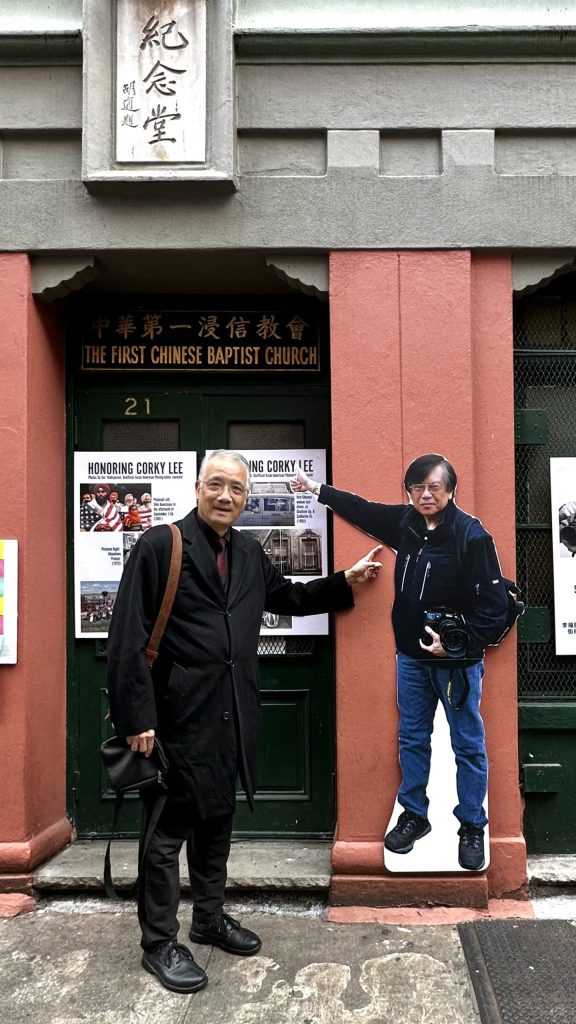
Bayer Lee points to a life-size image of Chinatown activist and photographer Corky Lee, outside 21 Pell. Photograph courtesy of Bayer Lee.
THE CHINESE BAPTIST CHURCH / THE MORNING STAR MISSION - HISTORIC PHOTOGRAPHS
Images courtesy of 21 Pell and Rob Gee.
21 PELL - BUILDING PHOTOGRAPHS
Photographs taken in 2022.