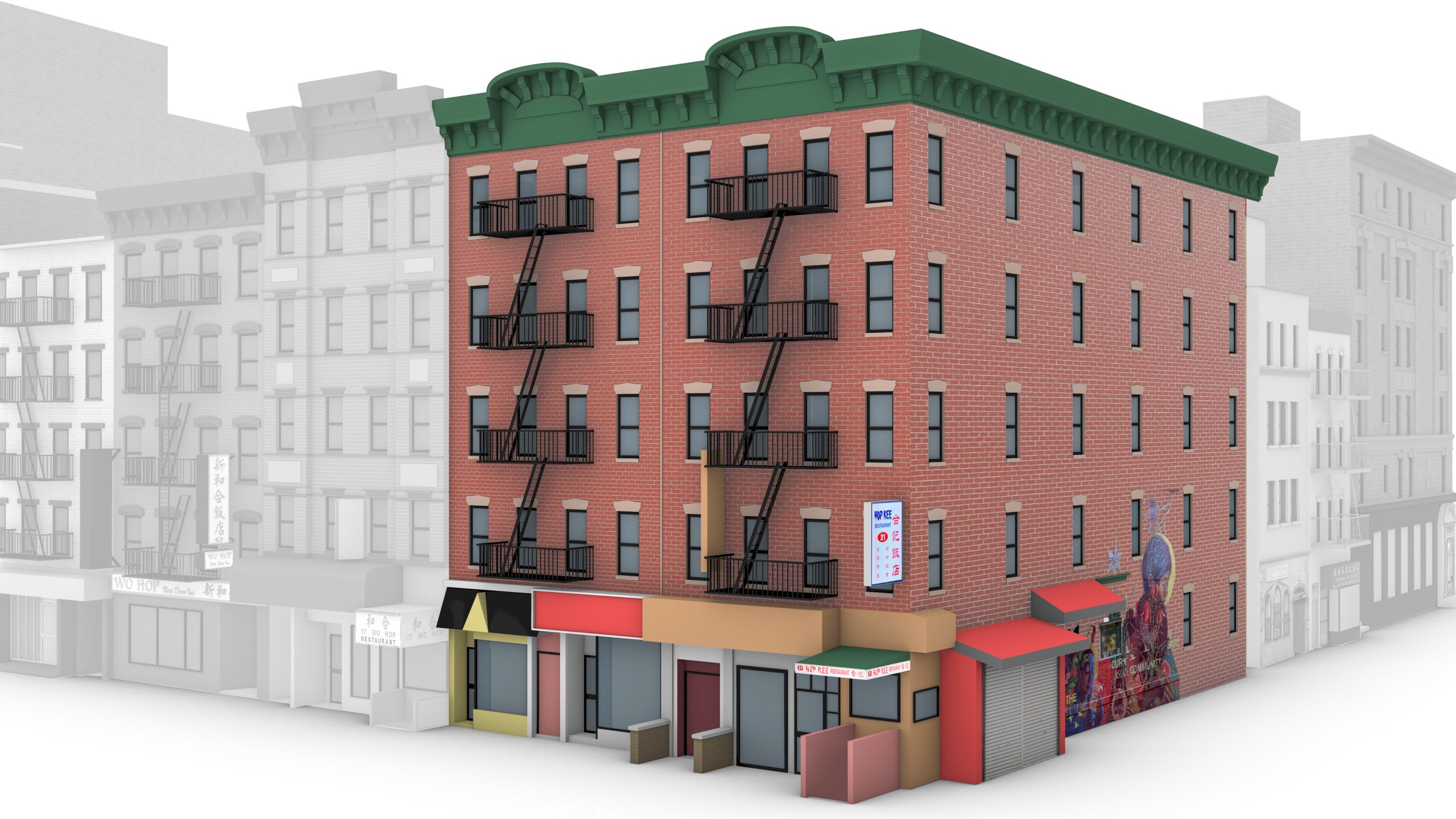
19-21 Mott
Hop Kee Restaurant
Built ca. 1870
2024
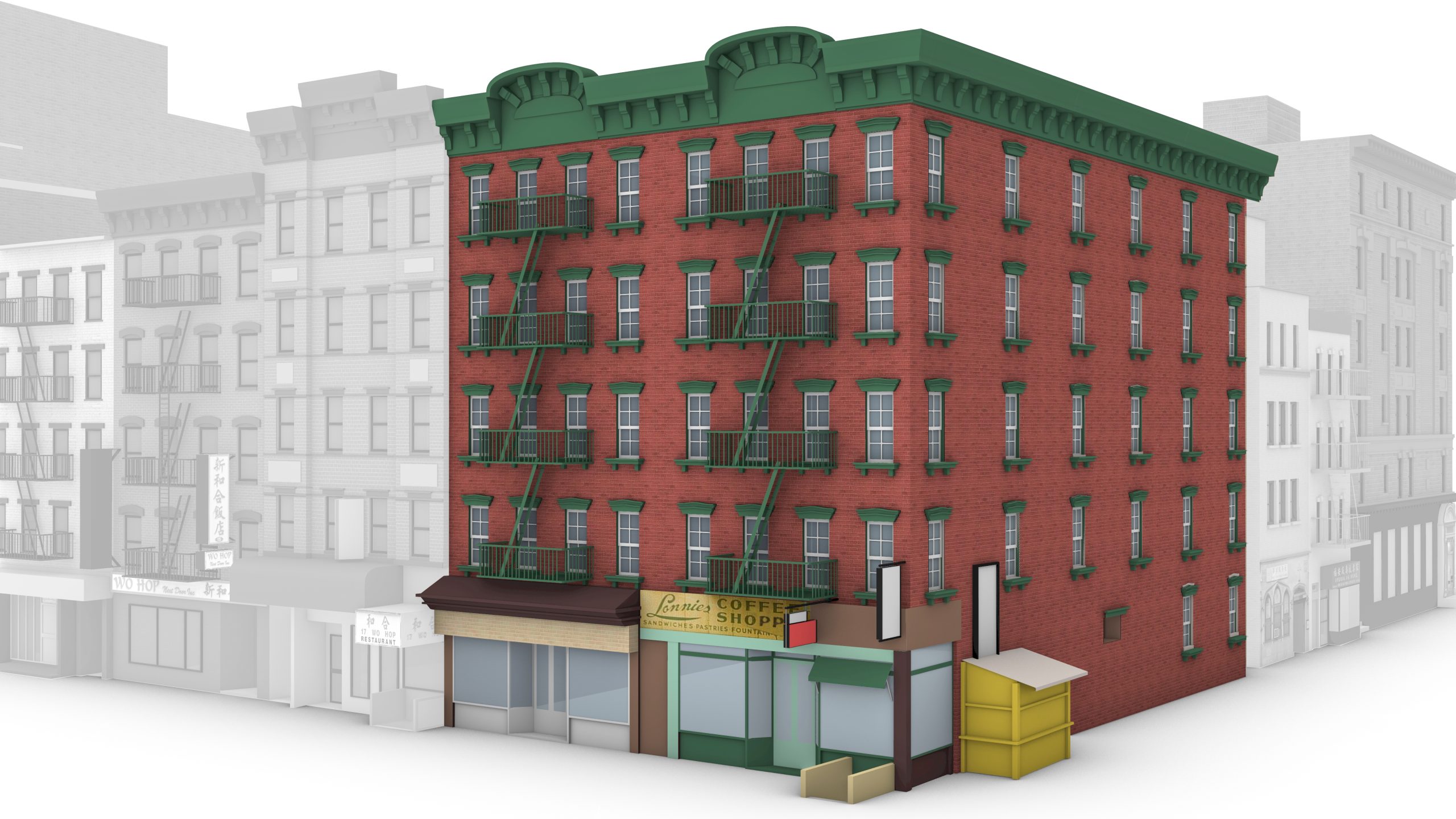
19-21 Mott
Lonnie's Coffee Shoppe / Hop Kee Restaurant
Built ca. 1870
1980s
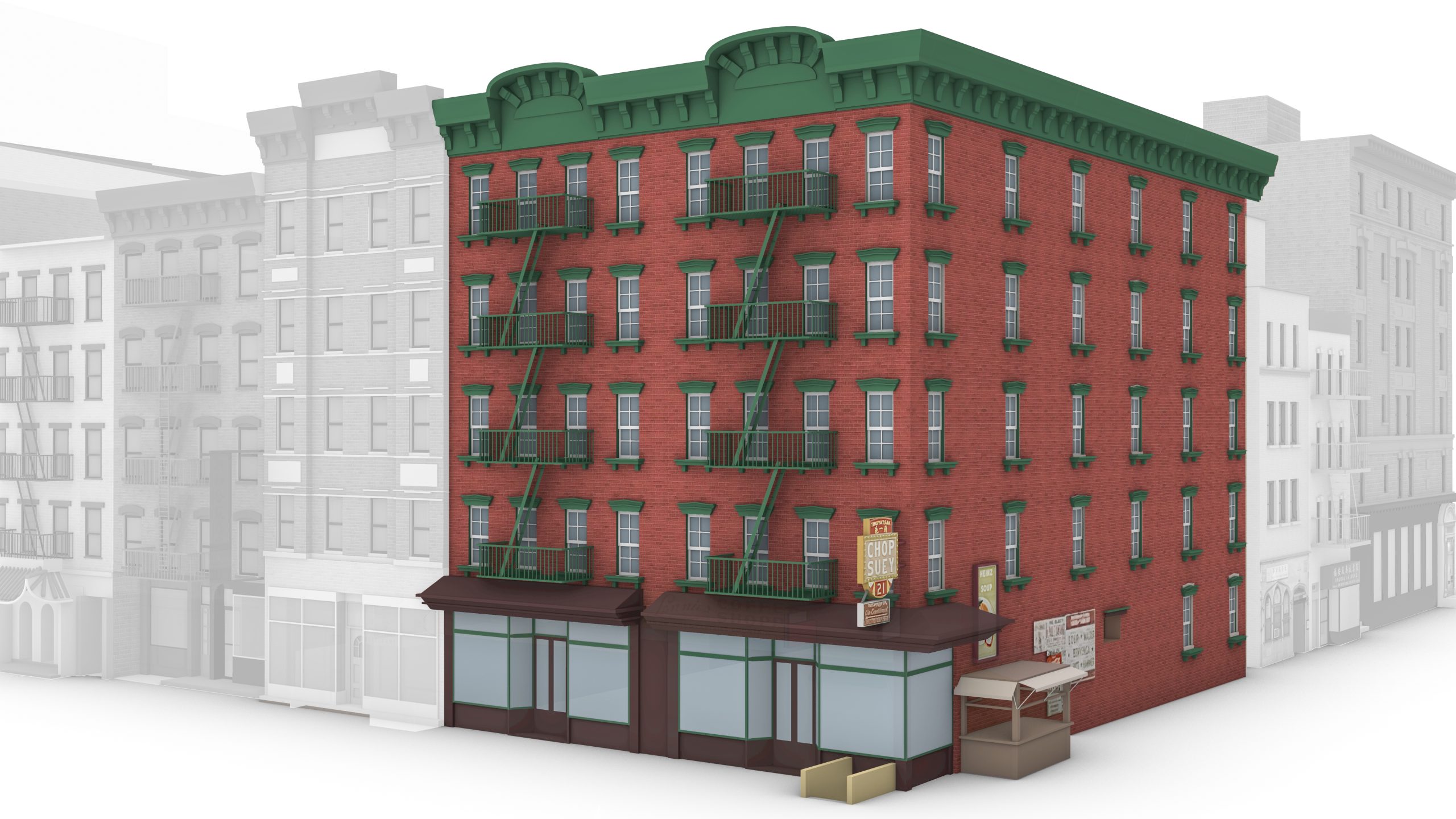
19-21 Mott
Ting Yat Sak Chop Suey Restaurant
Built ca. 1870
1940s
Interview
WITH JAN LEE (BUILDING OWNER)
Interview conducted in May 2024.
+ Would you give me a brief introduction of yourself and your connection to Chinatown?
I’m a third generation Chinatown resident – my grandfather came here in about 1890 – twice illegally, and on the third time he was sponsored by a local import/export business. This was during the Chinese Exclusion Act, of course. My father was born in the building in 1921 with his sister Lonnie – she’s a wonderful person and a character. The other siblings were born in China – my father was the youngest. And I’m the youngest of my father. I have two brothers (since passed away) and two sisters.
I was born and raised in this building [19-21 Mott], and I now manage it with my sister.
+ How long has your family owned 19-21 Mott? How did they acquire the building?
We’re coming up on our 100th year of owning the building.
My grandfather could read and write, which got him a job as the bookkeeper for a dry goods, import/export company. He was sponsored by the company in our building – I believe it was 19 Mott Street. The owners of that company, as was often the case, would go back to China now and then, leaving my grandfather in charge of the management of the store. While they were away, the buildings came up for sale.
As was with almost all of the merchants, who were renting, and at the time, just to underscore the importance of this, most Chinese merchants were not here to stay. They were here to get money, send it home, and go back to China. My grandfather said – absolutely not, I’m not going back. So he absolutely knew he was going to be here. When the buildings came up for sale, he used the money from the store and bought the buildings, because these owners were gone for five, or six months at a time.
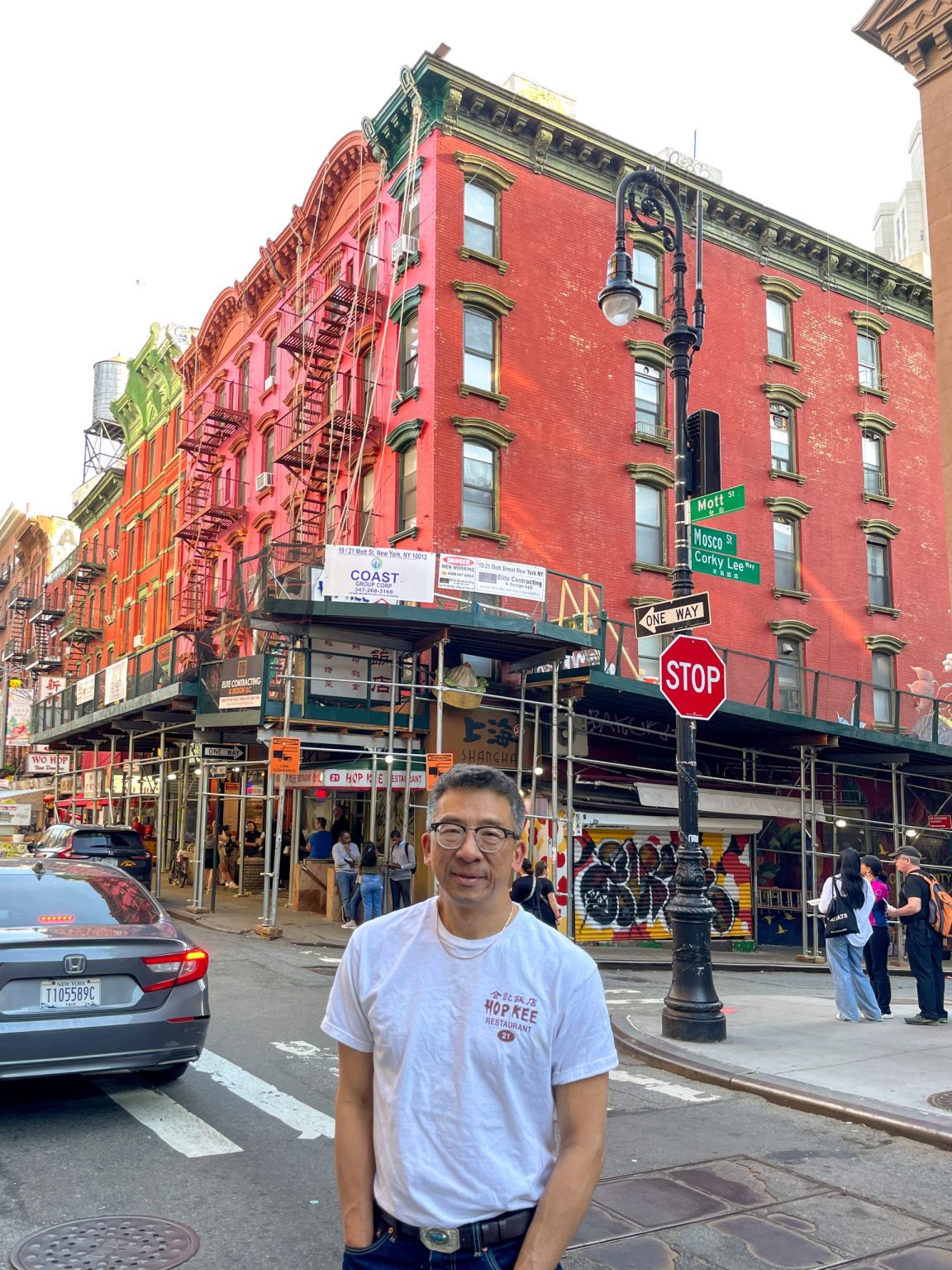
Jan Lee, photographed outside 19-21 Mott during our interview, May 2024.
When they got back, they were very upset that he took it upon himself to use their money to buy the building because as I said, most of the Chinese that were here in the 19th-century era were not here to stay; they were not interested in putting down roots here. My grandfather thought he was making a prudent, financially sound decision on behalf of the company. He got in trouble with the company and they wanted their money back. He went around to the family associations and bid to get the down payment back. He succeeded in getting his down payment back and gave it back to the owners. But then he had enough money to give the down payment to them – the owners of the buildings to buy the building himself… And then he kicked them out of the building. He evicted them and for the next 60-70 years, they were next door and these two men had to look at each other from across the street.
The company’s name was Tuck High. When they went out of business across the street, somebody had the foresight to take the windows, the whole facade, the storefront, and all the fixtures and they moved it to the Museum of the State of New York in Albany. My dad went as an old man to see the exhibit. They opened the exhibit for him and he saw the writing behind the walls – his father’s ledgers.
When my dad was born in the building, they were the first Chinese family there. It was mostly Italians. They [my family] had bought it from a Jewish family. He was an architect and must have been wealthy; he didn’t live here but lived in the Upper East Side. You have to think about who was willing to sell buildings to Chinese people in 1924? Not everybody. I don’t know how old it was when he bought it. Maybe it was built in the 1870s, or 1880s. The demographic has obviously changed over the years and started to become more and more Chinese.
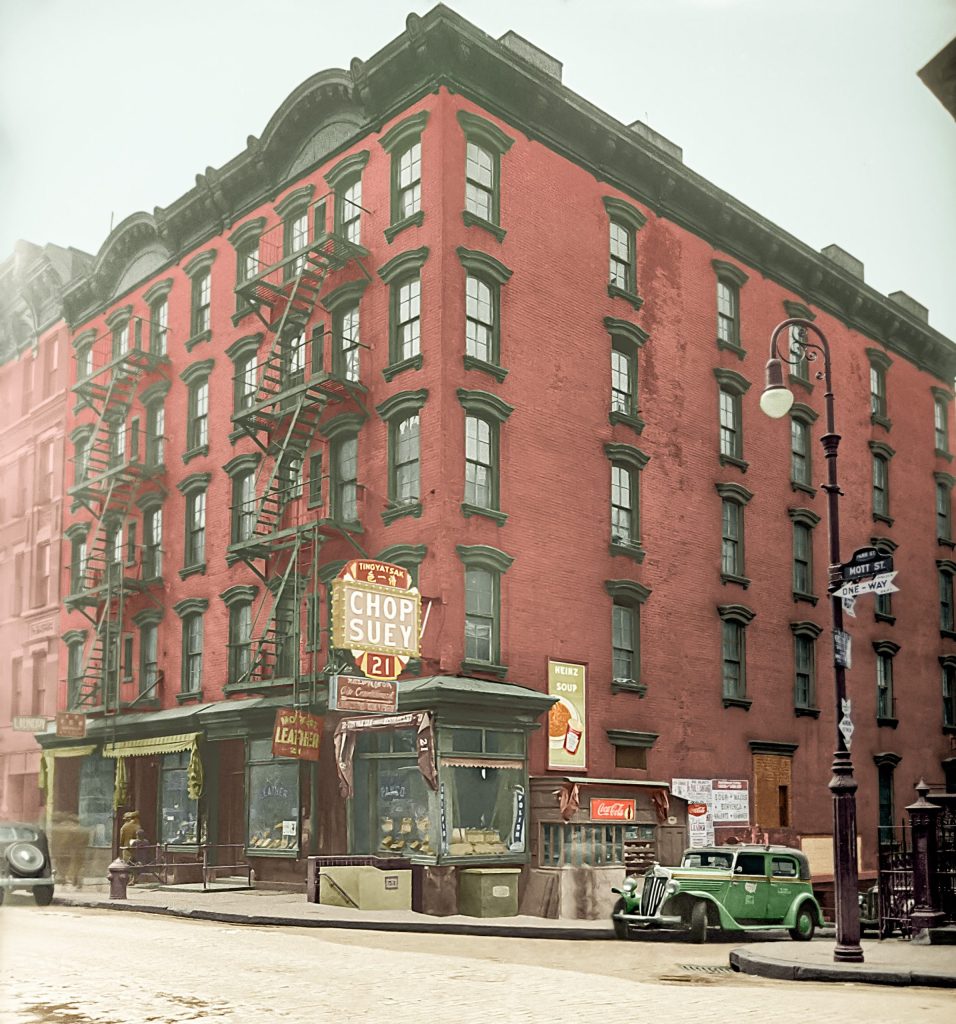
1938 New York City tax photo from the municipal archives. Colorized, courtesy of The Lee Family.
+ Tell me about your childhood in Chinatown.
What was Chinatown like at the time?
When I was a kid, all the stores in Chinatown had gold lettering in the windows.
My father’s childhood was more fascinating than my childhood. He was born in 1921, so his childhood was in the 1930s. He said the roads were still dirt and cobblestones. There were no parking meters so you could park anywhere. When he was a young man, he learned engineering. He and his friends would literally buy a car for $35, take apart the car to rebuild the engine in the street on Mott, leave it there, then come back the next day and continue working on it. It was that kind of environment. You basically knew everybody.
He was the kind of guy who was very handy. He became an aeronautical engineer. After World War II, he went to aeronautics school in Kentucky and from there, he really learned a lot about engineering, engines and so forth. He rode a motorcycle, a 1935 Chrysler. He was that type of very hands-on person, and he met other Chinese American kids like that. One of his closest friends was here from Chinatown, and the two of them started a trucking company in the 1940s after the war – Yee’s Trucking – and they had a route from Chinatown down south to Chinese farmers for Chinese vegetables. They had to compete with white truckers for the routes.
It was one of his jobs, and then his father, my grandfather, opened a Chinese hand laundry [in their building] and my father worked at the laundry while driving the trucks. They also owned a dry cleaner, a gift store and Lonnie’s Coffee Shop… we’ve opened up all kinds of businesses in these two buildings.
Most of the apartments are very small, they’re only 350 square feet. Many of them had multiple family members in them; they were immigrant families, so you’d find grandma, grandpa, husband, wife, sometimes a kid, sometimes like five to six people in some of these apartments. There were people constantly running up and down the stairs, so it was a lot noisier than it is today. Most of my apartments today are now occupied by single people. Times have changed. Those families all moved away. They went out to Queens and other boroughs. But when I was a kid, the buildings were much more lively. When I was around, it was exclusively Chinese.
My dad went to school at PS23, and I went to PS23. I was the last class out because they had just built Confucius [Plaza]. We used to split our classes between PS23: half the day there, and then they would walk us across to the other classroom in Confucius Plaza. I don’t know why, but half the classes were in the old building, and half the classes were in the new building. The student body was 100% Chinese except for the one Jewish kid who was the principal’s son. When my dad was there, it was primarily Italian and Jewish kids.
When I was here, I was with my friends from Chinatown. When I went to P.S. 23, I would stay at my friends’ houses sometimes. Everybody ate the same food. Everybody spoke the same dialects. Everybody had the same culture. So you felt like your friends were the extension of your own family because it wasn’t very foreign to us to listen to their parents talk. It was much more village-like here in Chinatown. I think that that was even more magnified when my dad was a kid because it was even smaller because he was born into the Exclusion Act… Chinatown seemed to remain small and “village-like” until the 1980s. The dialects changed when a huge influx of people from Hong Kong came, from Toishanese to Cantonese. The transition was not always friendly. All these groups were trying to find their way as this wave of immigration came. There was also increased gang activity because the new arrivals were vulnerable – they didn’t speak the language (Toishan or English). They didn’t have the same support networks we had here as Chinese Americans. I think it was a difficult time for them in the 1980s.
+ How would you describe your childhood daily routines?
My mom would make me breakfast, and I would meet my friend Mike at 37 Mott Street. Then we would go on. I remember I would watch them butcher the frogs in the window, just up the block from 37 Mott.
I went to school at PS23. We would play dodgeball in Columbus Park.
I would buy candy at Betty’s on Mott Street, across the street from the old Wonton Garden.
We would eat pizza at Pizza Palace which was on Bayard, directly across from the stone pavilion [in Columbus Park]. I think it was 25 cents a slice, and then they raised it to 35 cents, and everyone freaked out.
We would sometimes hang out at my aunt’s coffee shop, Lonnie’s.
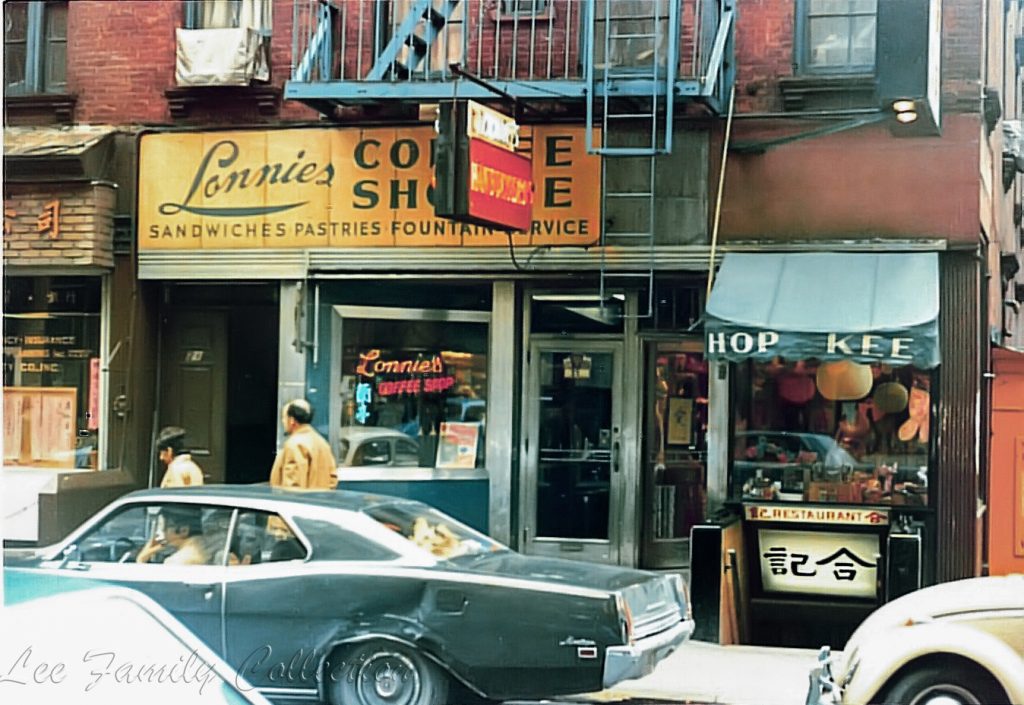
Lonnie’s Coffee Shoppe, 1973. Photograph by Shung H. Lee. Courtesy of the Lee Family.
+ How long have you lived here? What do you remember about the interior of the building and of your family’s apartment?
They’re mostly all 350 square foot apartments. In the 1960s, my parents combined a couple of apartments as the family got bigger. We had a whole house growing up. Our apartment was fully renovated in the 1960s; it was a pretty modern apartment. I did find out historically that the apartment used to have a mission in it – it was a Christian woman who would convert Chinese men. She testified a few times on behalf of the Chinese. At the time, the Chinese were called barbarians; they were called heathens, an inferior race, and she came to their defense. I can’t remember her name. The whole second floor was a mission of Chinese men with this white woman as their Christian savior, converting them to Christianity.
The building has five stories, four apartments on each floor, and a full basement (Hop Kee currently occupies the basements of 19 and 21 Mott). Before Hop Kee, the original owner’s cousins owned a different restaurant, which used to be called “Tin Yat Sick.”
When I was a child, the front door wasn’t locked. I can’t remember what we started with, locking the front door, but it used to be as simple as turning the doorknob and opening the door. Occasionally, there was a homeless person sleeping in the hallway, and I would call my dad, and he would make them leave. But it’s kind of remarkable when you think about it, that our building did not have to lock the front door. We didn’t have that many intruders.
As a child, my grandfather taught my father how to make kites by hand. And my father taught me… my father would fly kites from the rooftop of the building.
(Left) Flags of the Chinatown Community Young Lions outside 19-21 Mott for Lunar New Year, February 2023.
(Right) Jan Lee with the CCYL lion dancers on East Broadway, January 2023. Photographs by Cheryl Wing-Zi Wong.
+ What are your fondest memories of this building?
There’s a lot. I’m very fond of the location. It’s the epicenter of Chinatown for me.
Chinese New Year’s was always a special time for my family; my lion dance club, Chinatown Community Young Lions (CCYL) comes out of the building. It’s more symbolic because the club was started in the building – so we always start from the building.
So that is a very familial but conspicuous tie to the property of my club and my family: owning the club, starting the club and then also owning the building. Not everybody has that. It’s tied to an architectural element. Additionally, aside from the non-profit that is CCYL, the organization “Welcome to Chinatown” was founded in my building during COVID19 along with The Chinatown Core Block Association – all important to Chinatown.
The newsstand was built by my grandfather in 1928. The story goes that he built it for his wife to have her own business, so she sold Chinese pickled vegetables from there. Over the years, it became the first business for many immigrants. Italians and Chinese. Many sold fruits and vegetables from it, as well as Gino’s Italian Ices.
Lonnie’s was a fixture. It was there for about 30 years. Hanging out at Lonnie’s was a big part of my childhood. I was a bit young to be really hanging out at Lonnie’s – It was my siblings, who are much older than me, who lived in Lonnie’s. They were tied to it because they had to flip hamburgers for summer job money. All of my siblings worked there, including my mother. My dad would even come after work and work in Lonnie’s.
My dad designed this menu cover:
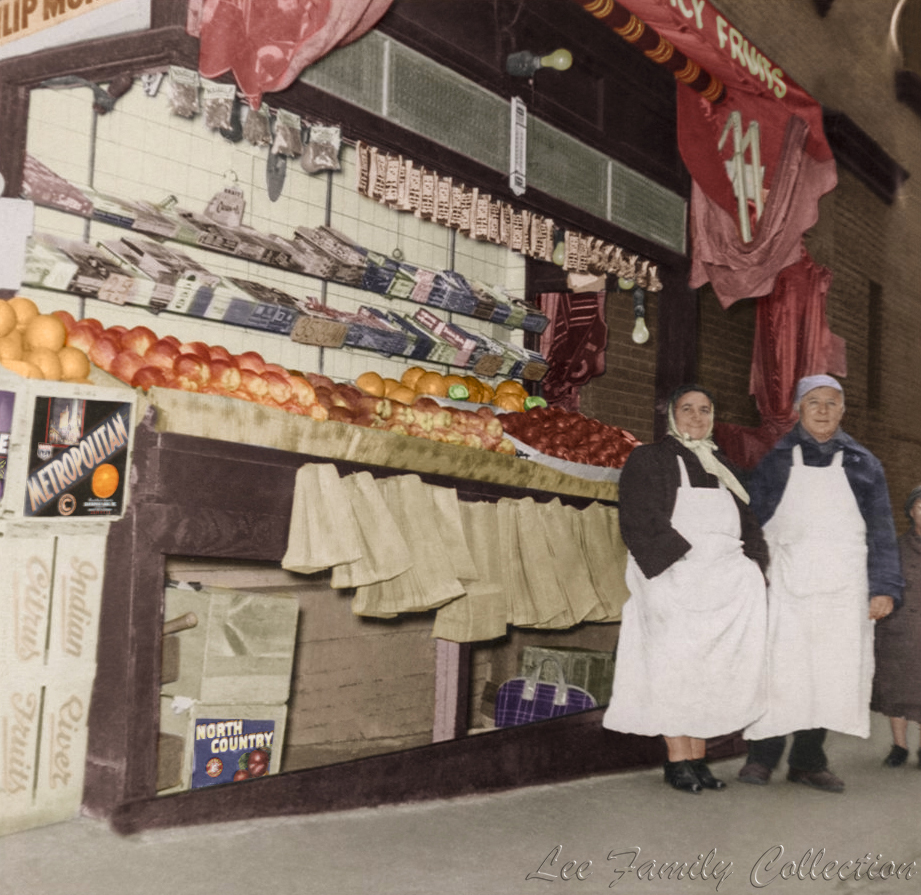
Leo Fruit Stand, 1960s. Photograph by Shung H. Lee. Courtesy of the Lee Family.
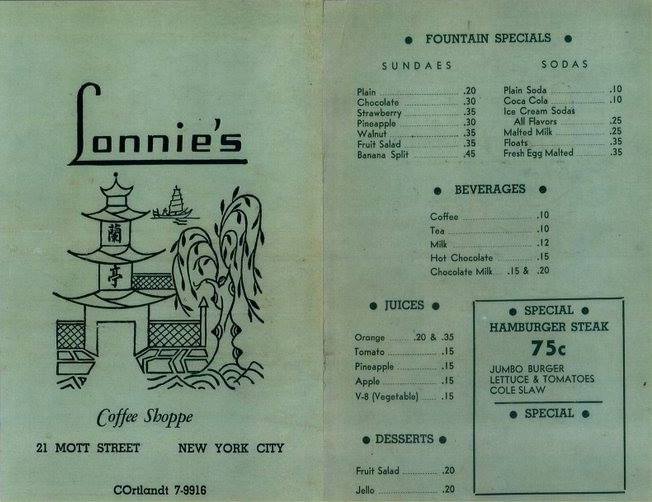
Menu cover designed by Jan Lee’s father. Courtesy of the Lee Family.
+ During my interviews, multiple community members mentioned Lonnie’s. Tell me about how Lonnie’s began. What did they serve? What was the restaurant’s interior like?
My aunt Lonnie used to work as a waitress as Nom Wah. She got a job at Nom Wah and my grandfather did not see the logic of her, his daughter, working for someone else. The store was available at the time and he said to Lonnie and my father (brother and sister) – why don’t you open something instead of working for someone else? That was totally like my grandfather – like, why are you giving someone else money?
So my father and his sister opened Lonnie’s without Chinese food. It was kind of like Happy Days, with hamburgers and cheeseburgers, all different kinds of cold cuts, a real soda fountain, lime rickeys, and Cherry Coke.They were very famous for their egg creams, and this was done in the old-fashioned way with a soda jerk.
They actually had something very specific at that place: ice cream cones, but the ice cream on top was square—a cube. They got their ice cream from a distributor that sold it in a square foil wrapping. So they would just take the square and put it on the cone.
So they built out the store. My father designed it. The back of the store, I remember distinctly, had a beautiful painting of Guan Yin which my sister told me was expensive wallpaper. That was the most Chinese thing about it, was that at the back of the restaurant. In front of it, they had a Chinese lattice window that my father made himself. There were booths in the back and swivel stools in the front. Formica counters, and neon signage inside, with a hand painted metal sign outside.
(Left) Opening day of Lonnie’s, 1956.
(Right) Interior of Lonnie’s, 1970s. Photographs by Shung H. Lee. Courtesy of the Lee Family.
+ Who was the clientele at Lonnie’s?
There’s this hysterical 1965 article – written by a white writer for the World Telegram, the New York Sun:
“Chinese food is absent. The scene was Lonnie’s… a place in the center of Chinatown… A hang-out of the Chinese high school and younger college crowd at 21 Mott Street.
Lonnie. Serves franks and hamburgers, coffee, donuts, and danish, chocolate sodas, and egg creams, but no Chinese food. Over the years, it’s become the established center of young Chinese students. Half the time they do their homework here, Lonnie said.
Some of them come in every day of their lives until they finish high school. Some, some spend their courtship here, Lonnie said. They go through college, usually Hunter College or City College, and they marry and have babies and bring them back.”
I used to walk with my mom up Mott Street, and you don’t know how many people remembered after Lonnie’s closed; how many people would stop and talk to her because they remembered her from Lonnie’s. There were a lot of Chinese marriages and interracial marriages that happened because of Lonnie’s.
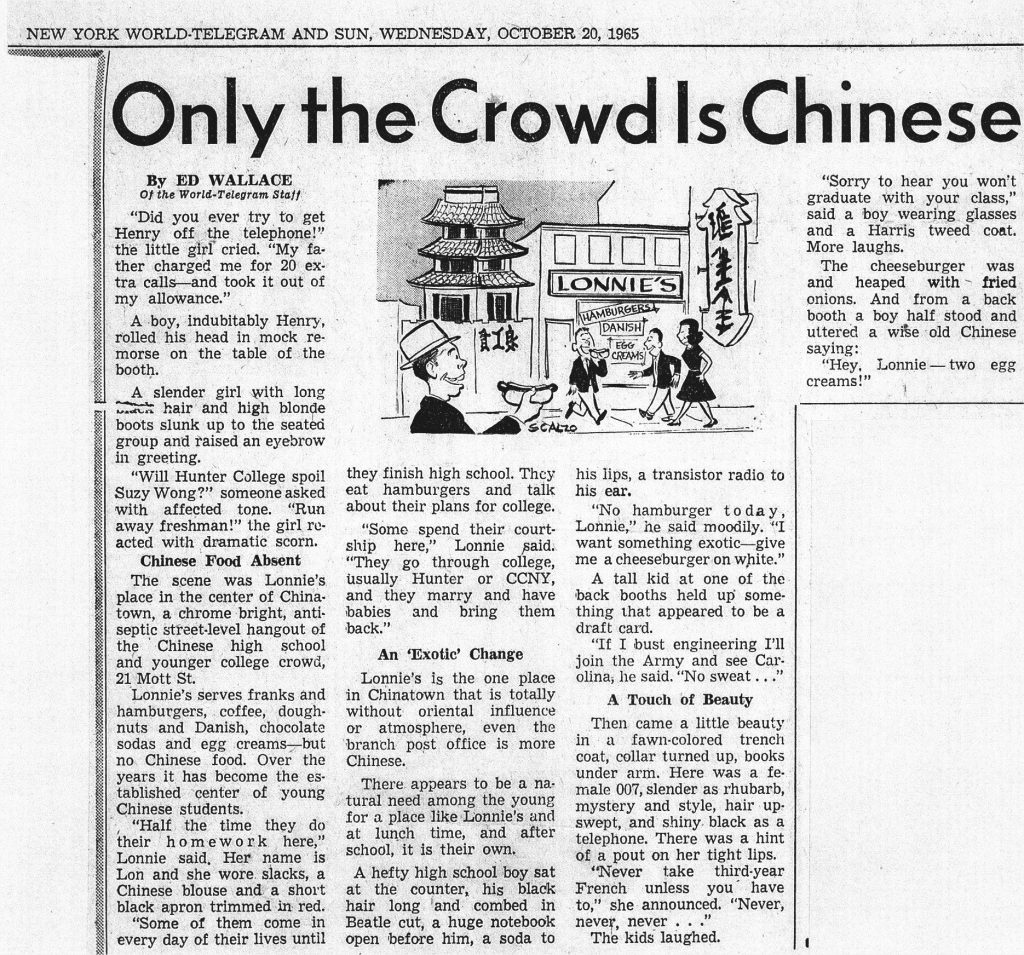
“Only the Crowd is Chinese.” New York world Telegram and Sun, October 20, 1965. Courtesy of the Lee Family.
It was a date place. And the Transfiguration School was here, so a lot of the Italian kids hung out there. That was one of the biggest parts of the business was the Italian kids.
Lonnie’s closed in the early 1980s. She was getting old and no one wanted to take it over.
+ When was this building constructed? Who is the architect for this building?
Maybe around 1870, 1880.
(Left) Lonnie and her acrobat troupe.
(Right) Lonnie with an eel on a fishing trip, 1950s. Photographs by Shung H. Lee. Courtesy of the Lee Family.
+ Can you share any information about the building’s history, or its past lives?
Lonnie Tai Pan (another Lonnie) had an insurance company there at 19 Mott at one time.
There was a gift emporium at 19 Mott.
My mother had a gift store called BoTiK on the corner of 21 Mott.
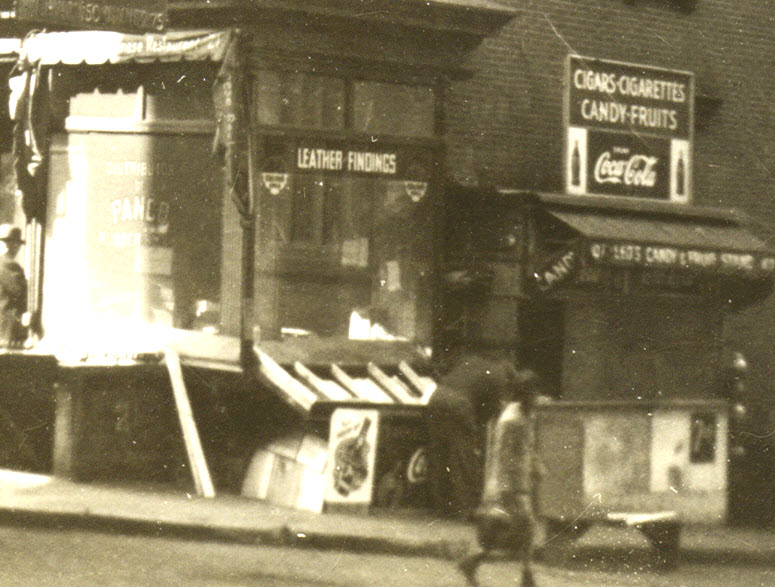
Detail from the 1938 tax photo from the NYC Municipal Archives: A sign for leather findings can be seen on the storefront, next to the newsstand.
What is now one restaurant (Hop Kee) used to be two buildings. The ground floor was separated into two floors and the basement was one whole floor – rented by Hop Kee – who has been there since 1968. Before that, there had been their cousins [in the space] since 1938. Our family and their family have been doing business together for three generations.
I’ve heard that in our building, there used to be a Jewish findings store (buttons in zippers) still catering to the fur and hat stores on East Broadway.
+ Do you know of any major renovations or changes to the building since it was first constructed?
There’s a lot of updating of the infrastructure – obviously roof structure and basement leaks, sidewalk repairs. Right now we’re doing facade work, painting, and cornice maintenance. Obviously, we’ve had to change the windows, but mostly the integrity of the building has remained the same.
+ How do you think this building is important to Chinatown?
My grandfather was one of the pioneer families who started Chinatown in the early 1900s. We know some other families that are really, sort of the Mayflower families of Chinatown. Some of those families became doctors and lawyers – white-collar professionals.
That was not my family. My family was much more blue-collar and retail entrepreneurs and we’re one of the last families still owning property here. A lot of those other families have moved away. If you go to Evergreen Cemetery, you see all the big family names: Wong, Chin, Lee, Moy, Chang, Ng, Leung. All those families are the anchor families, and they’re all from Toishan.
So that’s my family’s history in this building, with these Mayflower families, who all achieved things in this country at a time when this country didn’t want us here, so much so that they created laws to keep us from reproducing, starting families, building wealth and even coming into the country. And yet we found a way to thrive and build Chinatown.
Interview
WITH YIN KONG (DIRECTOR / CO-FOUNDER OF THINK!CHINATOWN)
Interview conducted in October 2022.
+ Introduce yourself – how did you come to be connected to New York Chinatown?
My family’s story doesn’t intersect with any of Chinatown. I was born in Winnipeg, Canada and most of my family is in Toronto and Vancouver area now. My family moved to Rockville, Maryland and I grew up mostly there. I came to New York City through school; I was studying urban studies and as a student, I was looking at Chinatown to understand why it felt so special to me, as a Chinese-American who hadn’t had much interaction with China growing up. I wrote a paper about the different types of vending in New York City — there used to be a lady who sold tofu out of a shopping cart near Grand Street — and thinking, why did you see this kind of very lively street scene in Chinatown that you don’t see in other parts of the city? As an Asian American, I thought — It’s really cool here, I like it here; feeling connected and not knowing why.
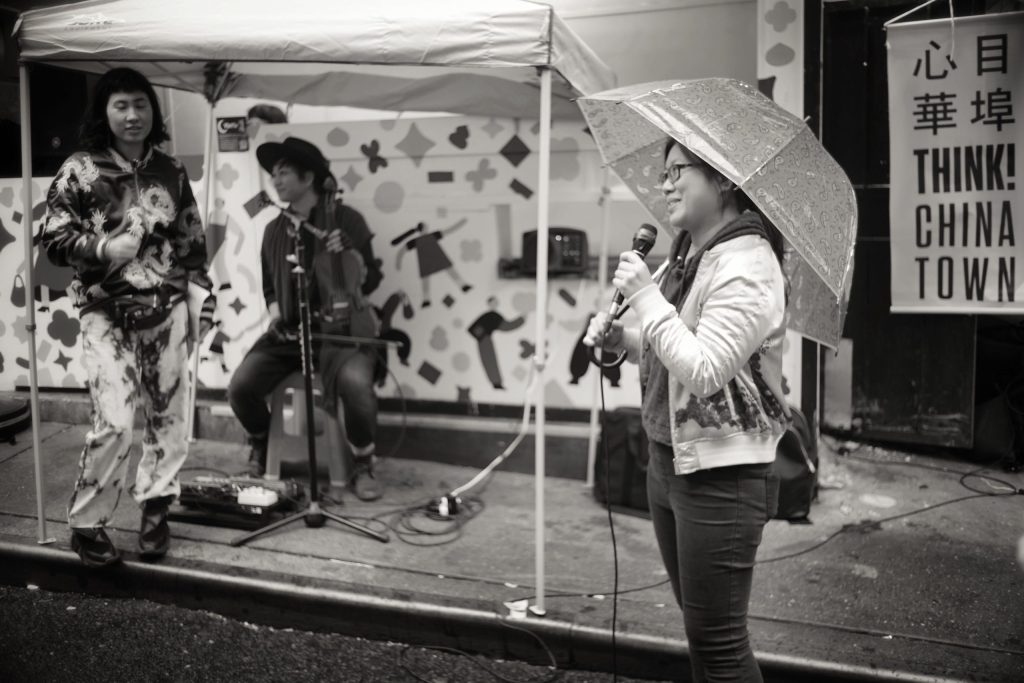
Yin hosting one of Think!Chinatown’s activations of the newsstand at 19-21 Mott. Photograph by Ed Cheng.
I actually ended up working in Beijing and Shanghai in China as an architect for seven years. Coming back to New York, it was the only place I wanted to go back to — Chinatown! There, it was me as an American going to China and realizing how not Chinese I was! A very different experience. It was a wake-up call for me that so much work needed to be done. I felt kind of complacent before, coasting on the work the Asian American activists had done before me, and being in Charlottesville pushed me to get back to New York and how I can contribute to pushing forward our Asian American standing in the country. My work, as an architect, has always been very place-based, and thinking about Asian American identity through place, which intersects with Chinatown.
+ How long has Think!Chinatown been at (been using) the newsstand on Mosco (at the building at 19-21 Mott)? What’s the story behind how Think!Chinatown came to be connected to the newsstand?
Until very recently, T!C for our 6+ years of operation, has not had a place to be; we’ve always been borrowing spaces around the neighborhood. The Newsstand became one of them; we got to know one of the owners, Jan Lee, through one of our projects (the Art of Storytelling) collecting oral histories and working with AAPI artists to illustrate and honor them. We did a story with Jan Lee and his family and that’s how we got to know each other. We always say through our storytelling projects that we are building network and coalition in the city; when something big happened to us — the mega jail plan in Chinatown — we got a lot closer by organizing together about this issue. Through all of that community-building work, we gained the Lee Family’s trust and they let us use their newsstand in 2020, which wasn’t in use before. It was the midst of COVID and we were still trying to present our arts & culture in Chinatown, so we built a mini museum for Corky Lee and Ed and Karen for them to show their photography work. It became a newsstand/photo stand place where photos were displayed around the newsstand and Corky would stand there and talk to anyone who came by. He was there for a whole week, from morning until night. Even being able to program that little nook was really fun and neighborhood-y. You could just stop by and chat. During the pandemic, we needed another solution; you couldn’t hold exhibits indoors.
For our ASSEMBLY FOR CHINATOWN project, we partnered with a design team A+A+A Studio and built outdoor dining solutions for restaurants in need in Chinatown, with murals painted on them. We needed a storage space to put our paints and materials in between different sites; we still use the newsstand for them.
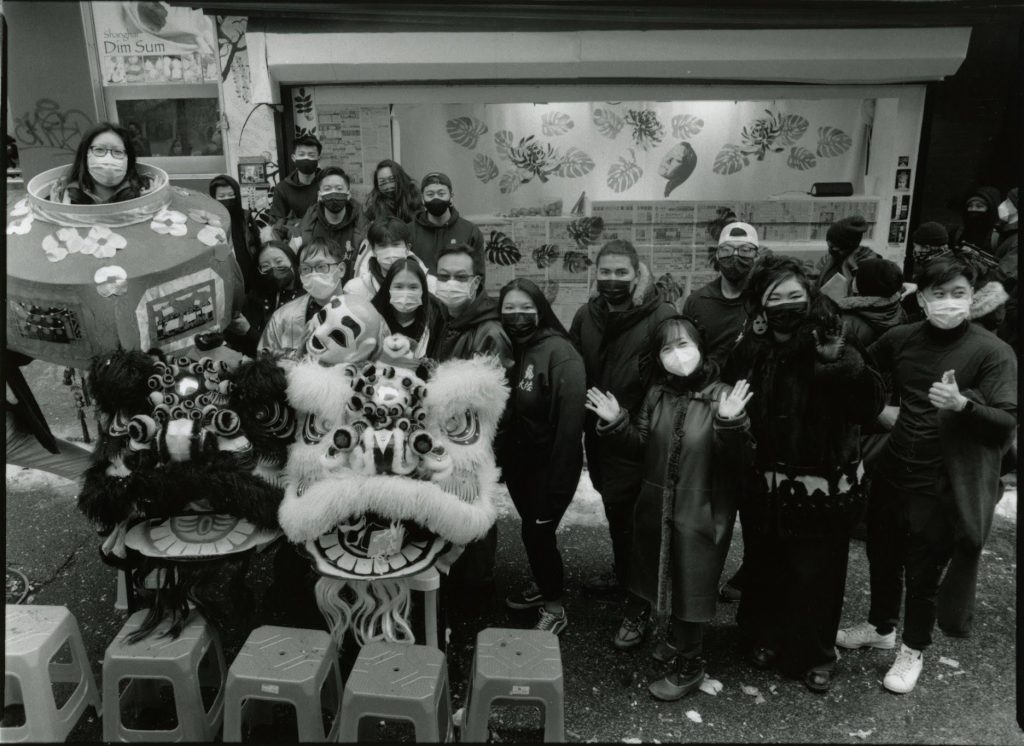
Photograph by Ed Cheng.
Meanwhile, Rochelle has been doing her storytelling projects with us. As a T!C team member, and that work has been collecting records from different families. She started playing records, having listening sessions and we finally worked up to — why don’t you DJ in the newsstand and we stood outside and danced? I think the first time was Lunar New Year in 2021 and Corky had just passed. We were thinking about how we wanted to take this place, which was now associated with the last memories of Corky (his last exhibit, his last time a lot of people saw him; during his exhibit in October 2020) — so the connection of seeing him in the newsstand was pretty sure — and celebrate him. It was cold because it was Lunar NY, but everyone came out and just danced. At the time, being outside together was the old place to do so — so we froze our butts off but just danced and realized it was a special thing. There are special Con-Ed traffic cones we keep in the newsstand; Corky got those from the Con-Ed folks, leaving those out to stop traffic — it was his way of claiming space. Every time we have a party, we bring them out to not worry about traffic being in the middle of the street. We just realized it was something people really liked; we kept doing it and these events have been growing and growing. We also painted a mural on the newsstand.
+ What would you say the importance of the newsstand is to T!C?
I think the newsstand is very representative of T!C. We’re flexible; we work within the spaces that we have and it’s all about access to our community. I’ve proud that we’ve been able to activate this seemingly tiny piece of infrastructure — a vacant newsstand — and we’re able to activate this entire block and there’s a lot of joy. This is built off of trust with a community member; and it’s become a gathering point for our community.
+ When was the newsstand built? Who is the architect?
Can you share any information about the newsstand’s history, or its past lives?
There’s a lot of things in its past life. Jan Lee did do a little bit of research on it. It was built by Jan’s grandfather sometime in the 1920s for his grandmother to sell pickled vegetables. Since then, countless immigrants have gotten their start tin this little stand. There are many Chinese fruit/veg vendors who worked there. There was an Italian couple that used to sell fruits and vegetables there. The famous occupant was Cecilia Tam (the egg cake lady) who was written up by the New York Times. There was a kerfuffle where DOB wanted to tear down the newsstand, because it was built without a permit, but it was built before 1938 before permits were required, so it should have been grandfathered in. I think Jan made a stink and has enough political clout to get attention.
A mid-summer block party, hosted by Think!Chinatown at the newsstand, June 2024. Photographs by Cheryl Wing-Zi Wong.
+ Have there been any major renovations or changes to the structure since it was first constructed?
I can only say that when we started programming, our two significant murals — one is “In the Future” — a WOW! Project and the AIR thing that T!C will be collaborating with them on. And the mural by Rose Wong that we commissioned on the newsstand. Those are the two big upgrades that
Another fun thing is that Amy is working on getting the street co-named Corky Lee Way. [The street was co-named Corky Lee Way in October 2023.]
+ What are your fondest memories of the newsstand?
I think in general, for me, as the director of T!C, having to run the arts festival, I always love the block parties the most, because I don’t have to do very much. It’s a block party — there’s no agenda. I can just go and dance and be really happy.
19-21 MOTT - BUILDING PHOTOGRAPHS
Photographs taken in 2024.