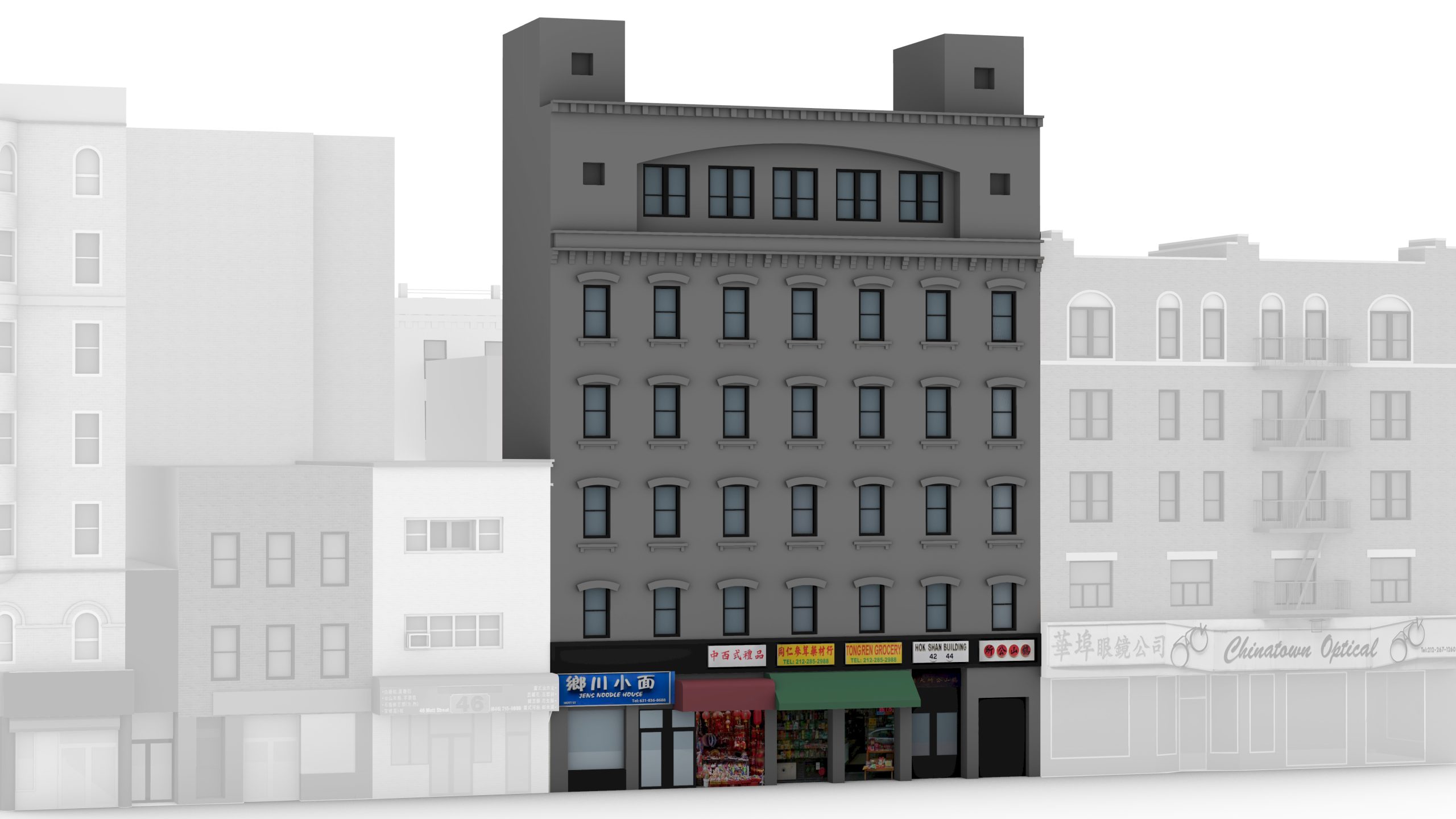
42-44 Mott
Hok Shan Building
Built in 1871 with a one-story roof raising occurring in 1889
2024
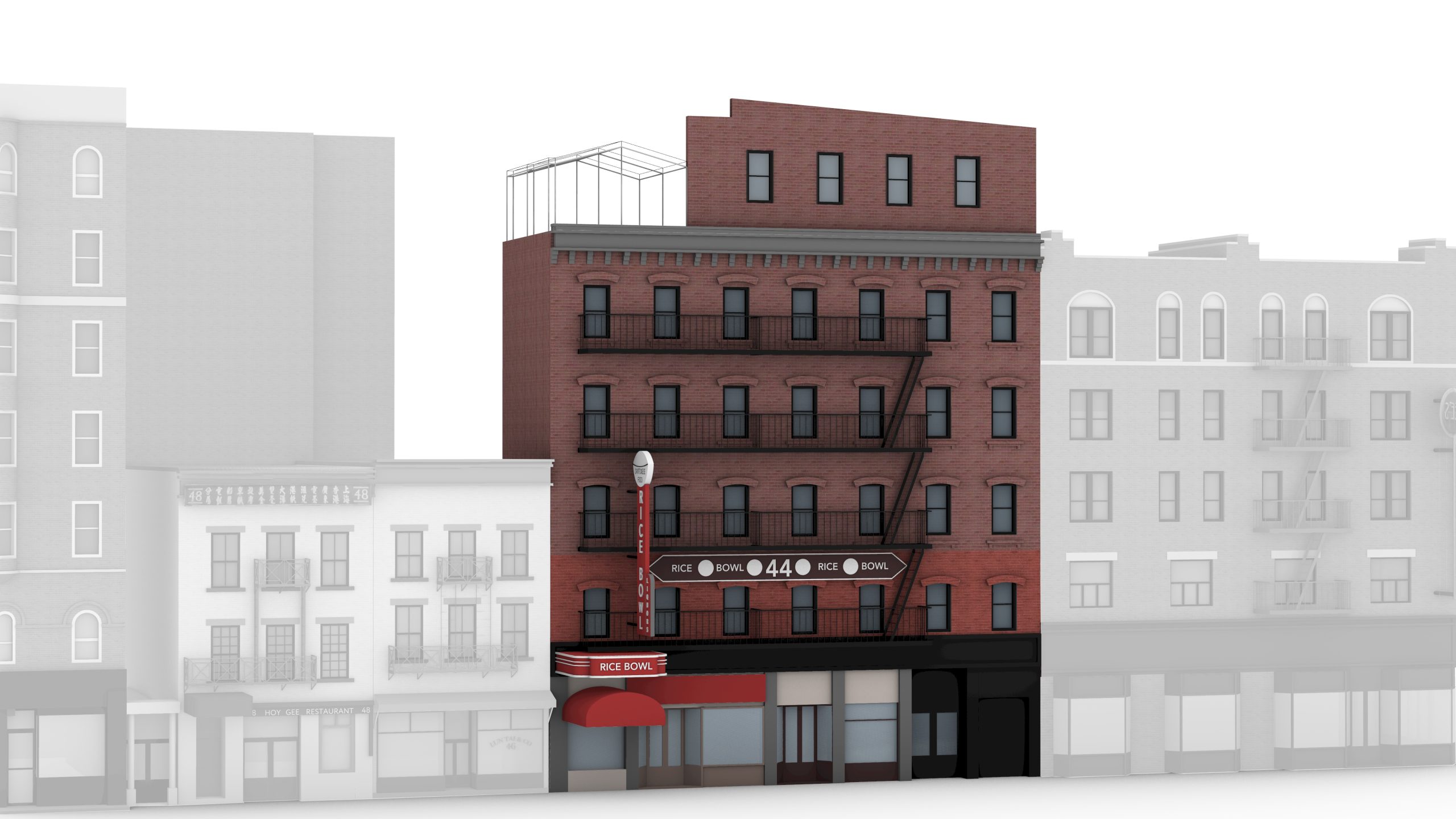
42-44 Mott
Rice Bowl Restaurant
Built in 1871 with a one-story roof raising occurring in 1889
1940s
Interview
WITH MARCELLA CHIN (OWNER OF HER FAMILY'S BUSINESS, THE RICE BOWL RESTAURANT)
+ Tell me about yourself – How long have you been living in Chinatown?
How did you come to be connected to Chinatown?
Almost a century – I’m 99 years old! I’ll be 100 in January.
I was born on 37 Mott Street in New York City – the building is still there. Everyone used to live there. We lived there for, I don’t know how long, then we moved to 49 Mott (the Lin Sing Association building) and lived there for a while. Then my mother brought five kids back to China to study Chinese, then spent some years there… then she left my brother Waltman, Victor and I. My brother Waltman and I went to boarding school (I went to a girls’ school) in Canton [Guangzhou] for eight years from 1930 – 1938. Victor was too young, so he stayed with my grandparents in Hong Kong. He never went to boarding school.
Then by 1937, the war came when the Japanese came. We were on summer vacation in Hong Kong with my grandparents and it must have been that summer or the summer before. Thank God – some bombing happened in Canton by the Japanese, so we weren’t in school. We stayed in Hong Kong until we left. It must have been at the end of 1937 or early 1938 when we came back to New York City. It took 20 days to get to New York. We arrived in Seattle, Washington by boat and then took a train to New York City, just us three kids alone. I was 12 then. Walter Chin was 14. Victor was 10. Some relatives in Seattle had a grocery store and picked up us three kids. We couldn’t speak a word of English anyway and were put up by these strangers. Then they put us up on the train to come back to New York. We did arrive at Grand Central [Station].
Then, we lived at 42 Mott on the top floor.
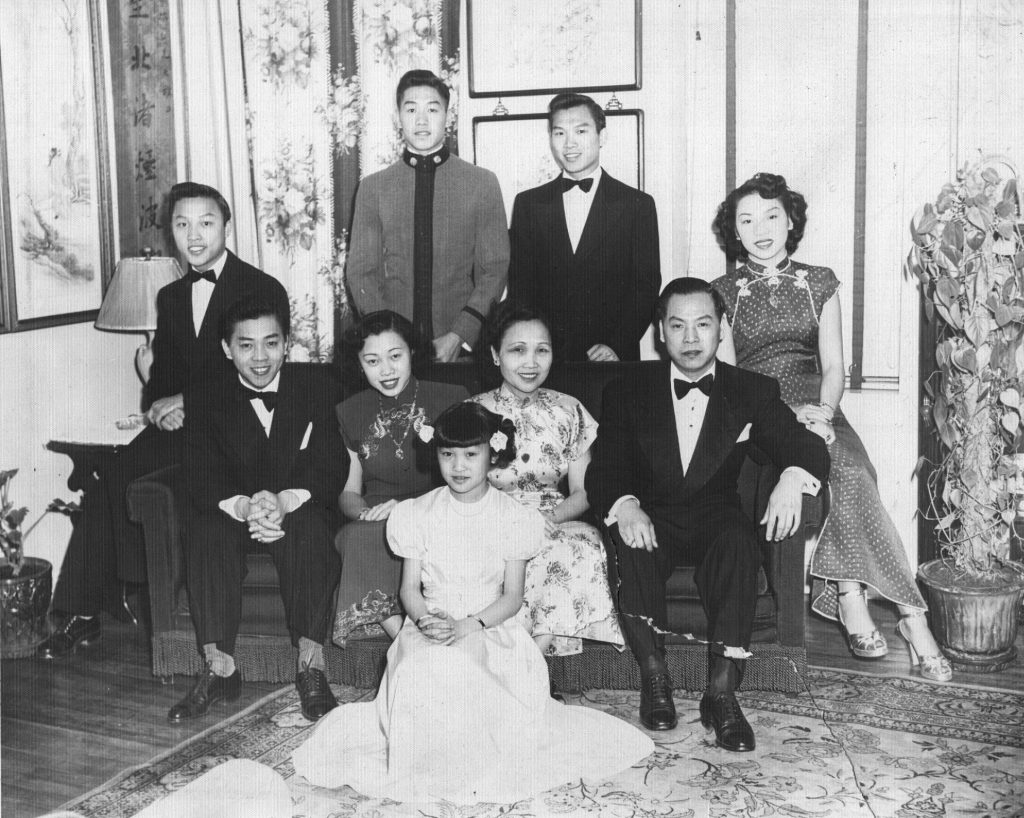
The entire immediate Chin Family at the time — Marcella’s siblings and parents. Photograph courtesy of the Chin Family. Caption provided by Grayson Chin, Marcella’s nephew.
Front from left: Walter Chin (Marcella’s oldest sibling) and his wife Betty Chin, Snow Chin (her youngest sibling), Tsui Chin Guey (her mother), Chin Suey Bing (her father) and Marcella.
Top from left: Newton Chin (the fourth son), Moody Chin (the third son), Victor Chin (the second son). Marcella is the second oldest of the siblings after Walter.
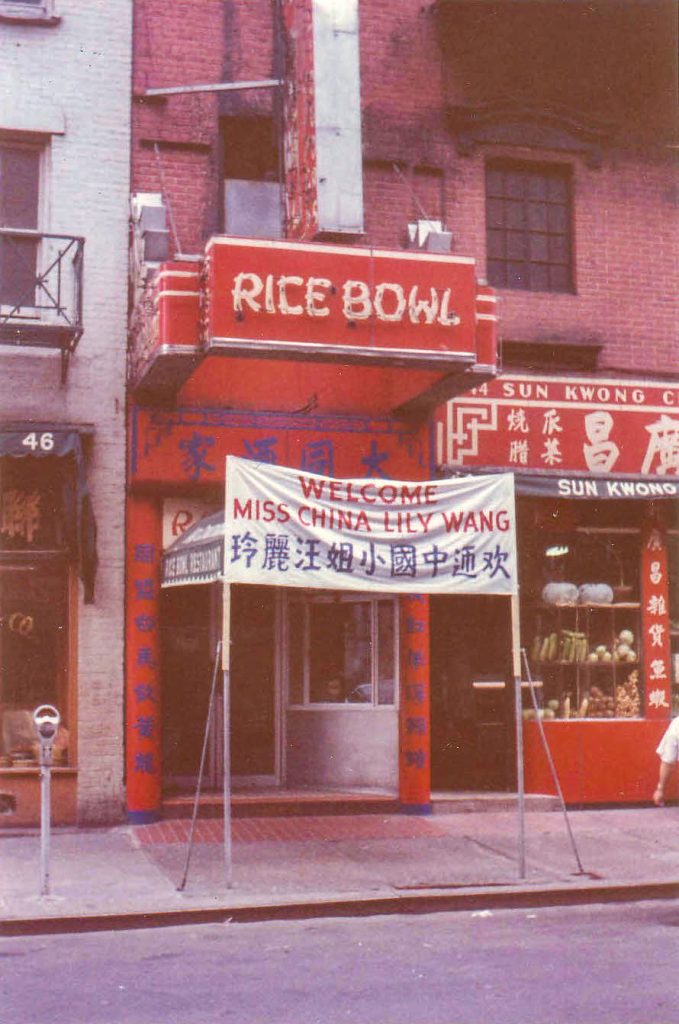
The exterior of the Rice Bowl Restaurant. A sign hanging beneath the restaurant’s reads “WELCOME MISS CHINA LILY WANG” with additional Chinese text beneath the English. This is likely to welcome Miss China Lily Wang (winner of the 1961 pageant in Taipei) to New York. Courtesy of the Chin family and the Marcella Dear, Museum of Chinese in America (MOCA) Collection.
+ Your father opened up the Rice Bowl Restaurant at 42-44 Mott Street in 1939. Can you tell me your family’s story with this building?
He opened it up in 1939, in the year of the New York World’s Fair. We came back at the end of 1938 and he decided to open up the restaurant after we came back from China. He had an idea to open up a fancy kind of Chinatown restaurant, catered to the lo fan (non-Chinese) anyway. We used to live on the top floor of the building. The Hok Shan Association own the building now and it’s always had Hok Shan [Association] landlords.
My father thought he made a mistake; by the time he opened, he didn’t believe in having partners so he put all of our savings into opening up the restaurant, in the sole ownership of a Chinese restaurant. With the World’s Fair, everyone went to the fair and not to the City, so business was not good at the beginning, which was hard.
Then after the Fair closed and the war started in 1941/1942… people were working overtime in war supply factories and there was extra money. His restaurant started to flourish when they came. We weren’t catering to the Chinese too much at the time.
Rice Bowl was the place in Chinatown where well-known celebrities patronized us… we were the first ones with air conditioning. My father was very fussy about people being dressed properly – if you didn’t have a tie and jacket, you weren’t admitted. We would have music, accordions, you had to make a reservation… we had a full house all the time after that. We didn’t have that much publicity, but people spread the word of mouth.
The restaurant was one floor at the beginning, but when things got better, my father decided to rent upstairs as a party room. It doubled the capacity of the downstairs. Then he moved the kitchen from the basement to the third floor… because the restaurant was on the second floor. The ground floor [of the building] was my father’s grocery store, Kwong Chong. They have the original sign at the back of MOCA (Museum of the Chinese in the Americas].
He had the basement, the ground floor, the second floor restaurant and later on the floor above, the third floor, as the party room.
Rice Bowl Menu Draft. The background of the menu is red with black letters reads: “The Rice Bowl Restaurant, in the heart of Chinatown, New York, N.Y., 44 Mott St. New York, N.Y., phone: WOrth 2-8785”. Courtesy of the Chin family and the Marcella Dear, Museum of Chinese in America (MOCA) Collection.
+ Did you work in the restaurant?
As kids, my father didn’t want us to be running around. He didn’t think it was proper to have kids running around there, so we weren’t allowed to go, since we lived on the top floor of the same building.
When I was 16 or 17, I was allowed to be with my mother in the restaurant. There was a cubby hole in the kitchen and I learned how to be the cashier with my mother.
My brother was allowed to be in the upstairs pantry with the dumbwaiter with the food coming down from the third floor… It was manual in those days.
The restaurant closed sometime in the 1970s…. 1974 or so? We had the business for about 35 years.
My mother and I ran it for about 10 years, and then couldn’t do it at the time – it was too much.
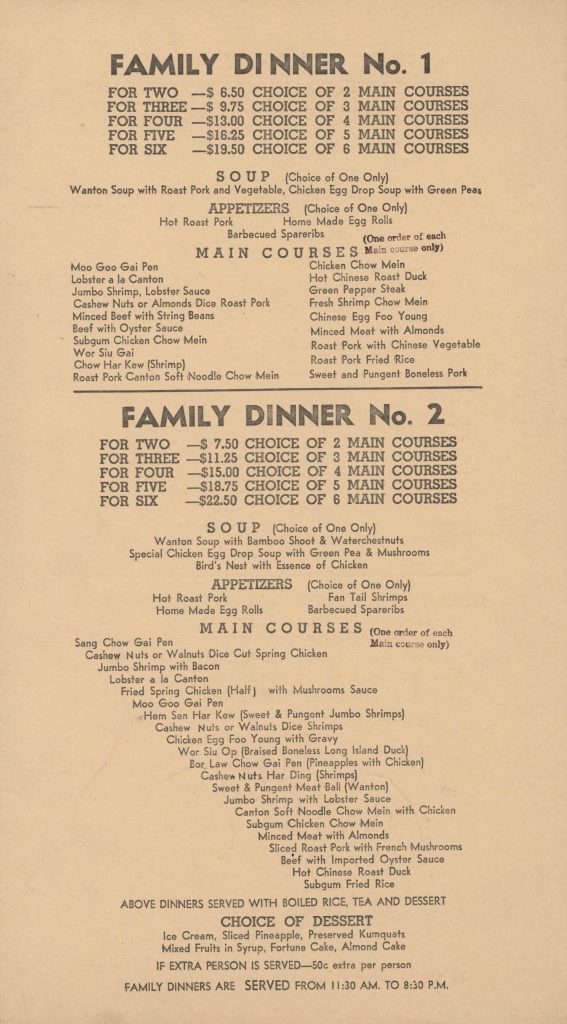
Rice Bowl Restaurant menu for family dinners.
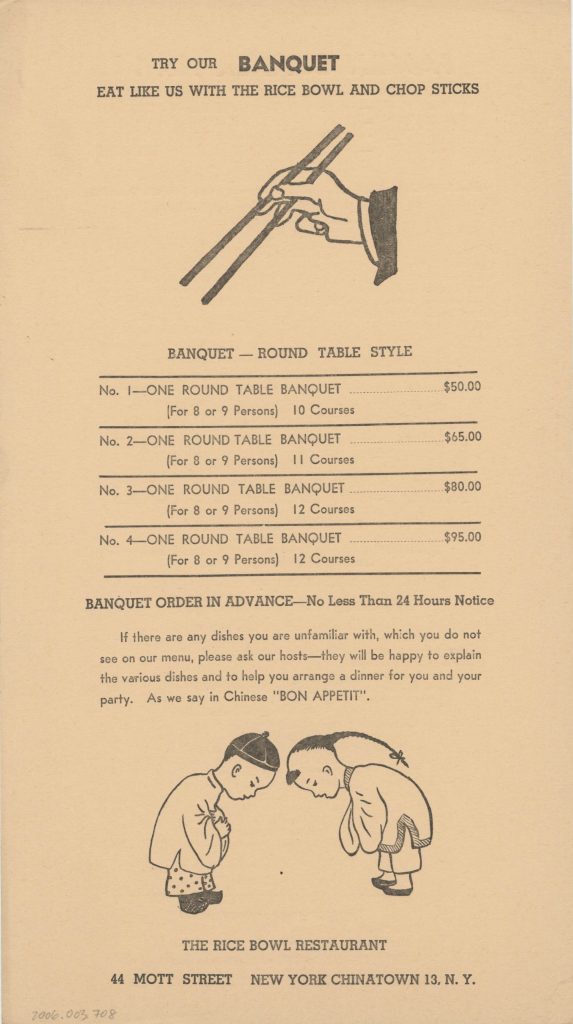
Courtesy of the Chin family and the Marcella Dear, Museum of Chinese in America (MOCA) Collection.
+ Tell me more about working in the restaurant as a cashier!
When I was going to school, I majored in international trade, import/export and worked [at the restaurant] at the same time. I met other people and also it gave me a chance to speak to people in English too. (It’s my second language – I didn’t speak English when I came back to China.) We mostly had lo fan clientele and the family made a lot of friends at the restaurant at the time, because it was a family business.
+ I have this image of your mother and you, in beautiful dresses, greeting people as they enter the restaurant.
I tried to make it kind of “Oriental” [dress] for the people. I would greet people when they come up, because the cashier was facing the stairs, so the first person you would see would be the cashier, the fish tank and the rock garden.
+ What do you remember about the interior of the restaurant?
It was pretty fancy. We had lights for the daytime luncheon – a bit brighter than daylight. By evening hours, we had a dinner menu with dim, more romantic atmosphere lights. We attracted a little more sophisticated clientele for the ambience.
Then restaurant was on the second floor. As you enter, you would go up a flight of stairs with a little landing. When you would go upstairs, you would face the cashier and you could look at the whole restaurant at that point. There was a little desk there with a cigarette counter, with a cubby hole and a high chair behind… it was almost like guarding the register and the cigarette counter. People would come and grab a cigarette in those days. On the left, next to the cashier, was a fish tank with a rock garden back there.
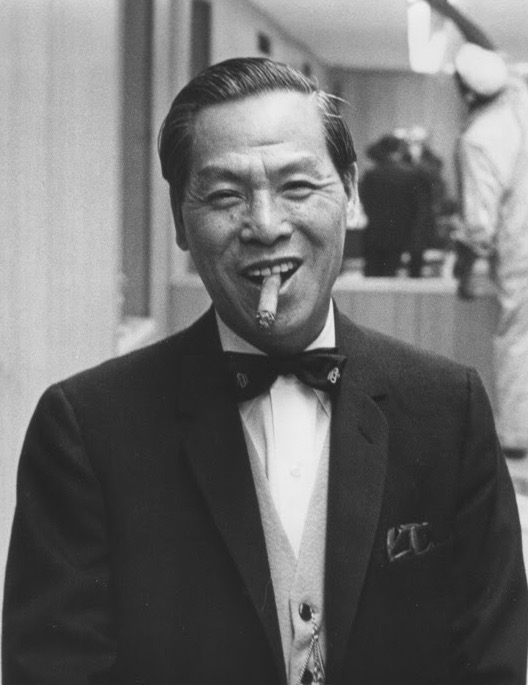
Chin Suey Bing in the Rice Bowl, ca. 1950. Photograph courtesy of the Chin family.
(Left) The bar at the Rice Bowl restaurant and (right) Chin Suey Bing at the Rice Bowl’s bar.
Both photographs are courtesy of the Chin family.
On the right side layout of the floor was a big A/C unit against the wall, the bathrooms behind the stairs and the pantry room where the dumbwaiter was. Before you got into the little pantry room, as you entered on the left was a little bar. It wasn’t a big bar, but it was almost stocked enough, like a regular bar, with about four stools that you could sit there on.
As you turned around to face the whole dining room, you had booths on both sides along the wall. They were regular booths with cushions, kind of reddish. They had lights along the wall, not bright, but regular bulbs.
Then in the middle, you had 2 lines of booths. At the end of the dining room, you had a whole wall mirror with a pagoda on top of it. By the pagoda in front of the mirror were two long tables for six there. There were separate tables that you could pull together to accommodate 10-20 people… otherwise, there were small tables.
There was a fire exit and a public telephone where people could pay money to make a call there.
The floor was terracotta, reddish tiles.
There were always tablecloths, even at lunch hour. It would always look very inviting. You could come any time and there would be a table for you.
Photograph captions (left to right, top to bottom):
(Upper left) The restaurant interior, stamped February 1970.
(Upper right) Interior of the Rice Bowl Restaurant, 1970s.
(Lower left) Interior of the Rice Bowl restaurant. Lily Wang, Miss China 1961, is seated at a table by the pagoda.
(Lower right) A bartender at the Rice Bowl restaurant bar, dated August 18, 1950.
All photographs are courtesy of the Chin family and the Marcella Dear, Museum of Chinese in America (MOCA) Collection.
+ What food did the Rice Bowl serve? What were your favorite meals there?
You would have to go to the museum [MOCA] and see the menus I donated. We have postcards with pictures of the dining room there.
We served so much – we tried to make it authentic for our customers. When I worked there, sometimes I helped to take orders or recommend dishes to them. We tried to recommend all the authentic dishes for customers – not just chicken chow mein and egg foo young. I recommended more interesting dishes to them.
I remember lo mai gai. Port Arthur was known for their lo mai gai at the time too. At one time, bird’s nest (yen wai gai) was affordable. There was also aerated, deboned duck (gua-lo gnap): They hang the duck in the hair, allow the skin to dry out and spice it up. It’s a long process and you have to order it ahead of time. Then you cook it and serve it right away.
We had banquet dishes. We did also cater to the Chinese for banquets… Our chef was sort of a banquet chef in those days. They don’t have as many talents these days! When we would have banquets, you had to order the dishes one week ahead… in those days, you couldn’t just walk in and have a banquet like you can now. You needed time to prepare it. There were eight dishes and three or four little appetizers, 12 dishes to call it a banquet. In those days – you couldn’t steam a whole fish and call it a banquet. That’s too easy! You don’t really have the banquet now these days the way it should be, I think.
+ Who came to the restaurant to eat?
Usually it was mostly the lo fan (non-Chinese). The Chinese would do the banquets, because we would do the real thing… Eight or nine tables would be a banquet already and we could accommodate that upstairs.
+ It seems like in many restaurants in Chinatown, there were often male bachelors (before more women were allowed in after immigration opened up after 1965) working as waiters. What do you remember about the staff at the restaurant? Who worked at the restaurant – was it a family business?
We were lucky; we had our waiters for forever. They all stayed with us, some for 20-30 years. They did well during the war years, they had their families here and their kids went to college. Our chef stayed with us a long time and became like family…
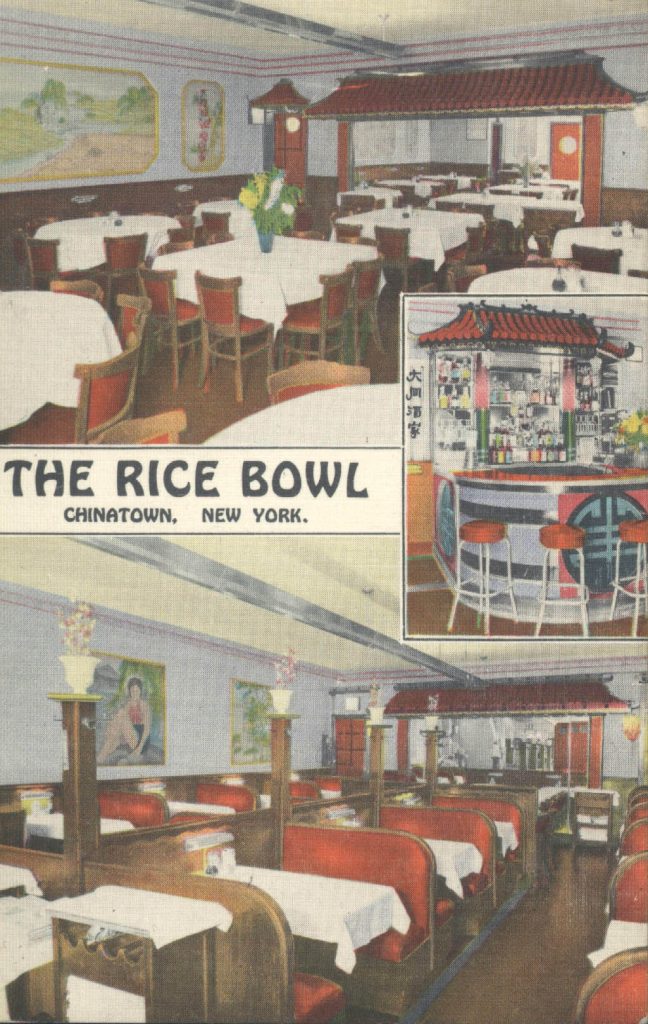
Postcard showing the restaurant’s interior. Courtesy of the Chin family and the Marcella Dear, Museum of Chinese in America (MOCA) Collection.
Later, we had younger waiters come by. The turnover happened when they got older and couldn’t handle it, so we found younger staff who knew old-fashioned cooking… later on, we had more lo fan but throughout the years, but who were more educated with Chinese food. Some of them, my friends especially, they did pretty well with Chinese food.
Scans of the Rice Bowl restaurant menu. Front and back covers are gold. Dimensions are 13″ x 9.5″.
Courtesy of the Chin family and the Marcella Dear, Museum of Chinese in America (MOCA) Collection.
There were no women [staff] except for my mother and I.
My mother worked in the dining room, greeting customers. Her English was limited but she was always cheerful and friendly, leading them to the table and giving them the menus, sometimes taking orders for drinks and everything. She was pretty good after a while at being a hostess.
I was a hostess and the cashier.
I ran the restaurant for a while after my father died… he died in 1960. I probably ran it for about 10 years with my mother. I quit my job (importing and shipping with United Merchants on 7th Avenue) and came to work at the restaurant full-time.
+ Describe your childhood in Chinatown. What was Chinatown like back then?
I was gone in China from ages five to twelve.
I remember before I went to China… I have pictures of Ms. Banta at the True Light Lutheran Church’s Sunday school. In those days, it was the only church we knew in Chinatown. I remember I had Sunday school with other girls my age on Mott Street. Ms. Banta was very good with the Chinese in Chinatown, taking care of the kids. Everyone depended on Ms. Banta.
We never went anywhere as kids; in those days, we didn’t go around to school before five.
When I came back from China, Chinatown was still very exclusive. We had a lot of people who came from China to escape the war then after we got back. And then a lot of young people who arrived in this country like I had, not speaking very good English.
I went to P.S. 23. It had a typical school mom in those days, who must have helped with school education to form a C-Class (Chinese Class) to educate these young kids escaping the war from China and arriving in New York City. It was a big number and mostly boys. There were only two or three other girls in the class. C1, C2, C3 – by the time you got to C3, you should have known enough English to be promoted to a regular class.
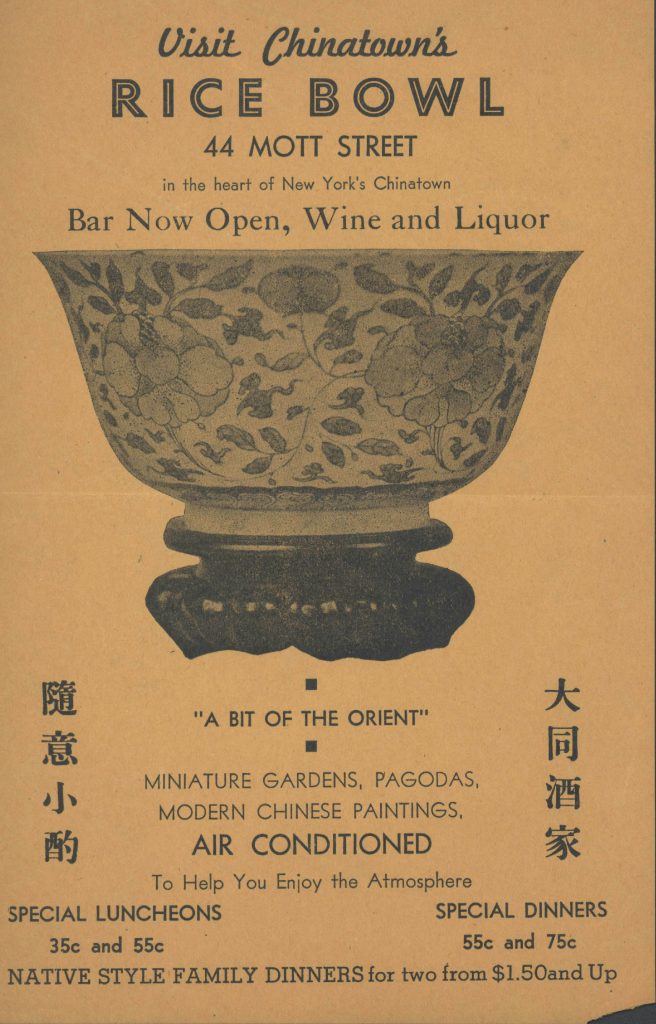
Scan of a Rice Bowl restaurant card. 5.5″ wide x 8.5 inches long. Courtesy of the Chin family and the Marcella Dear, Museum of Chinese in America (MOCA) Collection.
A lot of other kids learned English from the C-Class. It started with two girls – me and Hester, then Renee, then Grace… in those days, there were few girls. I was probably the youngest one of the girls. I went to 7th, 8th grade, then went to Washington Irving [Middle School] and my English was good enough to go to highschool at the time. The other girls dropped out, got married, I don’t know… but I stayed on and graduated. I never thought I was able to go to college. The war was still on, my brother was still in the army, my father was doing better too – and I had to go to night school to make up some courses in order to qualify for admission to NYU ‘s School of Commerce in Washington Square (now the Stern School of Business). I got my Bachelor of Science degree from NYU.
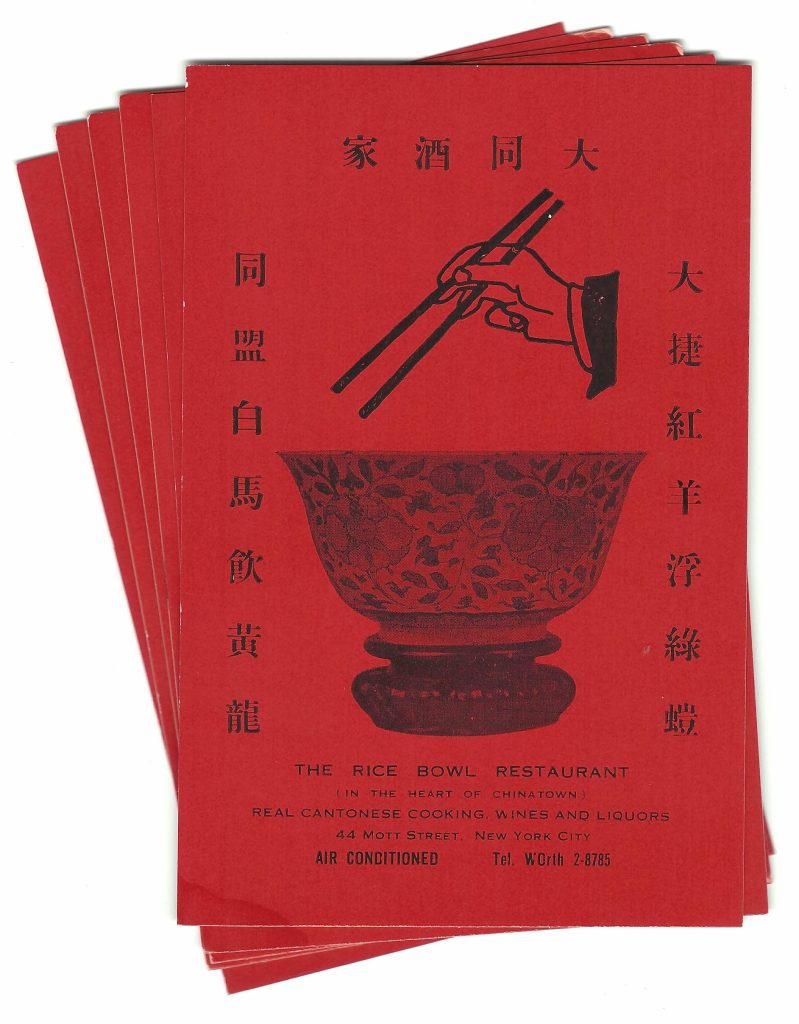
Six ad cards for the Rice Bowl restaurant. Courtesy of the Chin family and the Marcella Dear, Museum of Chinese in America (MOCA) Collection.
+ Do you remember if the building underwent any major renovations or changes?
We used to live on the top floor [of 42-44 Mott]. Before we came back from China, my father decided to have a penthouse up there. He renovated the whole floor and chopped off part of the bldg to make a roof garden. I don’t know how he did that, but he did. The association people let him do it without any question. We had a garden on the top floor. That’s why on the top floor, there’s like one-eighth of the building chopped off and they never restored it.
My father always liked to have a garden with flowers and a rock garden, so we had a rock garden on the top floor… When you stand facing the building, on the left, part of the building is chopped off – that was my father’s doing.
He renovated the whole floor for the landlord. It was a 3-bedroom apartment with a big kitchen and a big living room.
My father was active in the Chin [Family] / Gee How Oak Tin Association. When they [the association] bought the building on Bayard, my father had something to do with it.
+ What are your fondest memories of the restaurant?
I always have the image of the place – I practically lived there for half of my lifetime in a way. That’s how my father made the money to provide for all of us. That was always our family headquarters because he was always the sole owner. It was his home – he was there 24/7 and practically because he lived justupstairs. So we had very happy memories of the Rice Bowl. We made a lot of friends, a lot of lo fan friends. It helped our lives with lo fan who we became very friendly – the whole family liked to have something to do with us. That’s how we made lifetime friends. It was really enlightening to open our minds to lo fan in America. Not too many people had the chance to meet lo fan in those days during the war, and even after the war… they mostly stayed in Chinatown by themselves.
Rice Bowl restaurant Chinese menu, printed on papyrus designed brown cardstock. Some prices are handwritten in ink. Dimensions are 10″ x 6.25″ folded.
Courtesy of the Chin family and the Marcella Dear, Museum of Chinese in America (MOCA) Collection.
+ How do you think your family’s restaurant was important for Chinatown?
Well, it opened the door for nicer places in Chinatown than just these little chop suey places. And we served nicer dishes and tried to introduce more interesting dishes to our customers. I hope we did open the door to a lot of lo fan customers to Chinese food… and knowing and being friendly with us. Politicians and celebrities would come by because it was downstairs from City Hall. They came to Chinatown and when they wanted to go to a nice place, they would come to the Rice Bowl.
+ How did you see Chinatown affected by the pandemic?
How did you feel at this time?
I was isolated. I didn’t see anybody for almost two years. I kept my distance when my family tried to look after me and buy my groceries. No one came inside my apartment. I got kind of used to it, in a way. Life has changed.I feel a lot of differences now. The relationship with relatives and friends is not the same as before, though then again it’s now three years later.
Chinatown business-wise has a lot of changes. I still try to get around to see the changes – all of these stores that changed for a couple of years and then never reopened… many of my favorite places have closed down and there are all these new places. I’m beginning to feel a little strange walking around Chinatown. Sometimes I feel kind of sad that old stores aren’t there anymore and I wonder about these people – what happened to them?
Chinatown used to be known as a night place… I remember the Rice Bowl was open until 3 or 4 in the morning… people eating at that hour! Those days are gone.
Hopefully things will pick up, maybe slowly, in another year…
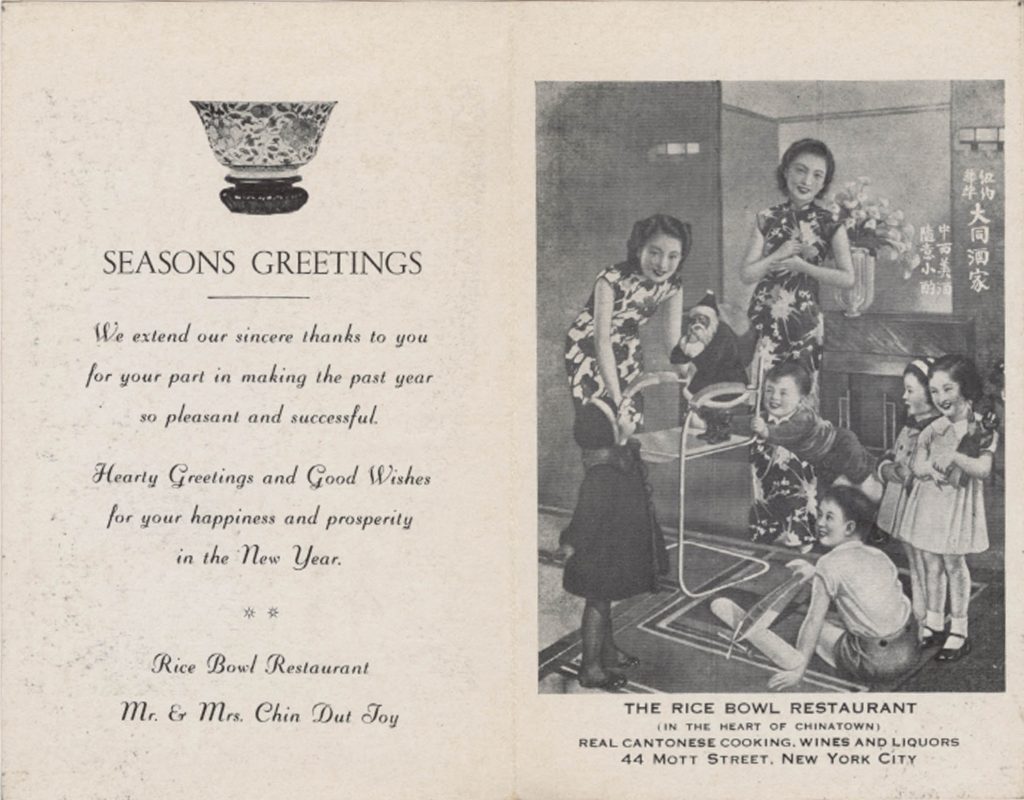
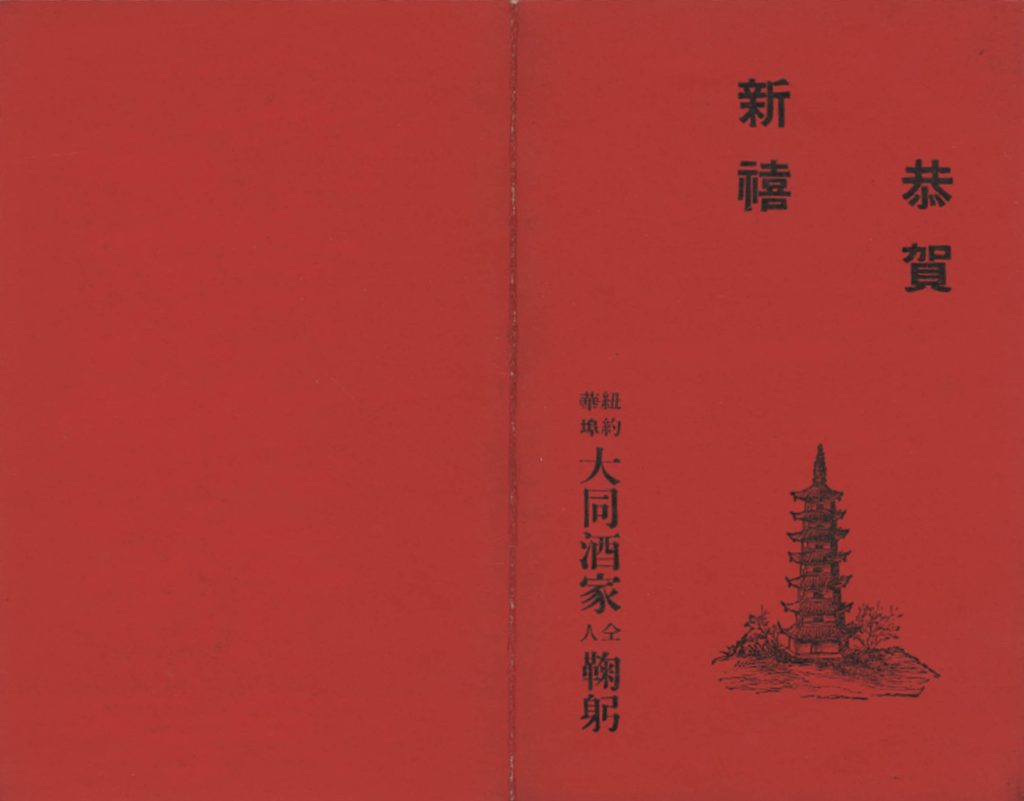
Rice Bowl Restaurant Holiday Card featuring print of two modern Chinese women amongst children. 5.5” long x 3.5” wide, folded. Courtesy of the Chin family and the Marcella Dear, Museum of Chinese in America (MOCA) Collection.
(Top) Rice Bowl Restaurant New Year’s Eve dinner menu. Cover provides drink options. Page 1 lists 2 options for 2 person fixed-price dinners. Page 2 provides a la carte options. The menu is printed on pink cardstock, 11″ x 7″.
(Bottom left) Chinese language newspaper advertisement for Rice Bowl Restaurant. Dimensions are 7.25″ x 2.5″.
(Bottom right) Rice Bowl Restaurant “Specials To-Day” Menu for Chinese Luncheon, 9.375” x 6” in size.
All images are courtesy of the Chin family and the Marcella Dear, Museum of Chinese in America (MOCA) Collection.
42-44 MOTT - BUILDING PHOTOGRAPHS
Photographs taken between 2022-2024.