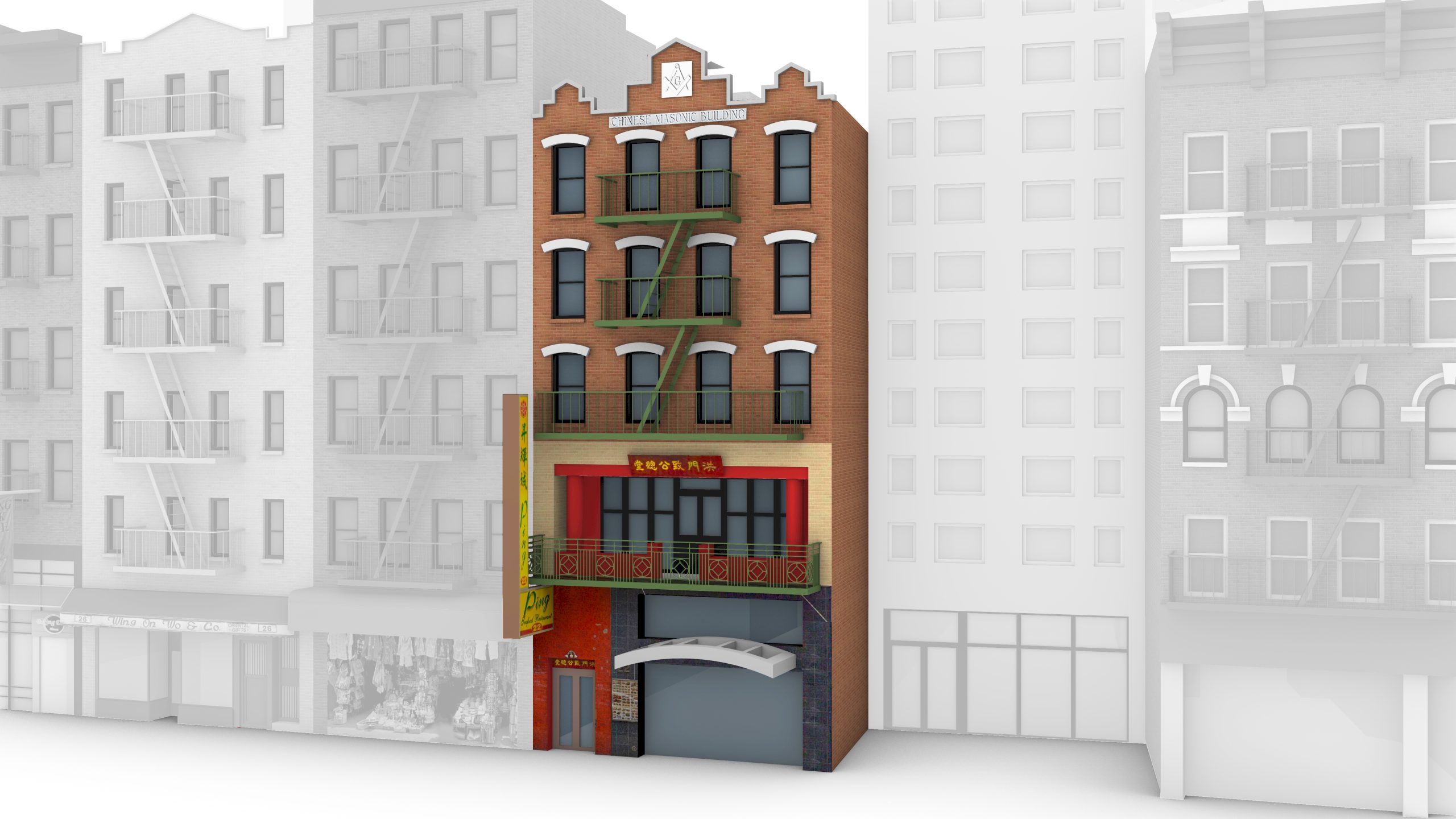
22 Mott
Chinese Freemasons Association
Ping's Seafood Restaurant
2024
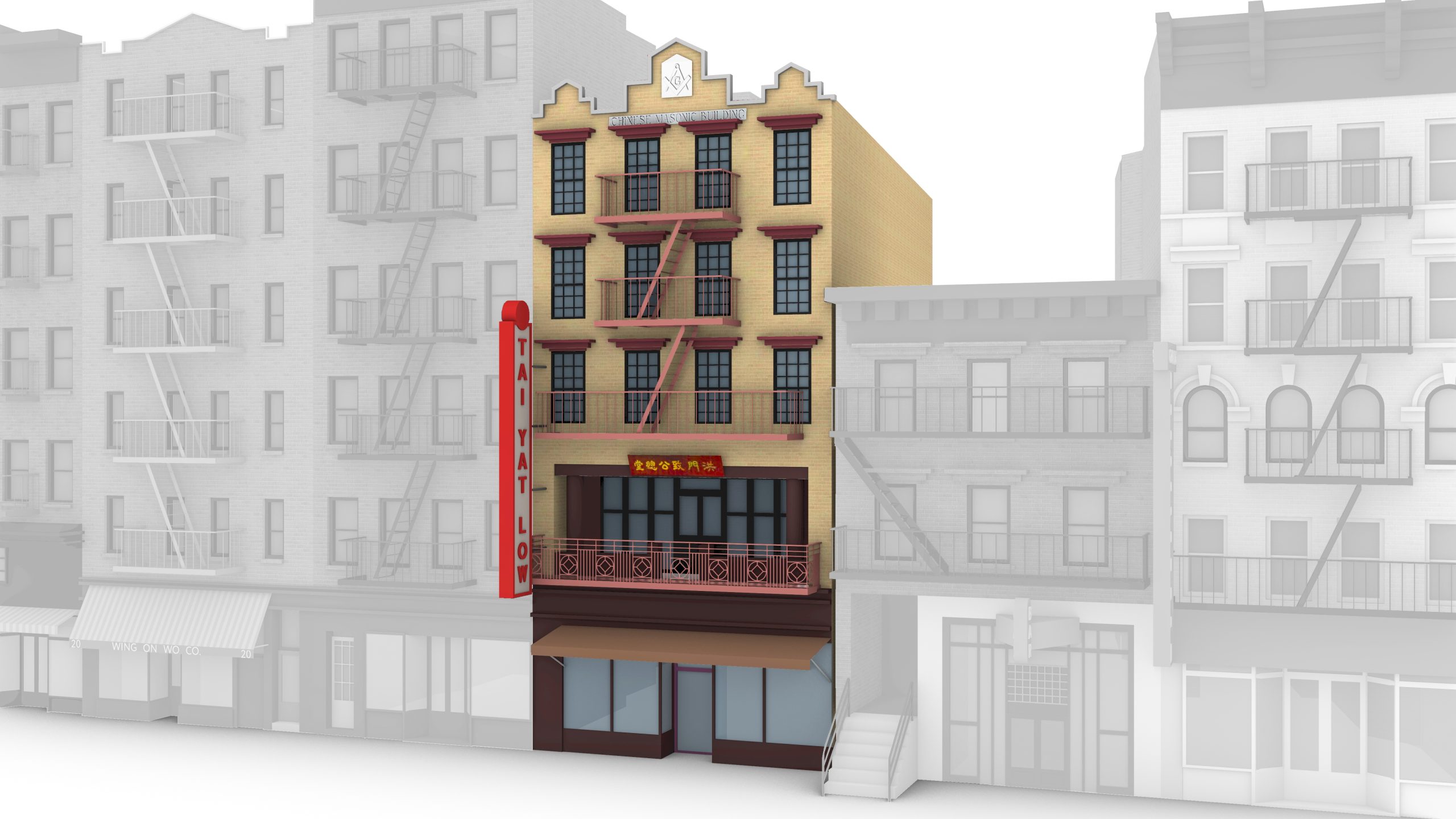
22 Mott
Chinese Freemasons Association
Tai Yat Low Restaurant
1940s
Interview
With ERIC NG (past president of the chinese freemasons association)
Interview conducted in May 2022.
+ Tell me about your past tenures as president.
When were you president of the Chinese Freemasons?
In 1994-1995, I became the president of the Eng Family Association.
In 1996 to 1997, I was the president of Hip Sing Association.
From 1998 – 1999, I became the president of the Chinese Freemasons Association.
From 2000 to 2004, I became the president of the Hoy Sun Ning Yung Association.
I became the president of the Tak Ming Alumni Association from 2002 to 2011. I held the title for too long.
From 2004-2007, I became the (international) president of the Eng Family Association.
From 2006-2008, I became the first president of the CCBA. By that time, I had become the president of many associations already. Then, from 2014 – 2016, I held the second term of being president of the CCBA.
From 2012-2013, I was the national president of the Eng Family Association.
From 2016 to 2020, I became the national president of the Hip Sing Association.
From 2018 to 2020, I held a third term as the CCBA president.
So, I’m the guy who’s been involved in community business since I stepped in in 1994. I never stopped. I like to use whatever formula we use. I don’t want to change it because when a new president comes in and uses a new rule, this mixes up all the associations. I hate it. That’s why I talk to everybody: Follow the rules. When you follow the rules, no one complains about you. That’s why we call this the traditional association.
+ How long have the Chinese Freemasons been in this building?
I think they bought the building around 1920, with the help of the American Freemasons. (They’re not Chinese, they’re the national organization. George Washington was a member of the Freemasons.)
In 1930, there was an American Freemasons Convention here.
+ How has the building changed over the last century?
They put signage up on the facade and maintained the painting on the outside of the building.
Downstairs has almost always been a restaurant. The Peking Duck House used to be down there, for at least 20 years — they moved to 28 Mott around 2014 or 2016. Originally it was Tai Yat Low Restaurant in the 1940s.
Most of the building has been relatively unchanged since [the Chinese Freemasons] bought the building.
+ Would you give me a brief introduction of yourself? When did you come to New York?
I left China when I was 4 years old. I came here to New York City in 1970 at 20 years old. The day I remember I stepped down, my relatives took me to the apartment – I first lived at 56 Henry Street.
I came with my mother and my brother because I’m the fourth and the first generation (born out of the U.S). With the fourth generation, I mean that my great-grandfather, grandfather, father & I were all here in New York City at the same time. Being the fourth and first generation is why I know a lot of history from my parents.
From 1970-1973 I worked at Chemical Bank, which is now Chase Manhattan Bank.
From 1973-1976, I worked at Deloitte (Huskin & Sells), a CPA firm.
In 1976, I started to make fortune cookies.
Twenty five years ago, I took care of the Eng Family [Eng Suey Sun Association]. And then later on, step by step, I started to take care of this building [Hoy Sun Ning Yung Association] and then the Chinese Consolidated Benevolent Association (CCBA) building.
In 1922, over a hundred years ago, the CCBA of Newark bought a plot in a cemetery to bury the Chinese in Newark. It was managed by the Eng family in the 1970s. Around 1980, the Eng Family [Association] gave authority to New York’s Eng Family [Association] to handle it. Around 2010, we tried to sell all of the space and we bought another 100 plots.
When I came in 1970, my grandfather had already passed away. Every year I go to ching ming [sweep the tomb for the Ching Ming Festival], so when I see these stones, I know the history. The CCBA owns spaces in Evergreen (Staten Island).
I’m also a collector. I always traveled to a lot of cities for stamp shows & auctions. This is my hobby.
+ How long have you been working in Chinatown? How did you come to be connected to Chinatown?
My parents never brought me to Chinatown [when I was a child.]
When I came in 1970, I had a lot of alumni from Hong Kong. We had alumni associations in Hong Kong and in 1971, we rented a space to establish the alumni. This space [for the Tak Ming Association] still exists at 16 Mott Street. The Chinese Consolidated Benevolent Association (CCBA) is the property owner. That was my first step into Chinatown. Alumni business is different from community business.
Every Saturday and Sunday, we hung out in Chinatown with the alumni. We learned a little bit of knowledge from Chinatown but we were not really involved in the community. I became involved later on because I started my business.
I started a business making fortune cookies in 1976-1977. Along with another alumni member, we took over the business from the previous owner. I sold it to him in late 1978. It was at 6 Chatham Square. Before, it used to have a liquor store in the storefront and we made fortune cookies in the back. I started another fortune cookie business, with fully automatic machines, in 1978 at 53 Chrystie. I sold the business to Wonton Foods in 1983. I was too busy and had no breaks as the machines were going seven days and seven nights a week. By then I was also doing wholesale, which I started in 1982. Major products sold were eggs and coffee. Martinson Coffee, which is famous in Hong Kong — I sold that product. At the time, all the cafes drank this coffee. By 1991, I had gotten a younger partner. I left this partner the business, minus the eggs and coffee. We split the company into two companies at 7-11 Ludlow and 23-25 Ludlow.
+ What was Chinatown like when you first arrived in the 1970s?
I went to work and my connection was mostly with the alumni. Every Saturday or Sunday we had meetings together. We didn’t go outside to do new things. Then, it was different. I was too busy.
In 1973, it felt like the situation was getting worse in Chinatown with the gangs… though they didn’t bother me with my business, and my store was outside Chinatown.
+ How have you seen the Chinatown community change over the past decades?
A lot has changed.
In 1975, the Vietnamese came here and the size of Chinatown boomed. My wife was Chinese-Vietnamese (she passed away in 2005). Between 1970 and 1980, a lot of Taiwanese came here. Around 1985, a lot of Malaysians and Singaporeans came here. At the end of the 1980s to the early 1990s, a lot of Fuzhounese came here.
Chinatown is changing — during that time, we expanded to the north, but we couldn’t expand westward because of the jail. We also expanded in the east. To the south, there were the projects, so we didn’t expand there. Hester, Grand Street – boom – Chinatown moved up north.
But around 2010-2015, from the north, the Americans pushed back.
+ What are your feelings about what Chinatown has been impacted since the pandemic started?
When the pandemic started, I had an appendicitis emergency. I stayed two months in the hospital and three months in a rehab center, four months resting at home and last year in January, I went back to the hospital for surgery again and then was doing better and better… It was a two-year experience.
I have nothing to say because Justin Yu, the former president of the CCBA, was the public face of COVID. He was famous because he first stepped into this title in this month. Everything shut down in Chinatown and he handled it.
Interview
With KARLIN CHAN (ELDER OF THE Chinese Freemasons Association)
Interview conducted in April 2022.
+ Give me a brief introduction of yourself.
I grew up here. I got to New York Chinatown as a toddler from the old village, so I’ve been here for over 60 years. I went to school here and I still live here. I saw the neighborhood go from three and a half, four blocks to a sprawling Chinatown in the 1980s and 1990s. Broadway and Canal used to be all Chinese stores… Chinatown on Mott and Elizabeth pushed up to Houston, and we even went up to the East River for a time.
+ What Chinatown buildings are you connected to?
I’m connected to just about every building down here.
If they didn’t replace the cement, you’d see my DNA down under every paver.
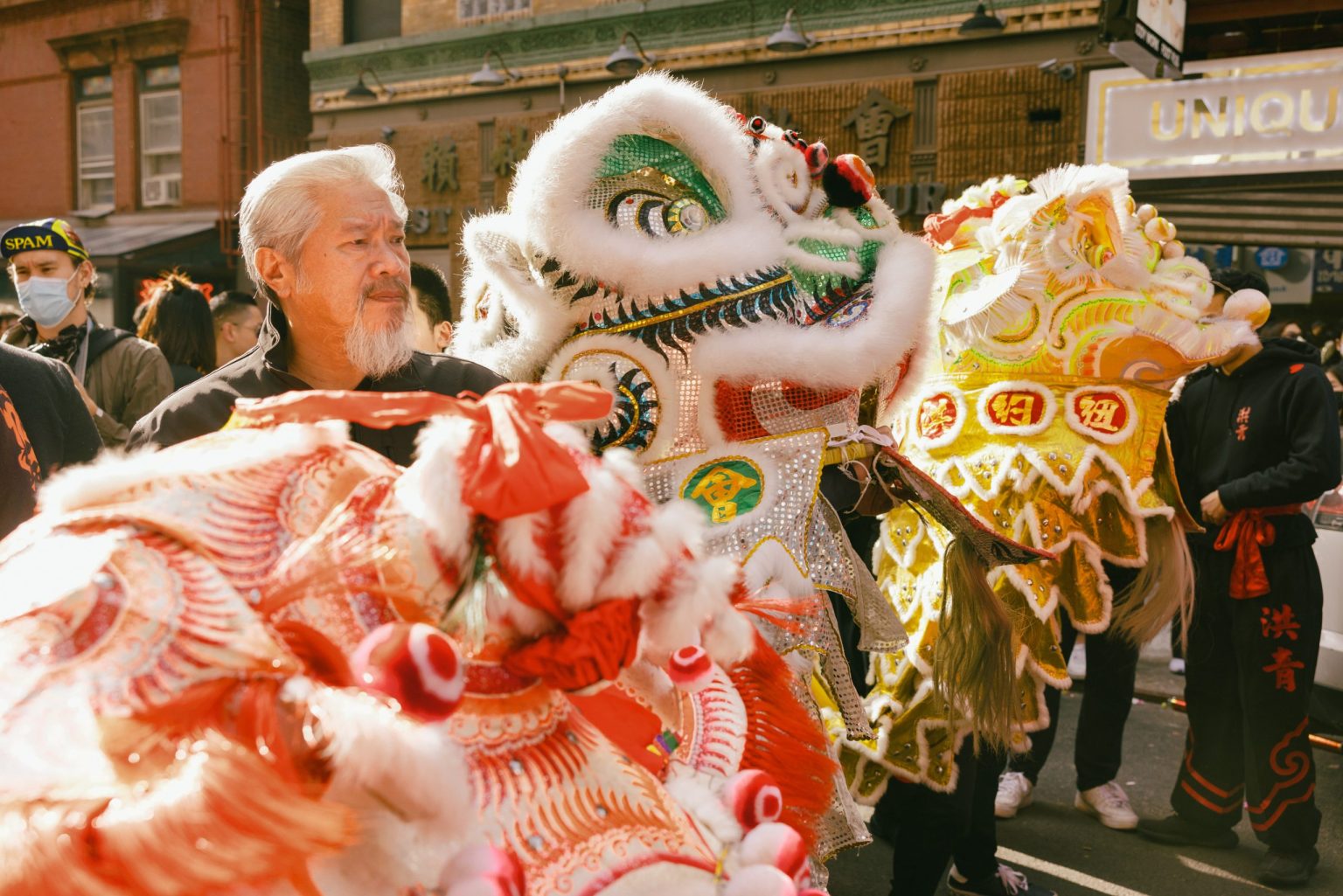
Karlin Chan with the association’s lion dancers on Super Saturday, 2022. Photograph courtesy of Karlin Chan.
+ How are you connected to the Chinese Freemasons?
I’ve been a part of the Chinese Freemasons for over 50 years. I started following them on Chinese New Year. It was a big deal here — stores closed for a week, with the exception of restaurants, since bachelors in this bachelor society still had to eat. I got more involved in the 1970s with the lion dancing and I started organizing for the association to bring more youth in. Today I’m the Elder of the association; I’m the eldest active member. Of course you won’t see me playing with a lion head anytime soon — but I’m still active on contracting shows.
I formed Chinatown Block Watch back in February 2020 out of necessity and the rise in Asian hate crimes.
+ Which buildings in Chinatown do the Freemasons own?
The Chinese Freemasons have several buildings; their headquarters are at 22 Mott. The association bought the building back in the early 1900s.
Over time, we had several other buildings but we don’t miss those.
+ Can you share any information about the building’s history, or its past lives?
Do you know of any major renovations or changes to the building since it was first constructed?
The building has basically remained unchanged over the past decades. The one change I’ve noticed, from old photographs from the late 1950s, is that the entryway, the stairs up to the building, used to be in the center of the building. At some point they must have redone this and now it’s a ground-level entrance.
There was a grocery store down there; the staircase was in the center and I remember going in there as a kid with my father. Back then, you had grocery stores that multi-tasked: some sold veggies, some sold fish, some sold meat and preserved canned goods. There were some stores that sold roast barbecue. There were many of those in the community.
That was in the basement. Where Ping’s [Restaurant] is now used to be the grocery store. It closed down in the 1960s.
The 2nd floor used to be another restaurant called Tai Yin Lo. It must have been there from the 1930s/1940s to the 1950s/1960s… They only occupied one floor.
The Peking Duck House was here before, but moved into 28 Mott.
+ What’s the interior of the Freemasons headquarters building at 22 Mott like?
It’s just a regular building…
The building is four or five floors with three floors of residential. [Chinatown] was a male society in the 1960s / early 1970s, going back to decades of Chinese Exclusion. A lot of these apartments on Mott Street had a roommate system — they didn’t have the whole apartment to themselves.
On the third floor is the [association] lodge. The meetings go on there; politician wannabes go up and visit… Nobody plays mahjong there. In the old days, all the family organizations did — mahjong was a pastime game.
The front place is one big room with historical pictures. They show pictures of events that may have happened there, like courtesy visits from dignitaries from China in the early 1920s / 1930s…
+ Are women allowed in the association?
[Associations] are still mostly male-dominated; but some have women’s auxiliaries. We do have women members. We’re very progressive that way. We’ve had women chapter presidents in other cities. This year, one of our national presidents, Boston-based, is a woman.
With the Freemasons Athletic club, we had an all-girl lion dancing crew dating back to 1984. We formed an all-female team and ran it for several years. We still have women playing.
+ What are some of your fondest memories of activities that took place at 22 Mott?
Nothing memorable happened there… the only memorable things were on Chinese New Year.
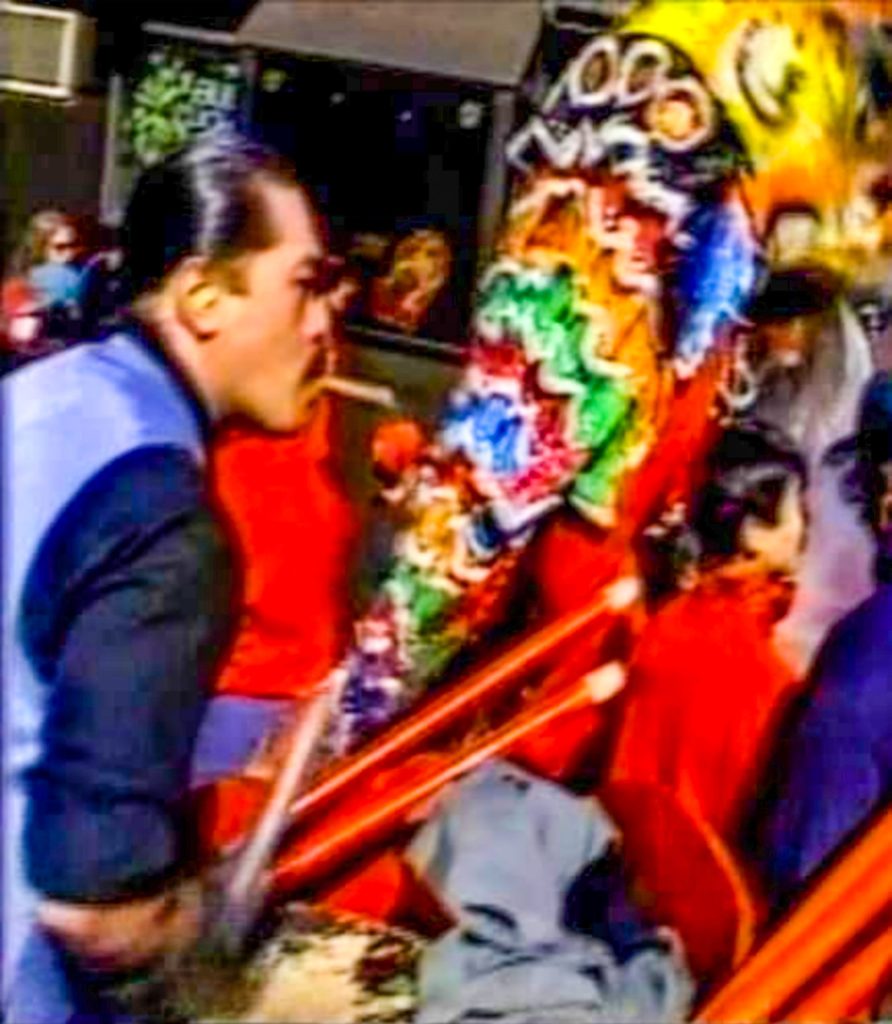
Karlin Chan, drumming with the Chinese Freemasons’ lion dancing troupe in 1989. Photograph courtesy of Karlin Chan.
We used to hang huge strings of firecrackers from the roof — 100,000 of them — they were 4 and a half stories tall… Every year we would do this. The fireworks would go on for days in the whole neighborhood. People came down here to play with the firecrackers. That was before they banned firecrackers. Guiliani banned fireworks after 1993. Now we have the confetti cannons.
+ Can you describe more about your experience lion dancing with the Chinese Freemason in the 1970s?
The athletic club was formed in 1956. Members of the Freemasons, the younger folks, wanted to form an athletic club for martial arts, lion dancing and bowling leagues… Mostly younger guys in their 20s. Our headquarters were on Canal and Mott Street. The Athletic club here was where the [lion dancing] practice was. We had a huge loft. Here, you learned martial arts. We moved out in 1981/1982.
Practice is still how it goes on today. You practice your repetition and your moves to imitate the mythical lion dancing. Back then, we didn’t have cell phones or camcorders, so you didn’t know how it looked to the spectator. You have to get used to the weight of the lion head itself. Practice makes perfect.
For a short while, I was the lion head… I was more of the drummer. The drummer follows the lion heads. Now, they key in the lions. It’s not as traditional as it used to be. Back then, every style of Chinese martial arts had their own unique set of drum beats. Now everyone seems to play more of a Malaysian [style]. I used to teach drumming.
After a while, it’s up to them to practice. It’s up to the next generation to pass it on.
+ What was growing up in Chinatown like?
I grew up on Mulberry, half a block from the school.
I went to school at P.S. 23. You’d get up and go to school yourself — at the time, it was safe enough to walk by yourself to school.
You got to school, and you got out at 3 o’clock. After, I used to play with other kids in Columbus Park or I went to a classmate’s house with five to six other guys — one with a large apartment at 3 Mott Street to play games or watch TV. And then at 4PM I went to Chinese school, which was five days a week. Chinese school lasted from 4-6PM at the True Light. There were two Chinese schools at the time — Chinese Consolidated Benevolent Center (CCBA0 or True Light. You walked in and went up to your classroom. Classes were fairly small, 15 to 20 people.
My father worked a lot. On Sunday my father was off; he would go out to say hi to my grandfather at the noodle place (at 71 Mott street) where my grandfather was a partner.
+ What do you remember about the noodle factory at 71 Mott that your grandfather was a partner in?
What was the interior like? What was served? Who came to eat there? When did your grandfather own the business?
Every Chinese restaurant was a chop suey house. It fed generations of Chinese immigrants here. We took trash, put soy sauce on it and fed it back to our oppressors. It was freaking brilliant — I love that. Basically all of the ingredients were the same: cabbage, bean sprouts, celery (the outer dark green stalks), chicken (skinned & deboned; the carcass goes into the soup stock for the gravy and the meat would be julienned or diced)…. Julienned chicken was used in chow mein or chop suey, and diced meat was used in sub gum chow mein or chop suey… [and this was] thrown over noodles.
There were several noodle factories that made wonton skins and noodles.
Nothing was wasted.
He had the shop, maybe starting from the late 1940s. It closed in the 1970s. He passed away in 1970. I grew up going there on weekends with my father. On Sundays, we would go in and say hello. We would hang out there inside; the workers would do this from midnight on and were off during the day. The noodles would ship out and go on the truck at 5AM… Normally during the day, people would come in, buy a pound of wonton wrappers (15 cents at the time) and the staff would play mahjong. You would hear mahjong tiles going in every other store. You would see the washbasin and pail of water with the pot of tea and teacups at the entrance. That was the traditional way of greeting people.
There was usually only one mahjong table there. They sold retail also. The back was the factory and the front had the office… There were solid wood and half wood, half glass partitions — the whole office was built that way. There was enough [space] to put two desks a few feet wide on either side of the office.
He only sold three products: fresh noodles, fried noodles, or fresh wonton skins. It wasn’t a place where you could pick products off the shelf.
I would usually take noodles and make roast pork lo mein…
This was the era of the egg noodle, way before this “Hong Kong noodle”, which is very thin. I prefer the thicker egg noodles. Julienned chasiu, throw in bean sprouts and toss it around the wok.
(Left) Karlin Chan, 1972. Photograph courtesy of Karlin Chan.
(Right) Karlin Chan on Mott Street, 2022.
+ What was Chinatown like back then?
Chinatown was so small. When you walked into any shop, there was a pail of water and five to six teacups and an insulated wicker basket full of tea — you would pour yourself a cup of tea if you were thirsty.
“Yut chee stang, lerng chee sook”
[Translation from Cantonese: One time, strangers / Two times – family]
At the time, aside from the Toishanese, there were the Hakka and Shanghainese. The Hong Kong Chinese didn’t come until after 1965, after the immigration quota was lifted… Everybody spoke Toishanese — and from the way you spoke, they would ask where you’re from. Which village? At the time, from the 1960s up until the mid-1970s, it was a close-knit community and most of the business owners lived within three blocks of their business.
Pot Luck on Doyers was one of the first dim sum places. It’s gated now, but was at either 9 or 11 Doyers (between Apotheke and Pulqueria). My friend’s father opened it. They got popular selling their gai bun jei (little chicken buns), before it was all Toishanese dim sum.
There were so many coffee shops because of the bachelor society at the time, even in the 1960s. Men would come first and set up and then bring their wives over (they had to get sponsorship). You’re not going to sit down in a restaurant and order a couple of dishes for yourself, so you would just grab a bao…it wasn’t until the 1970s that we had Hong Kong style dim sum with the carts.
My father was always working — he left at 4AM to open up the chicken market (Prince Poultry) up on Prince and Mulberry.
After the 6th grade, I started hanging out at Chinatown Fair — OK, fine, it was really the 3rd grade. Most of the time, we hung around Chinatown Fair. You had everything in there! You had a mini merry-go-round, a one-seat ferris wheel, the Bear Shoot, driving machines…
At 6PM I went home.
+ What were some of your most memorable neighborhood spots?
Jumbo House at 9 Elizabeth. This was one of the first dim sum places that opened up. The chef himself came from Hong Kong. My buddy and I worked there and found it disgusting that he put celery in everything – it was expensive in Hong Kong, so coming here, he put it in everything. We were there for like a year or so. They used to have a soft-serve machine up front. Coconut and mango… I used to get a combination of those.
In 1978, the Chinatown Ice Cream Factory opened there. It was the brothers. I met them at the Freemasons. They opened the Bayard Street Cafe — their father owned the building. Five brothers and one sister. One of the brothers is still there. Philip Seid. I saw him the other day… Kong Sihk Kong used to be Bayard Street Cafe. They served wine and beer and used to have an asteroid game in the back… They were open for a couple of years and then they gave that up.
I remember places with crushed ice, evaporated milk and simple syrup…
I remember Rocky’s Hardware on Bayard, where the florist is now, there would be Spaldeens [Spalding bounce balls], yo-yos, water guns, tops, cap guns, sticks for stick ball…
Wrangler Ranch on West 8th street was where the cool Chinese kids went to buy clothes.
Arrowhead and Village Cobbler were the places to get our platform shoes.
Yuen Yuen was at 61B Bayard and you could get watermelon slices for a quarter and Chinese-style ice. I’d go in and get bolo bing (pineapple ice). [It was my] favorite snack spot. The owner is the same as the funeral supplies store next door (at 61A Bayard)!
Chinatown back then in the 1960s and 1970s was all neon — people are like moths; they’re drawn to glowing lights.
67 Mott was Golden Dragon Restaurant, which had a fire-breathing neon sign. The restaurant closed in the 1980s.
Most Chinese restaurants had a bar. You’d walk through the bar to enter the restaurant itself. There were 20-something bars in town.
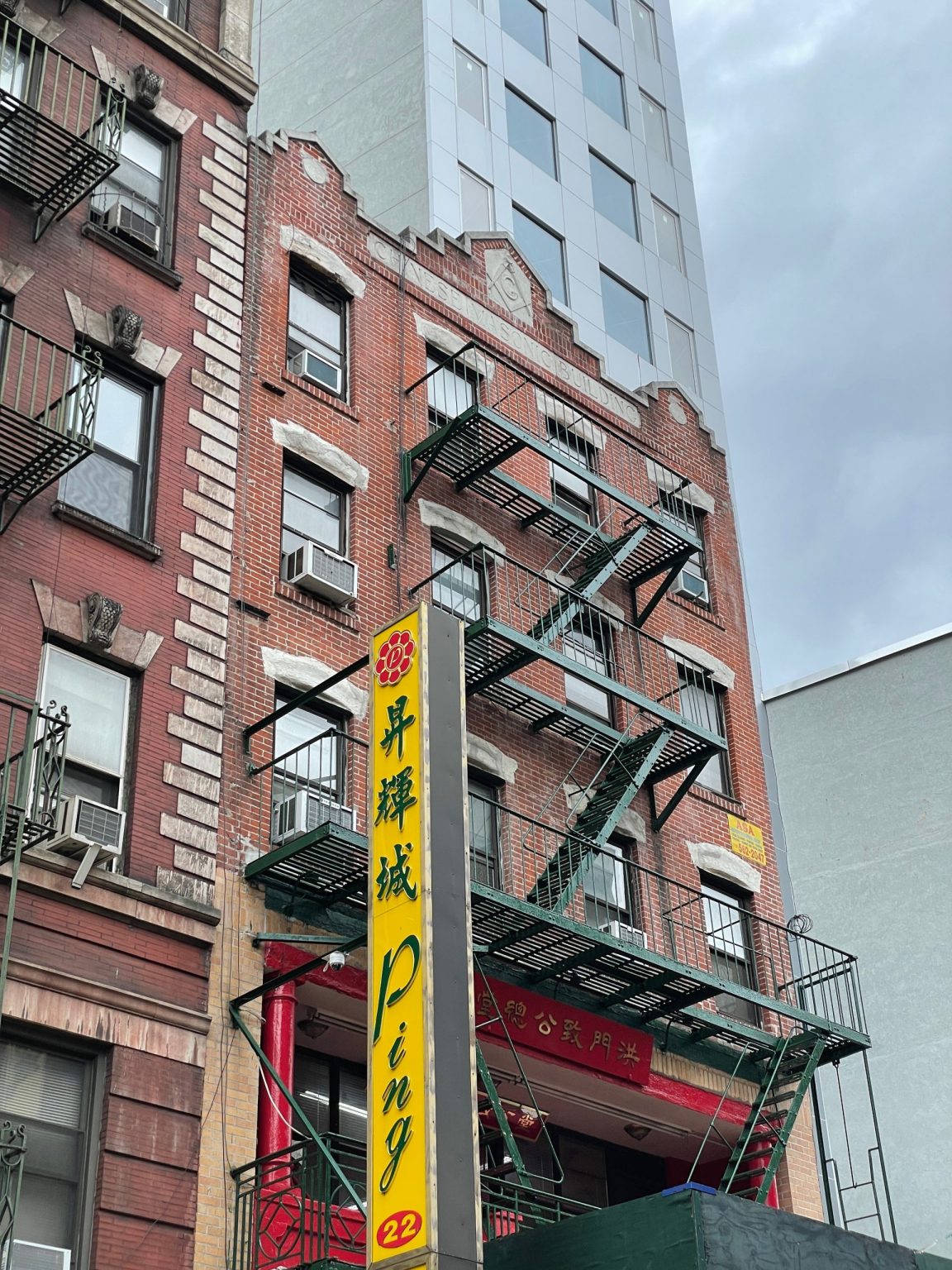
BUILDING PHOTOGRAPHS
Photographs taken in 2022.