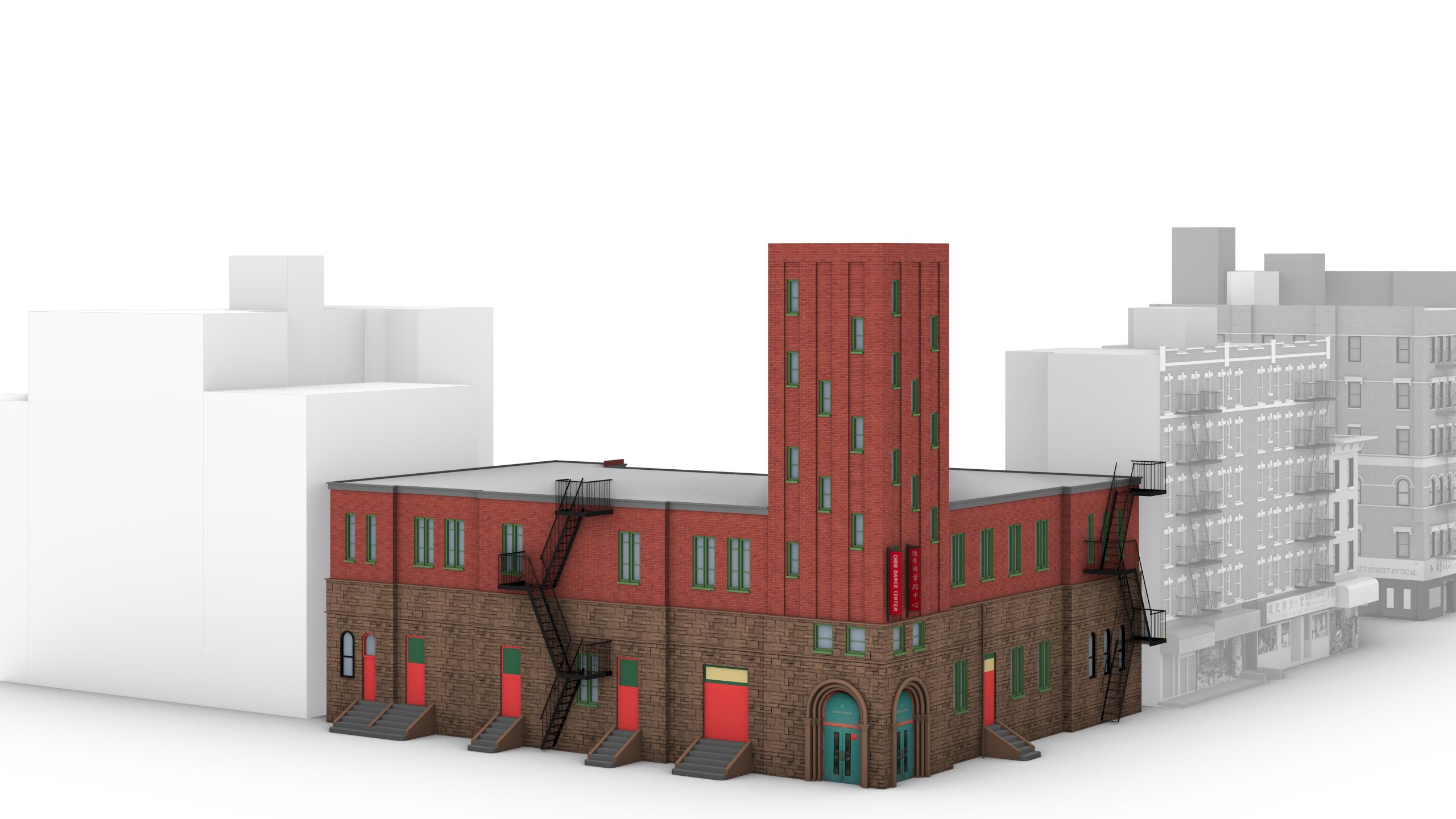
70 Mulberry
Architect: C.B.J. Snyder
Built in 1891
Damaged by fire in early 2020
2020 - 2024
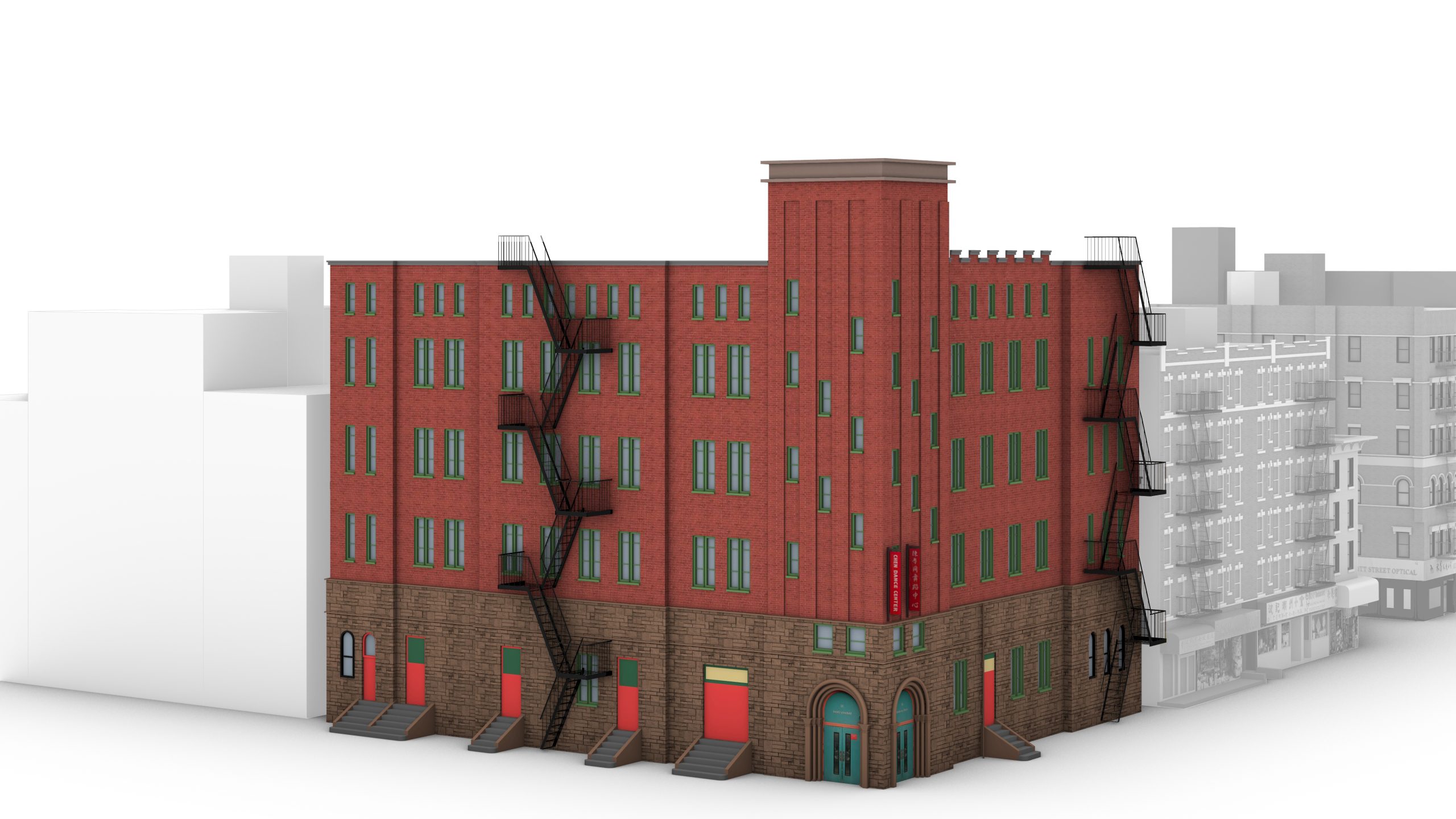
70 Mulberry
Architect: C.B.J. Snyder
Built in 1891
Decommissioned as a school in 1976 and became the headquarters for several community groups such as H.T. Chen & Dance, Chinese American Planning Council and Museum of the Chinese in the Americas (MOCA, then the New York Chinatown History Project)
1976 - 2019
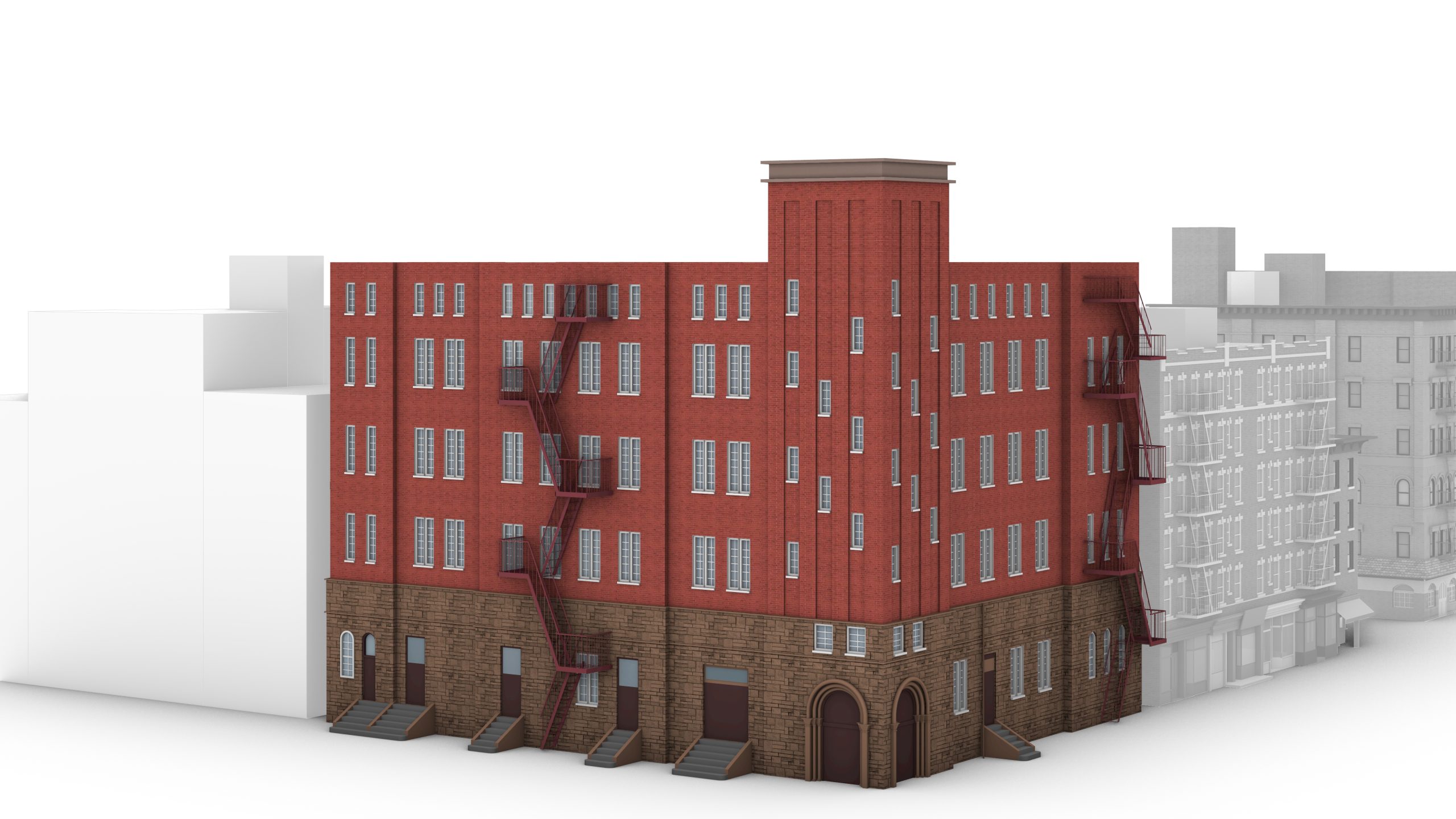
70 Mulberry
Architect: C.B.J. Snyder
Built in 1891
Public School 23, Manhattan
1940s
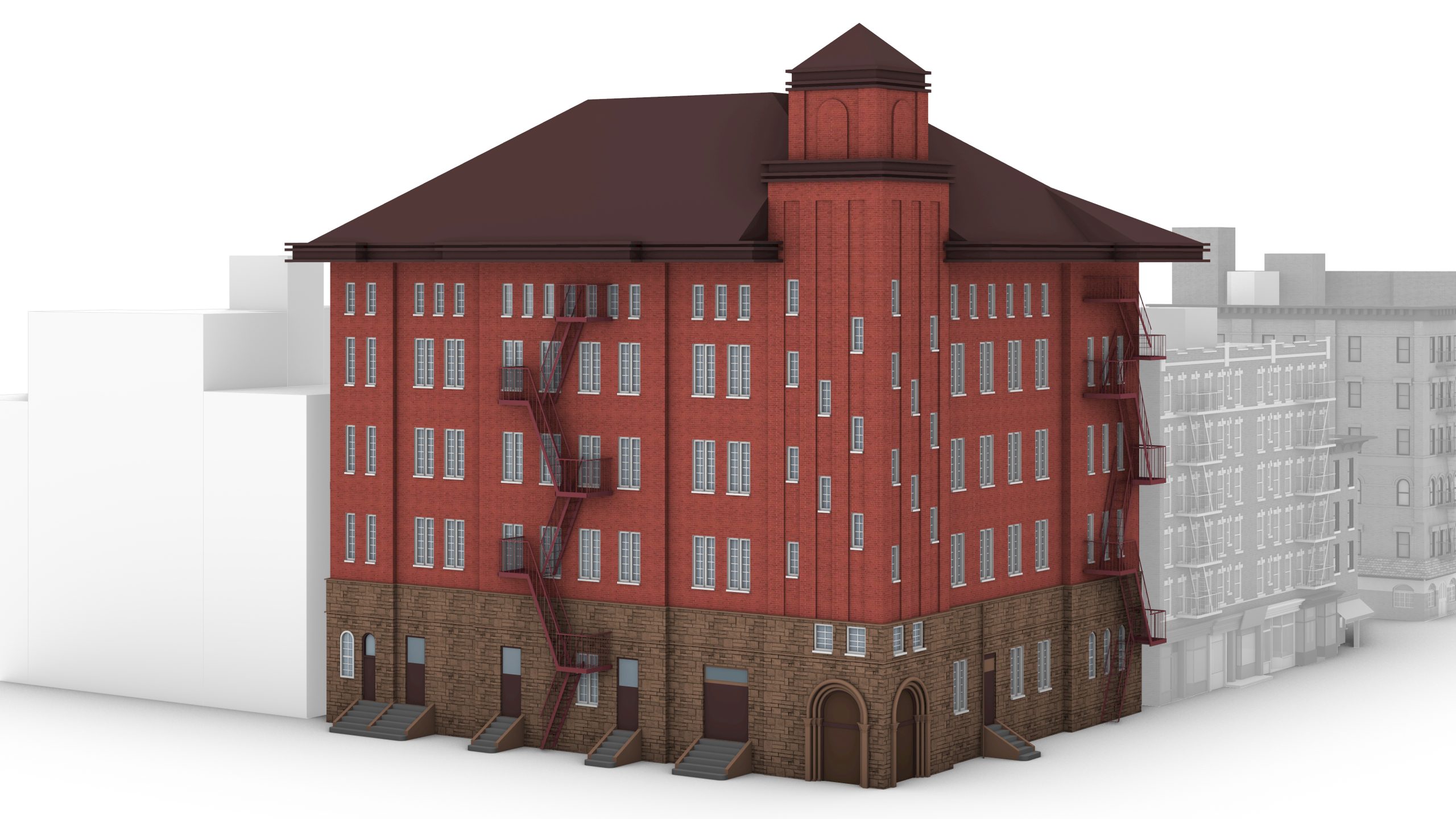
70 Mulberry
Architect: C.B.J. Snyder
Built in 1891
Public School 23, Manhattan
Early 1900s
Interview
WITH JOE CHAN (CHINATOWN RESIDENT AND ACTIVIST)
Interview conducted in April 2022.
+ Would you give me a brief introduction of yourself and your connection to Chinatown?
I’m Joe. I’m currently involved in youth and family development and I have been a resident and activist in Chinatown for the last half of a century.
+ What Chinatown buildings are you connected to?
P.S. 23!!!
I went to elementary school there in 1968 for 4th grade, 5th grade and 6th grade and my great aunt Jessie also went to school there, likely around 1910, 1911, 1912. She was born 1896-1897.
My teacher, Mrs. Brown, was my homeroom teacher for 6th grade and my great aunt’s teacher. She was my favorite teacher. You can walk into five generations of Chinatown community members and all of them will have stories of Mrs. Brown.
School was within walking distance; I lived on Mulberry Street. It was one block away. The first thing you’d recognize was the corner on Bayard and Mulberry. There was the tower — this was where the stairs were. On the bottom when you first walked in, you had a small basketball court / gym (which is now the senior center) and in the back, we had collapsible tables and chairs, which was our lunch room.
The ladies who served lunch were all Italian. The lunch ladies would set up the chairs and tables. Back in the days, we didn’t have to fill out forms for free lunches. It was included in our school. It was a lot of canned goods: soup, ravioli, occasionally corn and fish sticks. There was no Chinese food.
Back in the day, I was a rice ball. It was a derogatory Italian term for Chinese.
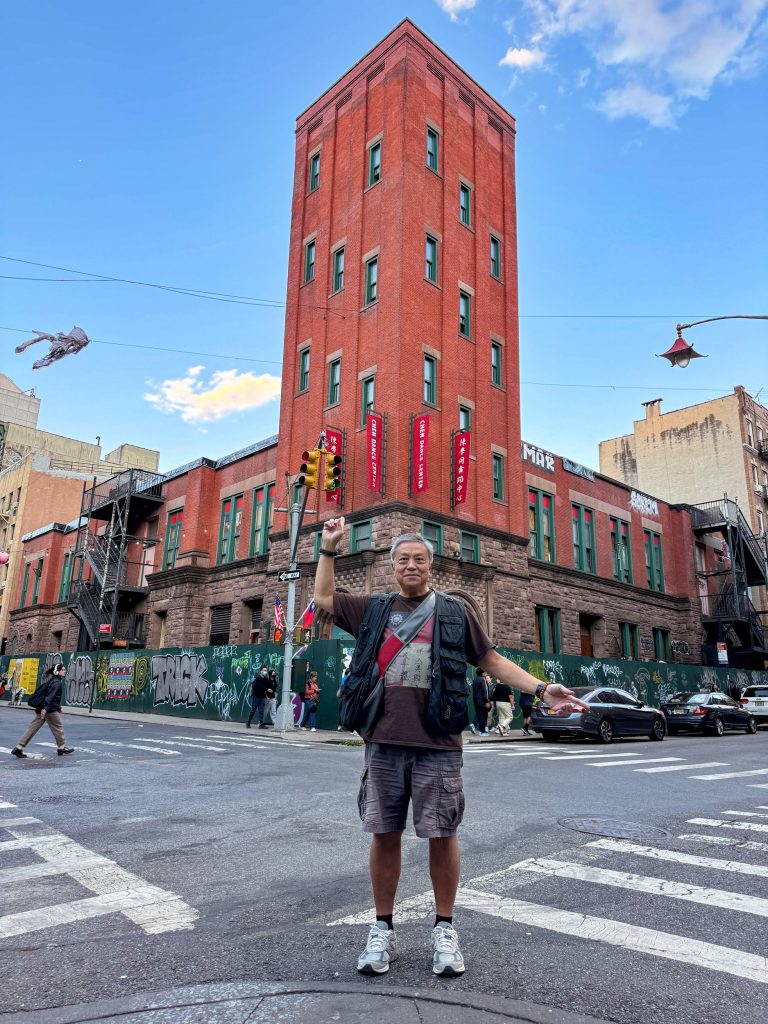
Joe Chan at the intersection of Mulberry and Bayard Streets, 2024.
All of the teachers were Chinese, Italian and Jewish. All of these ladies transferred to P.S. 24 and ended up teaching my daughter too. Mrs. Mak, Mrs. Chu, Mrs. Shan. She was always pitching to sell encyclopedias to students. I still have the original set from the 1970s. I still read them!
At the time in the 1960s, I believe it was a predominantly Chinese student body. The classrooms were what they called the industrial model at the time — the higher level still had the built-in desks with chairs, where the desk folds up and down with the pen-holders built in.
The kindergarten was on the ground floor and the older kids had to do the legwork to go to the higher classrooms — there were no elevators. It was co-ed. I remember there were a lot of posters and bulletin boards; green boards with chalk; penmanship, music, math stuff. All your basic 4th grade stuff. No Chinese, only English.
All of the students had a bank account from Bowery Savings. It was a way to teach us financial literacy; we would have milk and cookie money. Milk was on the house, but you had to pay for the cookies. Back in the days, these bank accounts were there to teach a kid how to be thrifty — you could have 7 cents in it. There were tours and we would visit.
The first time I experienced racism was from a Chinese kid. It was at P.S. 23. I was wearing a silk quilted jacket.
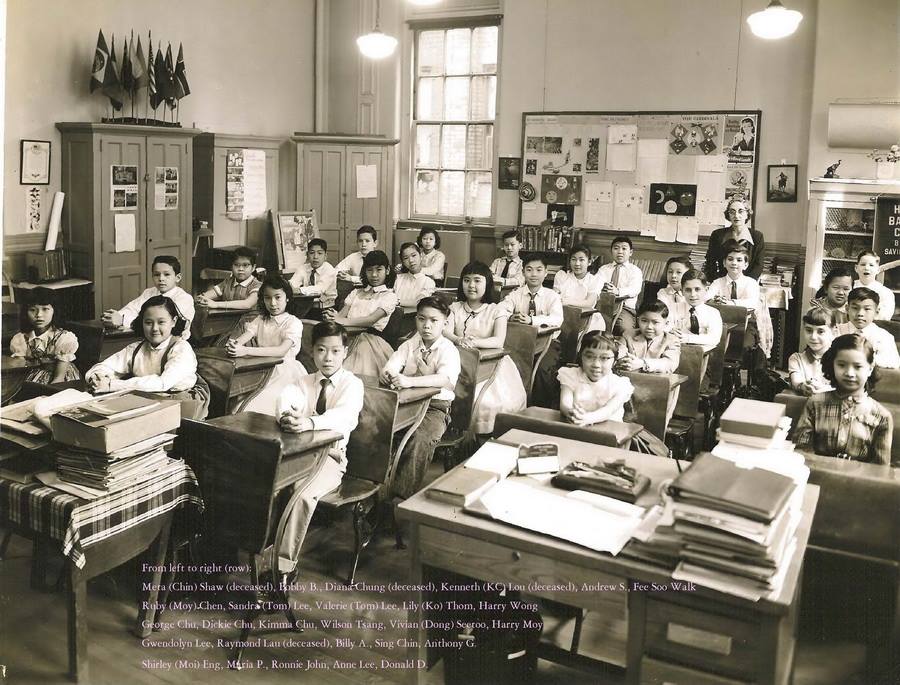
“I’ve attached a photo of my classroom and Mrs. Brown [from 1956-57], not of me but some of those students are aunts & uncles of me and my classmates.” – Joe Chan.
+ What was recess time like?
They set you down in the gym and people had their own cliques. It depended on who escorted us. As you got older, you could go outside. People would go to the corner pizzeria. My first experience having a slice was 25 cents on the northwest corner of Bayard and Mulberry.
We had beef with the kids at Transfiguration [Church’s school]. The kids were more privileged and let you know that.
There was always rivalry between Transfiguration and P.S. 23. We would pick fights in the park house in Columbus Park. We had Chinese handball, a smaller version of the bigger paddle ball and done in a smaller court. We had kick-the-can, Johnny and the Pony, stick ball…
In 5th grade, one of my art teachers was Jewish and one of my classmates was a gang member. We were drawing and my friend/classmate drew a Buddhist swastika. When the teacher saw him, she flat out slapped him and everyone was shocked. This individual just stood there and didn’t retaliate… and he was the one person you didn’t want to mess with! He stood there and took it.
+ How did you adjust with both Chinese and English language in school?
My great-aunt placed me in a grade higher than I should have been. I spoke English fluently but I had a British accent. I had to get rid of that because I got tired of running. A handful of kids would make fun of me. I was not “street.”
+ What are some of your fondest memories of this building?
The fondest memory of this building was my time during my elementary school years. Even though I only started in the 4th grade, it was during the first part of my 6th grade when I had Mrs. Brown as my homeroom teacher. She was the best, tough as nails, but everything you’ll find and all the fine qualities of an outstanding teacher. Also, the building has the coolest stairwell, it’s located at the corner of Mulberry & Bayard Street.
+ You mentioned you first “crossed the salt” in 1968 in this global year of turmoil! Tell me about your journey over to the U.S.
I was born in British Hong Kong on the Island. My biological father passed away before I was born; he was Aussie-Toishanese. I was supposed to be in Australia because the paternal side of the family were (are) all there. The Chan side then decided to tell my mom she’s on her own. I have a half-brother in Australia. I have a stepbrother here from my pops, who my mom remarried.
My pops had come back from America. Someone in the village in Toishan arranged the marriage for him and my mom agreed. He came back in the early part of 1967 and we stayed at my paternal grandma’s house in Hong Kong. Growing up, I lived in many different relatives’ houses.
We got on a plane. It was cool – my first time on a plane – and we stopped in Japan. In 1968 they had the coolest toilets, laser-sensor toilets. We ended up in Seattle and then on to JFK. We got off the plane. It was dark and somehow we took a cab and I think we came down Lexington Ave.
+ What were your first impressions of Chinatown when you first arrived?
I thought the stores were really cool. In 1968, it was definitely not as hustling and bustling as the streets of Hong Kong. The souvenir shops were cool, though interesting because all the souvenirs were made in Hong Kong or Japan. There were things made in China but even the shop owners thought they were better quality.
Walking down on Mott Street, I liked looking at the storefronts. The store signs were translated phonetically. I liked the neon signs.
The food was old school Toishan Cantonese. You would get food, menu-wise, that was geared towards tourists… but if you were Chinese, you could get the “phantom menu” and ask the chefs for Chinese dishes. Dishes still have a jook sing taste. There were different places for gung zai mein. There was Lonnie’s, which closed in the 1980s, and Red Rooster’s for burgers and fries. Sun Hop Shing took over the unit above Hop Kee.
+ What do you remember about your first home in New York’s Chinatown at 24 Mulberry?
When I first got here in 1968, I walked through the front door, which was solid polished oak with glass acid-etched with floral patterns. All the brass mailboxes were unpainted; Mrs. Carbone, the super, polished them. The second door that led into the hallway was also solid oak. There were brass etchings and brass railings with lace curtains. Every single button that you could push to the apartment, including the buzzer in the kitchen to let someone up, all worked. As you went through the hallway into the interior courtyard, it was immaculate. At the time, I was the only kid. It was a mixed population – Chinese, Jewish, Italian… Mrs. Carbone didn’t like me because I was a kid.
I still live here. The owner of the building, John, used to live in the apartment. My great aunt asked him to take it over. In the mid-1930s, they signed a lease and she snuck my dad’s name on the lease. I think the rent was 36 or 38 dollars. The Quality gas range in the kitchen and the sink set-up is from when the building was built! I’m one of the only tenants who has a patio / porch.
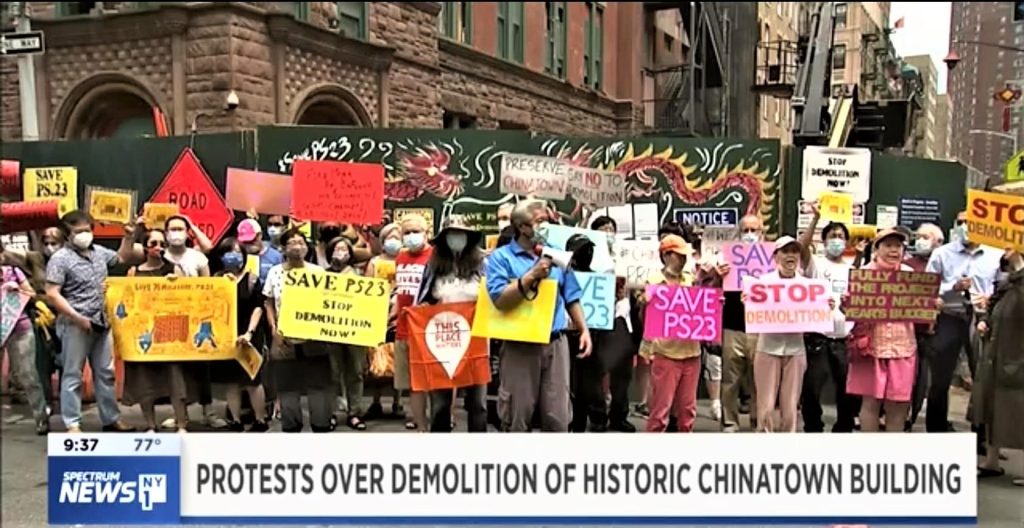
Chinatown protests to save the building at 70 Mulberry from demolition, 2020. Screenshot courtesy of Joe Chan.
“… the person in front is Karlin Chan, a Chinatown and community activist, and my Dai Loh since 4th grade.“ – Joe Chan
(Photographs taken in 2020.)
+ Could you talk about what the interior was like growing up?
When you first go up to the second floor, you see two doors. Only one of them works. The original owner took the first two apartments and converted them into one unit. I have the whole floor.
It was a hub for the whole family to come through. My great aunt’s bedroom was in the front (it was supposed to be a living room) and then the middle room was my bedroom (with a window that you can open up and a door) which was the converted hallway and bathroom. My mom and dad would be in the back room, which was supposedly the kitchen. On the other side in the other converted unit was the bathroom, living room and full kitchen with dining table. In the living room, Uncle Hingie had a desk in the front and a plaque by the front door. He would use it as an office.
+ What is it like today? Have there been any major renovations or changes to the building since it was first constructed?
It’s pretty much the same, but more dilapidated with water damage and things that the landlord hasn’t fixed. My apartment now looks like a steampunk alley: I have all new gas pipes and pre-war buildings can’t put sheetrock over gas pipes.
The fire escapes are the same. We have a lot more vents and pipes because the funeral homes flanking our building had to make changes. The flower shop has been there since the late 1970s… There was an attempt at a sandwich shop for a while.
+ What was Chinatown like in the 1970s and 1980s? How have you seen Chinatown’s landscape change over the decades?
In the 1970s and 1980s, the signage and security changed. The roll-down gates — we never had to have them before.
After the Fukienese came, you noticed the signage changing. Signs would be written in Putonghua spelling. All the PRC influence is seen in the signage and even the color.
Interview
WITH JACK TCHEN (HISTORIAN AND CO-FOUNDER OF THE CHINATOWN HISTORY PROJECT / MUSEUM OF THE CHINESE IN THE AMERICAS)
Interview conducted in May 2022.
+ Can you give me a brief introduction of yourself?
My name is Jack Tchen and I’m an anchor baby who was born out of a refugee family and the Chinese exclusion laws. Eugenics actually, very much shaped, unbeknownst to me, the reason I was born to begin with, and in many ways, the kind of set of labyrinthian, historical context that I’ve been trying to unpack through much of my life. I don’t think of my work as being academic so much as really being public… in an effort to untangle myself from the public histories and politics that my life has been trapped within and really trying to work that out in a public way. I don’t think of my stories as being that unique, but being part of a much larger context. Whatever I’m working out is also just a way to hopefully help other people work these questions out, both in terms of my personal research, but also in terms of my personal story and the kind of historical research and publications I’ve been doing. That includes exhibitions and films and other kinds of work. All of that is really meant to be not so much for my personal kind of untangling, but really more of an untangling of historical contexts and impacts that it has on all of us. Each of us experience it in particular ways, but at the same time, we’re parts of classified groups and spatial groups that are constantly being caught within politics and how power actually operates. Sorry for the convoluted introduction, but I just want to make sure that there’s an understanding of what our projects are really about from my point of view.
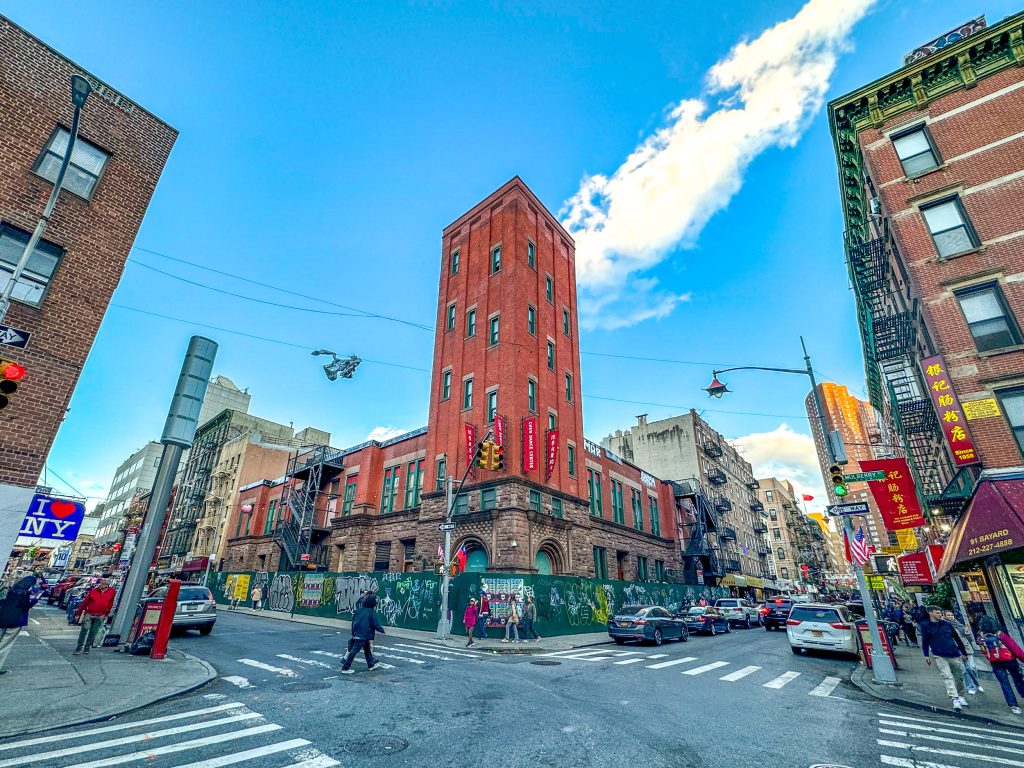
70 Mulberry, under renovation after the 2020 fire. Photograph taken in 2024.
+ Can you share a bit more detail about your family history in coming to the U.S.?
The very reason I was born was because my parents came on a visitor’s visa. They left Shanghai, China in 1949 — my father’s mentors in China were anarchist elders. Anarchists and communists did not get along, even though they were part of a broad left critique of the politics of China.
My family is from the Jianxi region in southern China, west of Fujian Province, but they moved to Beijing and Shanghai. As refugees, my family was trying to figure out how to join the three older siblings (their children) who’d already gotten to the U.S. to study. The fourth one somehow managed to get to the United States on his own and the 5th, Victoria, was born on VJ day – victory against Japan day. She was still with them. The three of them made it as visitors to the U.S. and my father was trying to figure out how to get more permanent status. He was not able to get refugee status. (It was 1949-1950.)
The only way that was offered really, because of the Supreme Court ruling about Chinese born on American soil could count as American citizens. That goes back to 1898. Supreme Court ruled that if there was someone born on American soil, then the parents could be kept. It would count whoever that person who was born, which turned out to be me, but also then, at the time, the parents would count also as being able to stay.
The reason why there were the Chinese exclusion laws, and the subsequent 1945 ruling that 105 people who were of Chinese origins could be in this country, was because with the repeal of the exclusion law, the 1924 eugenics laws of immigration kicked in. The 105 quota that dominated during this period of time was still in effect until the 1965 immigration laws were passed. My family was covered under the 105 quota. The 105 quota somehow was filled by the time my father was looking to stay in this country… So they came on a visitor’s visa and the only way they could stay was because of having someone who was actually born in America. That loophole has now been closed, so that [today] my parents would not be able to stay if I was born on American soil. They would not be able to qualify as citizens within that. There’s complications that have been kind of part of the battling back and forth of immigration laws and loopholes and Supreme Court rulings and all that. My life was deeply shaped by the fact that they came during the era that I was someone who was caught within the exclusion laws. The only reason I was born, ironically, was because of the exclusion and eugenics laws and immigration battles that happened after the exclusion laws. That kind of paradoxical, weird kind of historical accident is really how my parents managed to stay in this country, to be with their five older children, and for my sister, who was young.
I have this very weird paradoxical relationship to history and I think in some ways, I was almost fated. I don’t really believe in fate, but it was almost my destiny to try to figure out this stuff, as I was growing up in this country, and to deal with more of the racism of the country… And to deal more with why, for example, the Vietnam War was happening, which is when I was coming into awareness and adulthood. At that point, and going into college, I was ready to disentangle myself from the Midwest suburban community of Park Forest, Illinois (a southwestern suburb of Chicago) that I grew up in, and going into the University of Wisconsin.
I grew up in the Chicago area, and was very much impacted by Chicago, regional segregation patterns, but also postwar, spatial, racial spatial patterns that emerged. We don’t need to get into all that, but I’m very aware of all those kinds of dynamics as to why I ended up in Park Forest, why we ended up in Maywood, Illinois, why we could not move into Oak Park, Illinois, and all the kinds of racial segregational dynamics that were in play as my family tried to find a place to live in the Chicago area. My father ended up getting a job at the Field Museum of National History and he worked on bibliographies in a low-paid position, but he managed to hang on and stay there for a long period of time. It enabled him to raise a family (my sister Vicky and myself).
All of that background I offer as historical context for the kinds of nested questions that I’ve been trying to sort out for my life: Why the hell are we in the Midwest? Why are we here? Suburban prairie, with my parents, with my mother constantly talking about: “We’re gonna go back, we’re going back to China, this is not your home, don’t get used to it,” but then actually growing up and learning English and being a part of American culture and trying to figure out what this whole situation was all about. That’s really what has shaped the intellectual project that I’ve played out for my life. The real question I had, once I began reckoning with was what it meant to be Oriental in America – which never really understands or doesn’t really want to deal with Orientals, and I say Oriental in the sense that we’re kind of a racial formation of Chinese, Japanese, and all others who appear to be Oriental within the American understanding of the world.
Europe before Chinatown, which deals heavily with Orientalism, and the perceptions of the Oriental within the Anglo-American culture is actually kind of key. It’s a key part of working that out and therefore why Chinatowns are really formed in the shape that they are for. We’ll get back to that, but I just wanted to talk about how my current work is really to understand the deeper colonial context of othering. We can just use the convenient formulation of settler colonialism to say that the dispossession of indigenous peoples, and also the twinned enslavement of African peoples are the kind of preconditions upon which Orientalism really begins to formulate, because the other dimension of settler colonialism is really the ways in which Dutch and British and other European colonists, that the colonists in North America really wanted to trade fine extractive goods that could be traded with China. So my work really begins with that trading with China.
But before the trade happened, and before the Orientalist relationships really were established and reestablished between the new nation and the ships as a new nation wanting to trade with China, which is what New York before Chinatown was about. Before all that happened, the basic dispossessing of native peoples from this region of New York, and also with the enslavement system that the Dutch and British, really framed the New York region. Within those were the preconditions upon which trade with China would actually officially begin in the new nation period. That was the formation of the United States. What it really means is that the indigenous people being disciplined and dispossessed from this region was critical for the settler colonial project to happen. The massive extraction of beaver pelts, for example, was critical in terms of China trade. That, and also the enslavement of Africans in the region were part of the Atlantic world system in which these extractivist practices and these global trades happened within. It was really the trading of African bodies. That became part of the fundamental conditions in which a place like Chinatown actually begins to emerge. say all that because it’s too easy to imagine that Asian American history is somehow separate from all these other histories that we learn about, but in fact, they’re all intertwined in very intimate ways. We tend not to understand the connections that are there. b
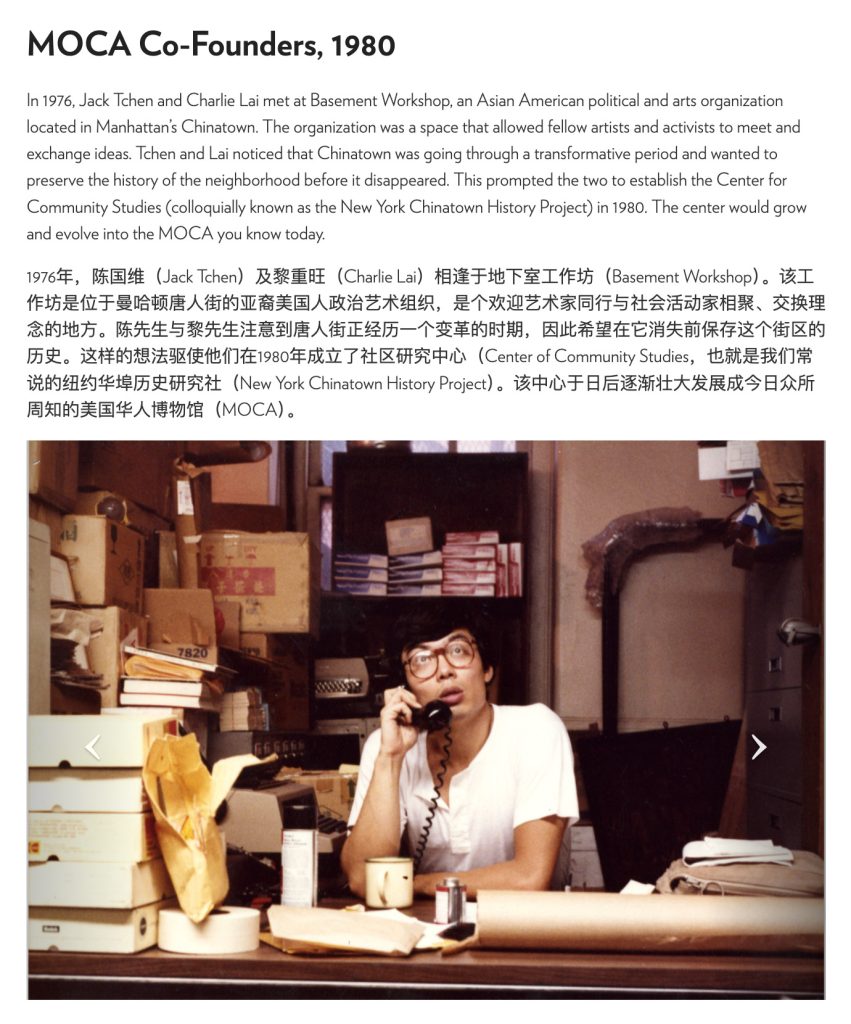
Screenshot from the MOCA web page about Jack Tchen and Charlie Lai. Jack sits at his desk, surrounded by Chinatown artifacts.
+ How long have you been working in / around Chinatown?
How did you come to be connected to Chinatown?
I’ve been working around and connected to New York Chinatown since 1975. I was born in 1951, a Midwesterner at heart. That’s both an advantage and a disadvantage in the New York context – because no New York Chinatown person will ever accept me as a hardcore Chinatown person, but it also gives me a perspective that’s been helpful.
I’ve lived in Brooklyn this whole time. In terms of working in Chinatown, it really started through Basement Workshop and just kind of volunteering. Basement Workshop was largely a volunteer organization and the project I first came to join was an oral history project. By the time I arrived in the late summer of 1975, the organization had gone through this massive political split. You can find that discussion that I talked about in great detail in the Archives Museum.
I thought I was going to be joining people doing oral history work in Chinatown, but they had all been part of the split and the materials were really gone. The collection of books remained there at this new loft at 199 Lafayette… So I just began volunteering and working there. But out of that, I began really thinking about how to form a project that would be documenting the dramatic changes going on in Chinatown as a consequence of the 1965 Immigration Act, which didn’t go into effect until 1968.
When I arrived in 1975, you were starting to get lots of new families and diversity in Chinatown laid on top of the “old timers” who had been here in New York for a long, long time.The old timers were a mix of people who were largely involved in the laundry and restaurant industries, which were the two legs of Chinatown during the exclusion period. They were also then able to support the creation of the merchants that emerged in Chinatown to both serve their needs, but also became part of the go-to Chinatown tourism. That became a way for Chinatown, Doyers, lower Mott Street, Pell Street. For that kind of formation of Chinatown to emerge and survive during really fierce anti-Asian and anti-Chinese violence and attitudes… Exclusion was happening, but to attract enough outsiders, from the streets of Chinatown, to survive as a tourist Chinatown.
+ How did you first get involved with Basement Workshop?
It was really just through Bridge Magazine that I was subscribing to in the Midwest and also through meeting some folks who were traveling around the country talking about Basement Workshop.
+ What were your impressions of Chinatown in the 1970s? What were your favorite places to go to?
I’ll just give some broad sketches. What I really noticed was that there was an absolute lack of understanding the interconnections between the new immigrants who were coming, and the old timers who were here. Because I had the advantage of studying some history and having a historical framing of some basic understanding, I could see why that happened. But also, I was just shocked at how little connecting there was going on. People I’d meet at the University of Wisconsin, who were from New York, were part of the new kind of 1965/1968 generation of immigrants. They had no understanding of what the prior old timers were about. One person who was just being very honest, said, “Oh, she just thought of them as dirty old men, you know.” So I wanted to know what that disconnection was and in many ways, it became a challenge of memory work of understanding how it wasn’t just textbook, abstract understandings of a group of people who had been there earlier, and new groups coming in. It’s because of these immigration laws.
But on the ground in the community, it’s about memory work, and about linking the understanding between new people coming in, especially the children, who were now hitting the age of being in not just college, but also in high schools, and what they were learning, what they were not learning, what stories they’re hearing and not hearing; and the older generations who were generally not wanting to talk about these stories, because they were always under the surveillance of the state and the enforcement of the exclusion laws. Even though things were changing at the time, and the attention was shifting, and the surveillance was not as heavy, the rationale for being closed mouth and not talking about these questions to their children was actually heavy. It was still there. In many ways, it was a chance for me to meet with the generations that were now trying to sort these questions out, as I was trying to sort it out. They were trying to sort it out in the spatial relations of New York City and the region, where thousands of Chinese laundries had been set up – as many as 10,000 at the turn of the last century, the 1900s. and as many as 10,000 Chinese laundries throughout the larger region. These were the children of the children or the grandchildren, or sometimes the direct descendants of laundry workers and restaurant workers themselves. It was still common when I arrived in New York to have lots of laundries throughout the region and it was those 1000s of laundry workers and the restaurant families, the chop suey restaurant families, that really constituted and drove the economy of Chinatown. But from the merchants’ point of view, they were the Chinatown. They had the stores in Chinatown. They were the ones who dealt with the customers. They formulated the commerce of Chinatown and the interface of Chinatown, and the image of Chinatown through their stores and the tchotchkes they sold and the storefronts and the neon signs and all that kind of stuff. They were the property owners… But in fact, the real economy of Chinatown was dependent on the thousands of laundry and restaurant workers who came into Chinatown on Saturdays and Sundays.
They came when they could get some time off, but the economy was really being driven by that base of the Chinese community. From a touristic point of view, I think the merchants thought of themselves as being at the center of Chinatown. I think they really knew, if they understood the relationships and the history that they lived through, that they were simply living because of the foundation from the money spent from the laundry workers and the restaurant workers. That’s really the foundation of Chinatown. That was the first fundamental insight I had, because I happened to be looking at the history of laundries.
Charlie Lai and I decided that the first grant that we would work on was to apply for a grant to work on the history of Chinese laundry workers, not looking at the Chinese merchant families, not looking at recent immigrants, but really trying to get at the foundational stories that really depended on laundry workers. That wasn’t necessarily a popular choice, but I think it became a choice from a more grassroots history, about who constituted the great majority of people and the people who really created the material basis for the merchants to begin with. It wasn’t necessarily popular, because I think the merchants really felt that they were Chinatown and to them, their history should be the first stories that were told.
+ What were some of your favorite restaurants to eat at in the 1970s?
The first place was by Basement Workshop, across the street. There was a family who opened up a simple place that would’ve been considered a classical Cantonese just serving the community. That was one of my favorite places. We got to know the family really well and developed nice relationships; we got invited to one of the new baby’s red egg party.
+ Through your work with Chinatown History Project, what Chinatown buildings are you most connected to?
The building I know the best is 70 Mulberry and 44 East Broadway, our first office.
I was visiting more of the formation of Chinatown before it became Chinatown, so for me the intimacy is with visiting the stories of lower Mott Street, Pell and Doyers.
+ What do you remember about the building?
The school closed probably around the early 1970s. We moved in there in the early-to-mid-1980s, during the Governor Abraham Beame administration, who began to give long term leases to these city buildings to community organizations. It was really the CCBA who got the lease, and a political process of the CCBA deciding which organizations they would allow to be in that building.
It was M.B. Lee, who was a more liberal, open member of the CCBA, who had a daughter, Regina Lee, who was part of Basement Workshop and the different kind of political groups that were circulating around at the time in the 1970s, that made it possible for us to get access to that building.The very first public schools that happened in the city happened in Chatham Square. For me, it’s really the formation of these multiracial, multi-immigrant immigrants that came on top of settler colonialism, on top of enslaved blacks and indigenous people who moved out, that began to form the origins of the city itself. The idea that somehow Chinatown is segregated and that the Jewish side is segregated, and that there’s a separate Little Italy – those are all retrospective constructions that happened in a time in which New York was seen as a cosmopolitan place that has all these different immigrant groups that want to just stay amongst themselves and not be part of the larger New York City narrative. That was never true. That’s a construction that New York City has towed itself. The deeper history is really of the port culture and places like P.S. 1 and P.S. 70, that’s where the real history of the city came out so Chatham Square and the docks nearby were really where the history was.
We just moved into it because it was possible to get in. It became a much less expensive space with more space than we had before. We began just converting classrooms into various kinds of specialized spaces: Administrative space, a library space, a collection space, a gallery space, that kind of thing. But as we were there, people would come up and tell us stories about having gone to school there.
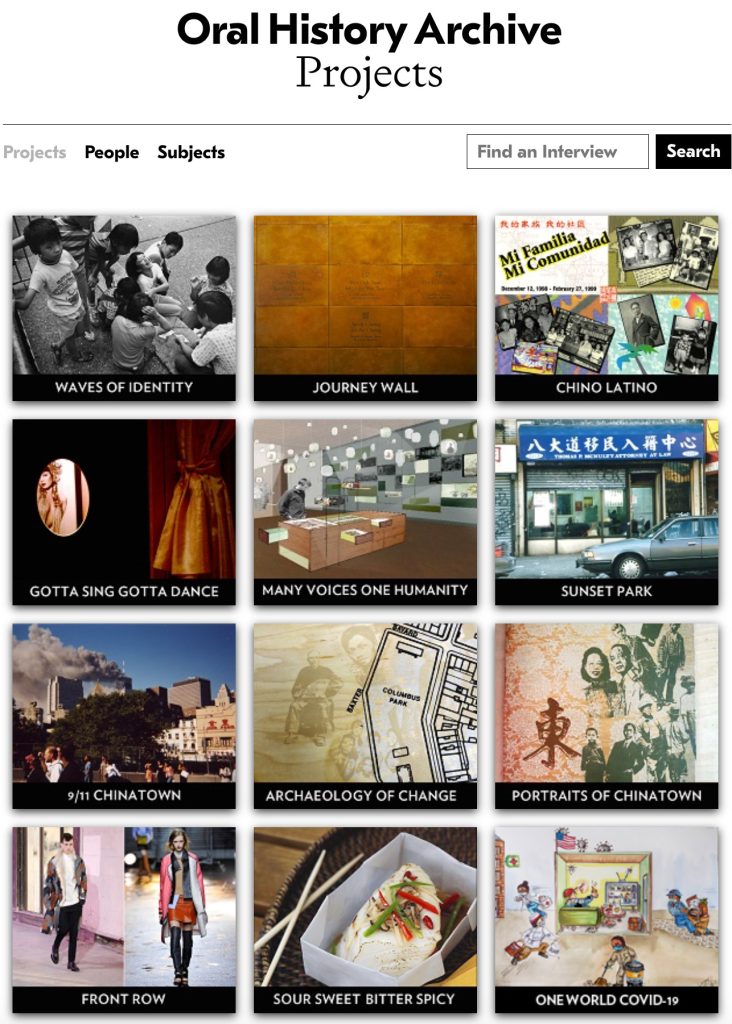
Some of the stories from the Oral History Archive — interviews conducted during the New York Chinatown History Project’s first year — are archived on the MOCA website.
One of the first larger public programs that we did was tell the story of the building itself. We had a reunion of people who had gone to the school and had been coming in saying, “Oh, I used to go there.” This is the story of Italians and Chinese at a point in which there’s a transition in terms of going from a mainly Italian neighborhood of Mulberry Bend and the Italian funeral parlors to increasingly more Chinese moving in. That was happening in the 1960s. This public program was a kind of extended exhibition or reunion. We suddenly had hundreds and hundreds of people who had gone to that school, wanting to become part of going back to the school, and having them in the auditorium that was still there and becoming a part of a chance to tell and share stories. It was one of the few events that Italians and Chinese had a chance to come back to and talk about the memories that they had. This is memory work. So really, what the New York Chinatown History Project was about was memory work and really on the ground with people who had lived the stories and lived the history, but didn’t necessarily have a chance to study it, but had a chance to be always sharing it when they’re in the streets. We began to discover that people who really lived only blocks from each other, but had not seen each other since they were in public school together. We were starting to reconstruct their stories and reconstruct their memories in the context of the union itself.
Being in the physical building itself became a great way for people to reconstruct those stories. They would talk about all sorts of things and those tapes are available in that collection (hopefully it survived). I’m not sure what’s left of the collection and what made it through, because of the fire and fire hoses.
+ Tell me about your work with the Chinatown History Project and the community you found there, and then its evolution into the Museum of the Chinese in the Americas (MOCA).
We started in a rented office at 44 East Broadway and then were able to, with political maneuvering, move into 70 Mulberry. I would say, it was really the exploration of a bunch of stores that were disappearing on Chatham Square that became my first real deep dive into old Chinatown and the Bowery. Bowery goes right into Chatham Square and a lot of those stores had 99-year leases that were expiring. Lots of dumpsters started appearing. The Chinese businesses that were moving in to replace the old businesses that were there – was our chance to get into some of these stores that were not Chinese. That’s why I’m really talking about Pre-Chinatown, which is the intimacy I gained. They were gutting these stores, throwing away things that had been there for a hundred years. It was a historian dumpster dive. The dumpster is where I got to know the old Chinatown and the pre-Chinatown. Pre-Chinatown for me is as important as the emergence of Chinatown.
Then before we knew it, after dumpster diving, we started building a collection of things appearing on the curbside. I spent a lot of time writing proposals and organizing the space. While I was walking around, stuff started appearing. The actual remnants of what I would call the “port culture” of which Chinatown was a part of, started appearing. The port culture in Pre-Chinatown is really, to me, the authentic historical context in which Chinese began arriving in New York. It was labeled as a Chinatown later on, when the anti-Asian exclusion laws and tourism began to emerge.
The early Chinatown that settled around Chatham Square was beginning to service the Chinese living in that area and then as the exclusion laws got more intense, and the anti-Chinese feelings got more intense in the 1870s, they started aggregating around lower Mott, Pell and Doyers. That set of businesses that began to emerge began to figure out ways to make more money. Merchants did this by appealing to the people living in the neighborhood and selling tchotchkes.
+ When you talk about early Chinatown around Chatham Square, what years was this – mid-1850s?
It was a gradual process that began from the loose groupings of Chinese sailors, travelers and entertainers coming out of the Opium Wars in the 1830s,1840s who started aggregating around lower Manhattan. By the 1870s, 1880s they started to concentrate more in the Chatham Square area and lower Mott Street, Pell and Doyers Street.
The Chinese quarter really emerged as a way to blend into a historic neighborhood of the port culture area (Lower East Side / Five Points / Downtown) before it became taken over by major municipal buildings. It was really lots of smaller buildings, survivor buildings that emerged around the port culture where the ships were docking. Many people were getting on ships, many people were jumping ship. It became an intermingling, very complicated area that was really where New York emerged from.
+ Can you share any information about the building’s history, or its past lives?
At the beginning of the 1900s, it became a school.
The lived memory only extended so far, and then that’s where a researched memory of the building, a history of the building, kicks in. Usually the way history works is that’s more what the historians who are trained and credentialed will write about. Their work is considered reliable, and they’ve gone through certain archives and that kind of thing. People’s memories and people’s stories are generally dismissed as somehow unreliable and not important. What became clear to us is that all those stories, both in terms of the official archives and what traditional historians have acknowledged has been part of history, which includes the architectural history, needs to be constantly played against by the stories of the people who actually used and lived and occupied those spaces.
That really became kind of a baseline value of what we were trying to do at the history project. It was never about the fetish of the space itself. Of course, that was important, because people lived through that and moved through that, created meanings and spent a lot of their lives in those spaces, but it’s more about the stories that are not part of the archive, that are silenced and not considered important. In that building, with all the people who went through that and the stories that they had, there were so many important stories that were never fully documented. We just began touching it. For me, it became an example of the port culture, of an intermingling that happened in the public schools when you had enough people who had a critical mass of families that began to emerge. These were not just families who were only Jewish or only Chinese, or only this or that. The very first Black community emerged in this area. Some of the early census materials that you see in the New York before Chinatown book is really the intermixture of peoples who were Irish women together with Black men and had families. The same with Irish women who had families with Chinese men. This is really the true story before there was a Chinatown. This is the real story of New York, and it still is the story of New York – those meanings, memories and little bits of artifacts that we found that really tell the story of that community, as opposed to a purely Chinese community.
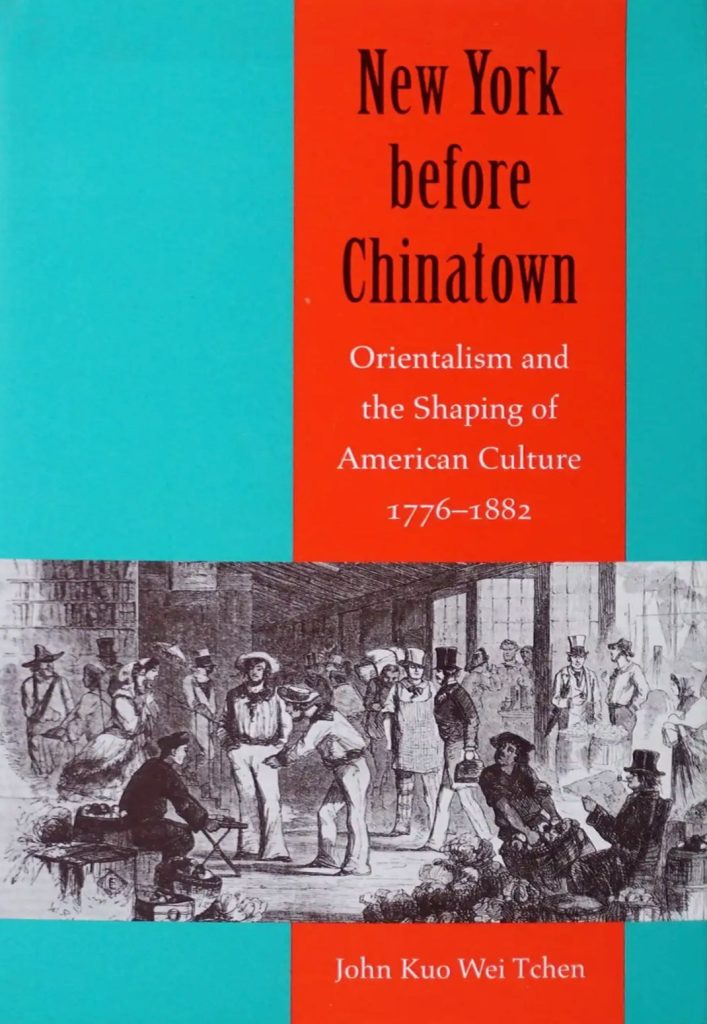
The cover of Jack Tchen’s book — New York before Chinatown.
+ What are your fondest memories of this building?
It’s hard to decide which one was the favorite, because it was just that time of life. Every day there were things that we were finding and people we were meeting and talking to, so that the little staff we had would be going out and then coming back. Every time people came back, there would be new things that people would be discovering. So it was really just the energy of the time. It was a remarkable time, and we just happened to be there at the time in which all that stuff was being tossed out and the old Chinatown, the old Chatham Square was transforming. All the buildings around were transforming, and all the new immigrants were coming in, and therefore all that old stuff was just being thrown out on the streets. That was both this feeling of constant loss, because we’d never be able to collect enough. We only caught a little tiny fraction of what had still been there. There was that sense of loss and disconnection and people disappearing, although a lot of the photographs that we did collect were from people who probably had nobody to remember them anymore. They were fragmented from their families back in China, and they probably didn’t necessarily have someone to really watch out for them and to send their bones back to China. A lot of people just never made it back.
I think there’s that sense of loss, but also that sense of anything we could find and begin to tell the stories of, we would just collect. It was just a massive gathering effort, really. Every day for years and years, was that effort, and I think that spirit was the one that I think, if you talk to any people who really worked at the New York Chinatown History Project or the Chinatown History Museum, or the different iterations, that that act of just collecting and meeting people and trying to document their stories has been the most powerful memory that most people would have.
+ Do you have any old photos of yourself collecting or with any artifacts?
We didn’t take pictures. Honestly, we didn’t see ourselves at the center of that story, so we didn’t spend a lot of time doing that kind of work. We were mainly just going out and documenting other people. You’ll find that stuff in the collection, whatever survived. But I didn’t collect any of that myself. [If it’s there] it’s not going to be within the Chinatown framing, because a lot of the work that I was more directly involved in was around documenting laundries that were scattered throughout the region.
We were asked by the Chin family (there’s been coverage of this story – there’s a Smithsonian article that gets at the story of the Chin family, that Mr. Chin was killed in the South Bronx); the family was closing down the laundry, so we went to help the family pack up the laundry. Anything that we wanted to take, we could take, and the daughters of the Chin family were part of that whole story. It was really traumatic. That’s why the story is as much about loss and disconnection and the passing away, and archives and collecting is really about the passing away as much as anything else, right? From this case, it was very traumatic, because the father had been killed, and the family was closing down the laundry, which had been their lifeboat of surviving. In some ways, I think the most important memory I have is really that family entrusting us to go and pack up their lives after this tragedy. We, in effect, helped them make that transition. I think those are the most powerful examples of different people who left the building they’d been in for decades, and where all those memories were connected to, and all their family photographs were in front of, and all that stuff to transition into their lives. That would happen more and more. Sometimes it’d be an organization where we got called in. There was a space that had been a band that the opera company had left, and then we were invited to just take anything that was left in the opera. Other times we’d be coming upon a Chinese laundry, and then the new construction people would be taking down the laundry sign to get rid of that stuff, so we’d be catching it just in time. That was the constant story that would be repeated every day in some way or other.
+ What are your feelings about what Chinatown has faced since the pandemic started?
The pandemic is just one more moment comparable to 9/11 in which Chinatown and the role it’s played has changed, and that the role of a museum and cultural organizations need to step up. Chinatown and the role it has been playing historically has shifted because of the way residential patterns of where people can live, and the possibilities of entering into the mainstream economy have expanded. Not to say that racism and anti-Chinese feelings have necessarily diminished, but they haven’t been targeted in the same way that they used to be targeted.
I live in Brooklyn, and just a couple avenues away from me is Sunset Park, which I’ve seen emerge out of a Finnish and Scandinavian community that had been there and declined, and then the new Chinese community emerged here. People who could only live in the Chinatown area now can actually move out here and then move out further. I’ve seen the kind of expansion of where Chinese can live, and that’s opened up in a dramatic way. I would say anti-Black racism has continued, and ambiguous feelings about Hispanic peoples have remained ambiguous. So Chinese and Asians are now able to move into neighborhoods that people don’t want these other people to move into… Some more complex racial dynamics. We become complicit in that process in ways that people don’t even realize about the roles that we’re playing. For me, I’m just seeing the sweep of what’s happening. My optic is really both historical New York before Chinatown, the formation of Chinatown, then New York after Chinatown. That’s the kind of sweep of attention that I have.
Mr. Lum, the lone laundry guy and [one of] his daughters, Mary Lum. Mary Lum is one person I’ve known well over the decades. She was part of Basement Workshop and did a lot of stuff in Chinatown, but the lone laundry guy ended up being a realtor as the Scandinavian folks were leaving Eighth Avenue, and he began attracting people from Chinatown to start a business there. Those are the changes that I’ve seen that are not just focused on Chinatown. I really don’t want to be too sentimental about any one favorite store, because from a historical perspective, those are changes that can oftentimes be used as a way to say this is our part of the city, and nobody else should come in. I actually don’t believe that. I think cities are very dynamic places. To me, it’s really more the Justice questions. They’re actually more important than whether that store remains or not. Of course, as a historian, I will research that store and actually get attached to the stories that I’ve uncovered. But I think it also can be a real problem to want to defend. I think we have to be acknowledged, and the stories that are all part of New York City, and how Chinese stories and Asian stories have been so misused and abused.
I think it’s important to defend Chinatown from gentrification. I think that’s the biggest problem that we have now, is really how the whole city is becoming a place to make money, to have bigger and bigger companies extract history as a way to make money. That whole way in which history now is becoming part of the marketing of buildings that realtors will engage in, I think that’s horrific and obscene, and basically the biggest problem that we all face in Manhattan. It’s also happening throughout the city. That kind of commodification and financialization of everyday life is the biggest threat that we all face, more than whether it’s one group or another coming into our neighborhood where they “don’t belong”. I think that that story is one that is wrong.
Interview
WITH TOMIE ARAI (ARTIST AND CHINATOWN ACTIVIST)
Interview conducted in May 2022.
All images included in this interview are courtesy of Tomie Arai, unless otherwise noted.
+ Please give me a brief introduction of yourself – How long have you been working in Chinatown? How did you come to be connected to Chinatown?
I was born and raised in New York in the Upper West Side, in post-World War II New York. When I was growing up, there were very few Asians in the city. I’m Japanese-American, and there were only a handful of people my age. I saw Chinatown as the only geographic community of Asians that I was familiar with. Before the 1960s, it was still a bachelor’s society, before the new influx of immigrants. I think that, as a result of the immigration in the 1960s, there were, in the 1970s, a lot of people my age who decided to think more deeply about identity.
When I was in my 20s, I heard about this group of Asian American writers and artists who were coming together to put together an anthology of Asian American art — it was based on this group of folk musicians called Yellow Pearl… and so I went down to Chinatown and met this group of young artists and musicians. It was really the first time that I was in a group of Asians, growing up in the city. I used to be the only Asian in the class, a familiar story for people of my generation. It was the beginning of my path to becoming an artist. I met my husband (Legan Wong) in 1972 in Basement Workshop. When I met him, he was teaching the first Asian American experience course at Hunter College, before Ethnic Studies was taught at college. They wouldn’t allow him to call it an Asian American History course. Faye Chiang, the director of Basement Workshop, allowed him to teach the course. He got me interested in history; his parents owned a laundry in Crown Heights and his mother worked in a garment factory in Chinatown and later in Long Island City.
When I became the first artist-in-residence at MOCA (Museum of the Chinese in the Americas) in 1988, I read a lot of the stories in the archives. It was an offshoot of Basement [Workshop]— [originally called] the Chinatown History Project. At that time, I did a silkscreen print project based on oral histories of Asian women living in NYC. In 2006, I co-initiated a project called Archaeology Change, looking at changes in the community. We interviewed the landlord of the building that it’s currently in, Larry Goodman, who talked about the fascinating history of the neighborhood that changed. We interviewed the owners of Pearl River Mart, grocery owners across the street, people who were being displaced by MOCA, etc…
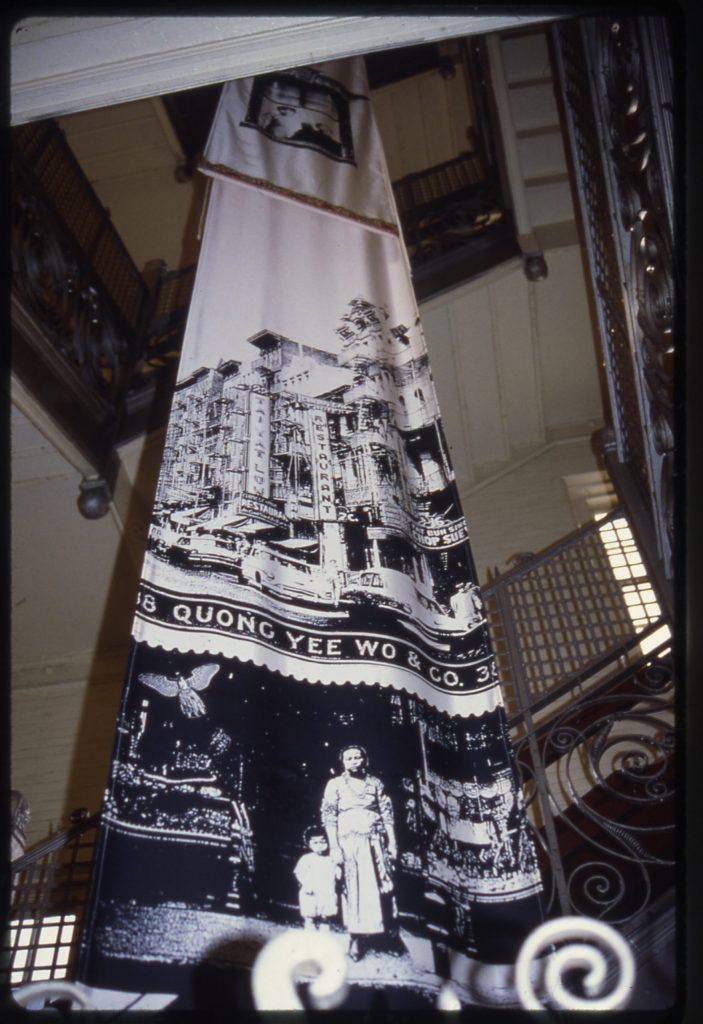
“Memories of NY Chinatown” banners, installed in the 70 Mulberry Street stairwell in 1988 by Tomie Arai.
Basement was more than an arts program. It had four programs:
- Bridge Magazine (a publication of Eleanor Yung’s brother, Danny Yung) that had a 10-year history and was published bi-yearly.
- AmerAsia Creative Arts
- A youth / daycare program
- Chinatown History Project – which began with interviewing tenants living in Chinatown… Jack [Tchen] & Charlie [Lai] began then to seriously collect artifacts, to salvage the things that were being discarded. This was the beginning of MOCA.
Basement was made up of young people and right out of college, you had like-minded people there. Back in the 1970s, you had alternative spaces: artist-run spaces which allowed artists to come together, which then became the stepping stones to galleries. I always felt that Basement was unique; it wasn’t defined in any way.
+ Tell me about your work with Godzilla and the community you found there.
Godzilla didn’t come about until 20 years later. Most people in Godzilla already had careers at that point. It wasn’t until Godzilla that a lot of curators and artists got more attention. People weren’t in Godzilla to boost their careers; they were just there to talk about the art world being exclusive to people of color. That was part of the conversation going on in the 1990s. It wasn’t until years later when Ken Chen proposed that Godzilla had come full circle and that we should think about disbanding. A group of younger artists wanted to take the reins. We were already being threatened by Toho – the people who owned the copyright of Godzilla – who wanted to take it to court. The next iteration had to have a different name, which became Godzooki.
Godzilla wasn’t rooted in a physical space; it was nomadic. We met at different galleries and at peoples’ houses. Ken Chen was the de facto leader and meetings were initially at his house. There was a lunch group that met in Chinatown. Then we started meeting at galleries like Exit Art, Artists Space, Art in General. At one point, we had a couple hundred people. For a while, we had monthly meetings and we had to set up a phone tree (before the internet) to call people. I remember even sending postcards out; it was ridiculous. I was in charge of mailing lists. We also had a newsletter with shows listed. That’s how we got the news out.
One of the Godzilla shows, curated by Lydia Yee, was called “Sights of Chinatown.” She had all of the artists do shows in the different stores. Leader of the Luncheon Club, Ikjoon Kang, decided to take a table from a restaurant – I don’t know how he got it – and put all of the names of the artists in Godzilla on it and laminated it. He also came up with a zine of all the cheapest eats, the restaurants they had eaten at. Back in the day you could get lunch for $3.
+ What was one of your favorite dishes in Chinatown?
Sam Bo Fan (Three Treasures Rice) was one of my faves then. It was one of my favorites then and I can’t find it anymore.
My husband and I had our wedding banquet at Port Arthur [Restaurant at 7-9 Mott]. One of their specialties was roast chicken stuffed with sticky rice. I still think about that. I think it closed like a week after.
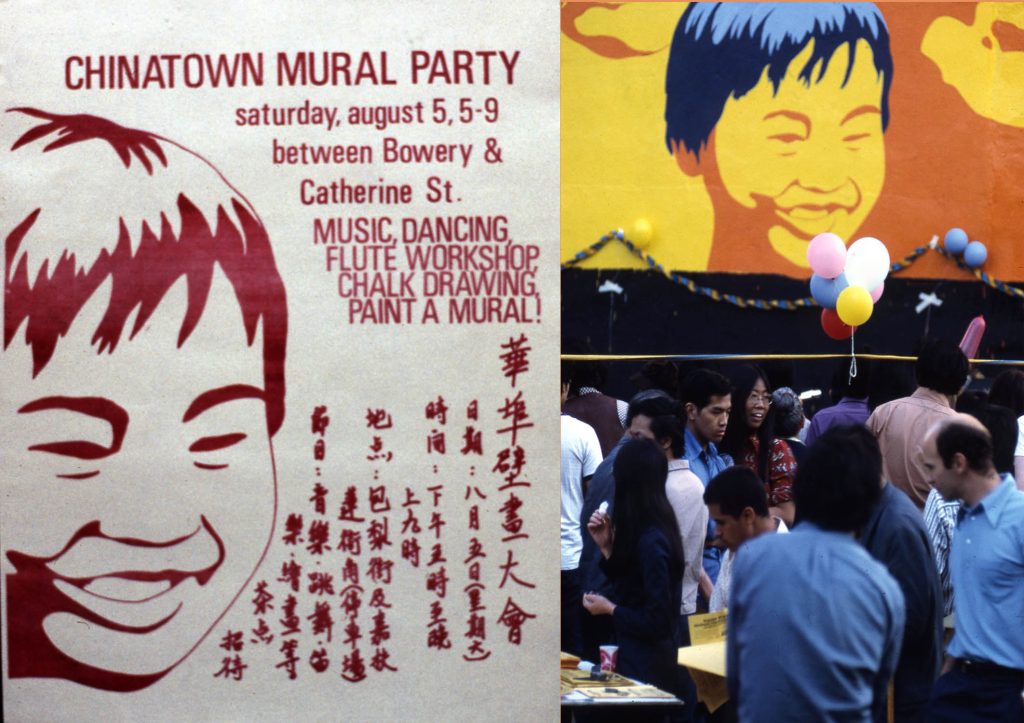
The mural, “History of Chinese Immigration to the US ” in Chatham Square, 1972 (Project Director: Alan Okada) and the leaflet advertising the block party held in Chatham Square.
+ What was your impression of Chinatown at the time, back in the 1970s?
There are old-timers like Henry Chang (Chinatown’s resident writer), Wing Lee (related to Sandy Lee), Jan Lee’s brother, Corky Lee and Victor Lee who all hung out together as teenagers and talked about Chinatown being like a village and a small town: everyone knew each other and grew up together… and it was, in many respects, much smaller in scale. I remember that it felt like we were building something new when we came down. Formerly, I felt like there weren’t a lot of platforms for young people to have a voice. It’s not surprising that a lot of people who were members of Basement went on to become leaders in the community, running senior centers and community centers, becoming teachers and principals, founding health clinics and becoming leaders in Chinatown.
My husband was involved in the Census. He was sent to these buildings to knock on doors. He had to go into alleys and it was eye-opening to see some of these living conditions. He didn’t know all of these places existed. I think that was the beginning of him really wanting to learn more about history. He participated in the Chinatown Health Fair.
In the 1970s, there were a lot of different Chinatown events that galvanized younger people my age, in their 20s, to really think about how they could help the community and how they could become involved. There was so much political rhetoric in the 1970s and there was all of this discussion about theory and practice and bringing together activism and community. There were all of these storefronts, where people would get mobilized out of, brick and mortar spaces where people would come and learn about the organization…
+ Tell me about the murals you worked on in Chinatown with Basement Workshop and City Arts.
I was introduced to murals through Basement. My first project was walking down the street and there were some people painting a mural on Pike Street – Project Reach, a youth program working with teens in gangs – and they even put my portrait in the mural. They were able to partner with an organization called City Arts Workshop. The first mural they did was in the Smith Houses on Catherine. They proposed Basement to do a mural in Chatham Square.
“The History of Chinese Immigration to the U.S.” was the title of the mural. It was directed by Alan Okada. I might have painted a day on the scaffolding. There were dozens of young people who helped paint it. It was a yellow mural with a scene from the Massacre of Rock Springs… It was painted where the Global Bank is now, in what used to be an old tenement. There was stationary scaffolding back in those days (without insurance!) five stories high, without protection. I can’t believe we took 14-year olds on those things.
I worked with City Arts for seven years. It was really designed to involve young people and people who were not artists in the creation of these public art murals. There was a process when we really tried to engage the community and get feedback. A lot of those murals really lasted for years because people were really invested in maintaining them.
“Wall of Respectful Women” was painted on East Broadway at the Garden Restaurant, where the Jewish radicals used to meet before it became Wu’s Wonton King.
I went on to do a mural with Alan on Madison and Pike (on the P.S. 3 playground / side of a pentecostal church) called “Chi Lai Rise Up, Arriba!” It was a mural about Asian American history in the shape of a tenement building opening up. At the time, people were protesting Confucius Plaza (1973-74). There were so many protests about discrimination on the construction site. There were daily pickets and I actually got arrested too. It was an important part of labor history in Chinatown.
At the corner of Hester and Bowery, at I.S. 131 — the old junior high school in Chinatown that was previously I.S. 165, we created a mural.
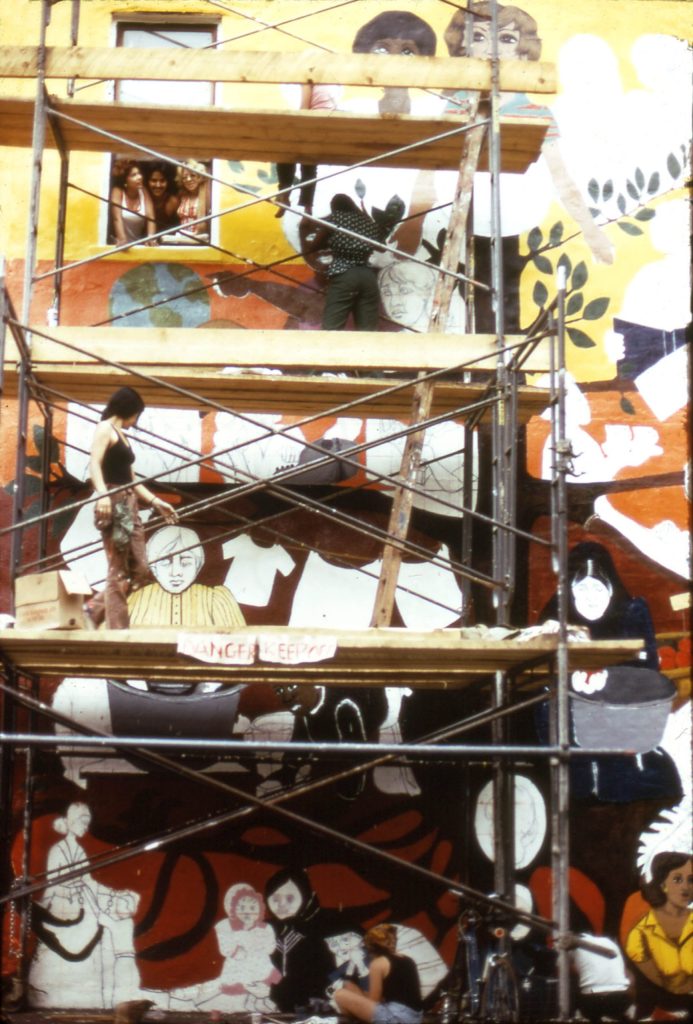
The mural, “History of Chinese Immigration to the US ” in Chatham Square, 1972 (Project Director: Alan Okada) and the leaflet advertising the block party held in Chatham Square.
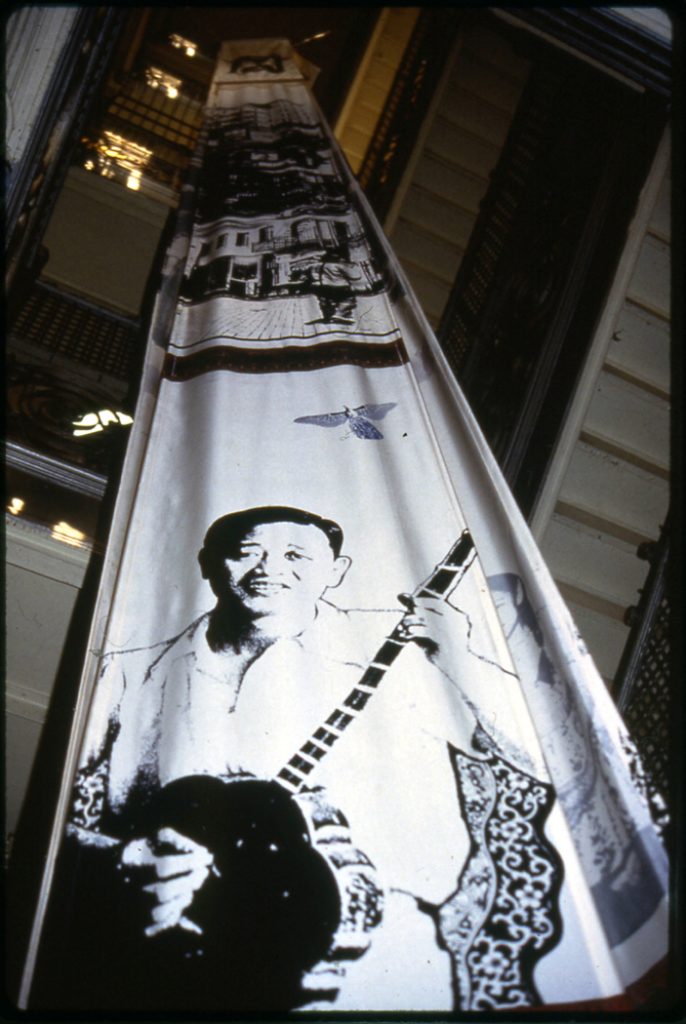
The other side of the “Memories of NY Chinatown” banners, installed at 70 Mulberry, 1988.
+ You’ve done so much work in Chinatown. What Chinatown building do you feel the most connected to?
I have the fondest memories of 70 Mulberry.
I have a 40-year relationship with MOCA. I remember how different the organizational culture of MOCA was at the time — they were on the second floor of this historic school building. When you walked into MOCA, there was one office and everyone was sitting there. They had stored all of the artifacts in a room to your left… There was this feeling that you were entering into the past; there were all of these signs they’d salvaged from restaurants and businesses and things people had donated that were up on the wall. There was a small gallery in the back that they invited different people to curate shows for.
When I was working at MOCA, you would hear the sound of the mahjong tiles at the senior center on the floor below.
The banners were created in conjunction with the permanent exhibition there that Billie Tsien designed in the shape of a lantern. Everything was very intimate. They shared a floor with the lion dances (Chen Dancers). In 1988-1989, I had received a grant from Creative Time to do some banners that would hang in the stairwell to read the history of the Chinese in New York City while going up the stairs. The images were silkscreened. There were three of them to symbolize the three periods of growth in Chinatown:
- Early settlement of Chinatown (with different stores, in the early 1800s – 1900s)
- At the point of the 1960s immigration, at the brink of it changing from a bachelors’ society
- Present day 1970s (included a class photo from the school, P.S. 23)
+ Tell me about Chinatown Art Brigade and how it forms part of your artistic practice.
It’s been so interesting to work with W.O.W. because it’s a younger generation of artists and people interested in creating work about the neighborhood. It’s really opened up my eyes to what possibilities there are that are different from the way I’ve worked in the past.
I love murals, but there are so many other ways you can imagine spaces and transform them. I think originally that’s what CAB wanted to do — to question how artists can work with communities and develop with communities to speak about some of the things that are hard to address and to make changes. I think as artists, we’re trying to make art and say things differently.
One of the hallmarks of the murals is the process — you can’t paint a big mural by yourself. CAB has learned from its mistakes as it neglected a lot of steps in the process. We’re always trying to learn from that. One of the things I appreciate so much about being in Chinatown is that I am always so aware that I am simultaneously an outsider and an insider. An insider through the years I’ve spent working here, but I am not privileged in a way to speak on behalf of the community. I need to be aware of my role in this complicated process, which is to listen, be open and never assume anything.
I love that Chinatown is something where you see things at scale. The city can be overwhelming and I come here and there are some things that are constant. Like seeing Karlin on the corner. Places that are still here. I appreciate them.
+ How have you seen Chinatown change over the past decades?
I feel like in many ways, I’m kind of an outlier. I see Chinatown through the eyes of someone who visits it, which isn’t the same as someone who lives here day-to-day. We did a mapping project with CAAAV (Committee Against Anti-Asian Violence) with the tenants and it was an interesting experience for me, because people who live here don’t see the changes… because they live with the changes. It seems to people visiting that things are changing overnight.
Now I feel like everything has changed. The store you wanted to go to is now a bar. I think that there was a hyper development happening here until the pandemic… and now you see so many abandoned storefronts. Things have emptied out in a way that contributes to this feeling of real precariousness. You can sense that the future of Chinatown is threatened.
+ What are your feelings about what Chinatown has faced since the pandemic started?
The pandemic has changed a lot of things. It’s made it that much harder to understand how to get past the impact. Jobs, housing… Thinking about where this community sits in terms of the plans the City has for recovery — it’s hard to wrap your head around.
The issue of safety is driving so much fear and fear of change. More calls for policing give the sense that this community isn’t safe. I think we really have to try to understand how these issues are connected.
It’s always been so important to me to live and work here in Chinatown because I feel like it’s a microcosm of the city. Chinatown is such a global place, and not just a local neighborhood. What happens here has an important impact on what happens elsewhere.
70 MULBERRY - HISTORIC IMAGES
Please visit these amazing resources to view historic images of P.S. 23 in the 1930s and beyond:
+ “The Heart of Chinatown,” 70 Mulberry Street on the NYC Municipal Archives’ website.
+ “The History of PS23 / 70 Mulberry” by architectural historian Kerri Culhane, who is also interviewed about the Chinatown buildings at 41 Mott, 60-62-64 Mott and 83 Mott.
+ Photographs of a preserved artifact: a drawer of female student records on the MOCA website from the late 1800s into the 1900s.