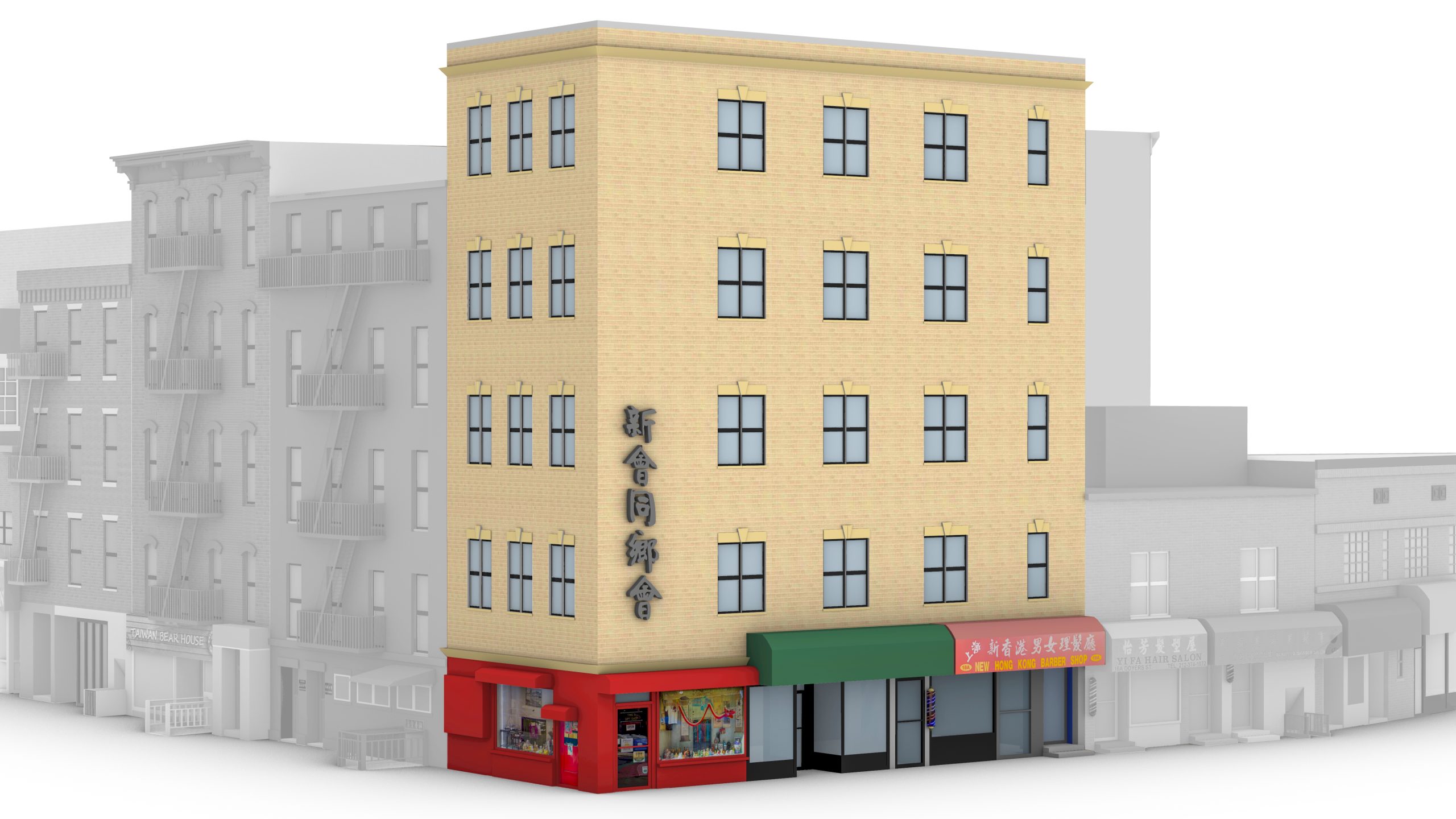
18 Doyers / 17 Pell
Former Ting's Gift Shop / Sun Wei Association / Mabu / New Hong Kong Barber Shop
Architect: Patrick Murray
Built in 1928
2024
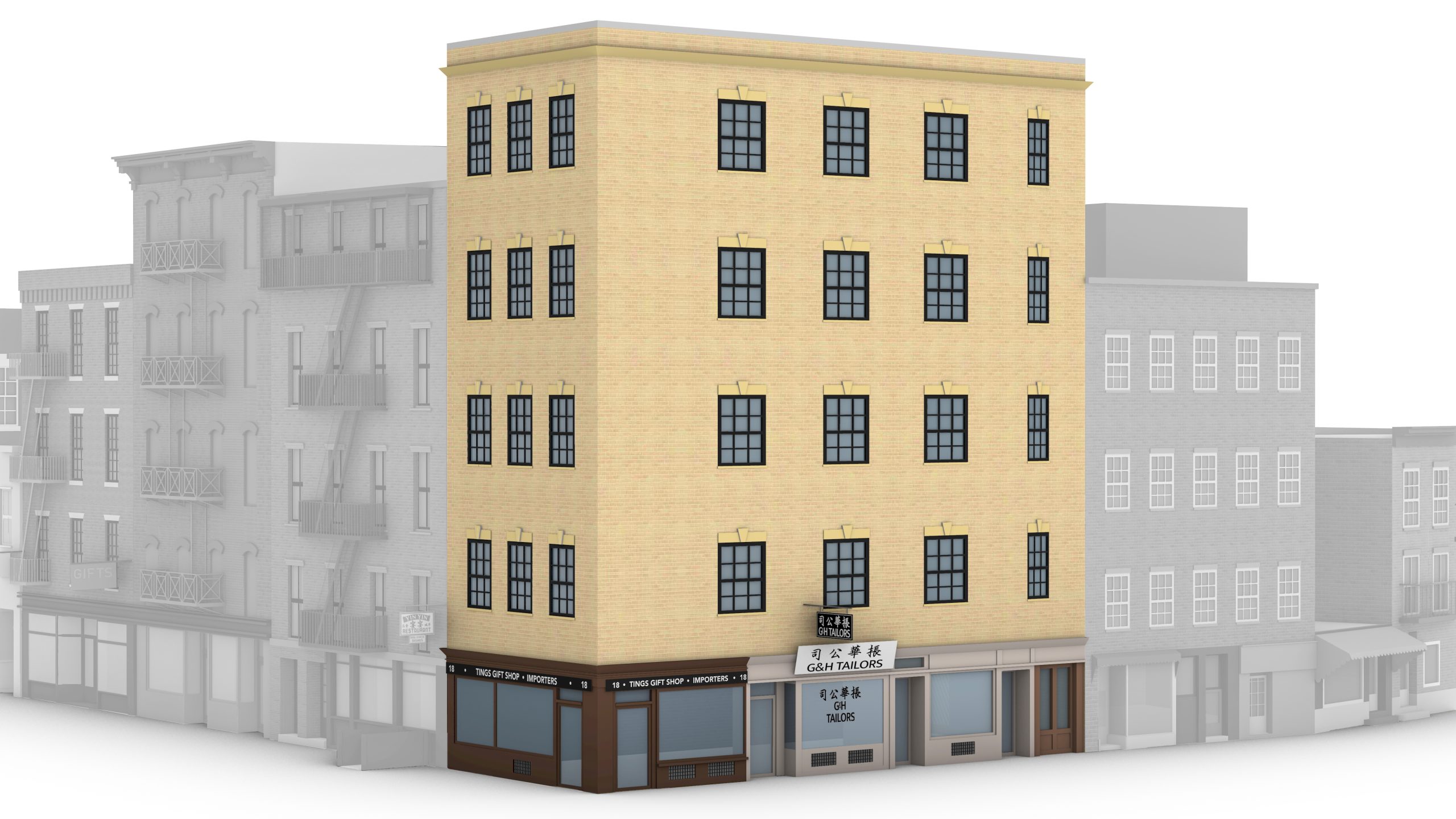
18 Doyers / 17 Pell
Ting's Gift Shop / G&H Tailors
Architect: Patrick Murray
Built in 1928
1950s
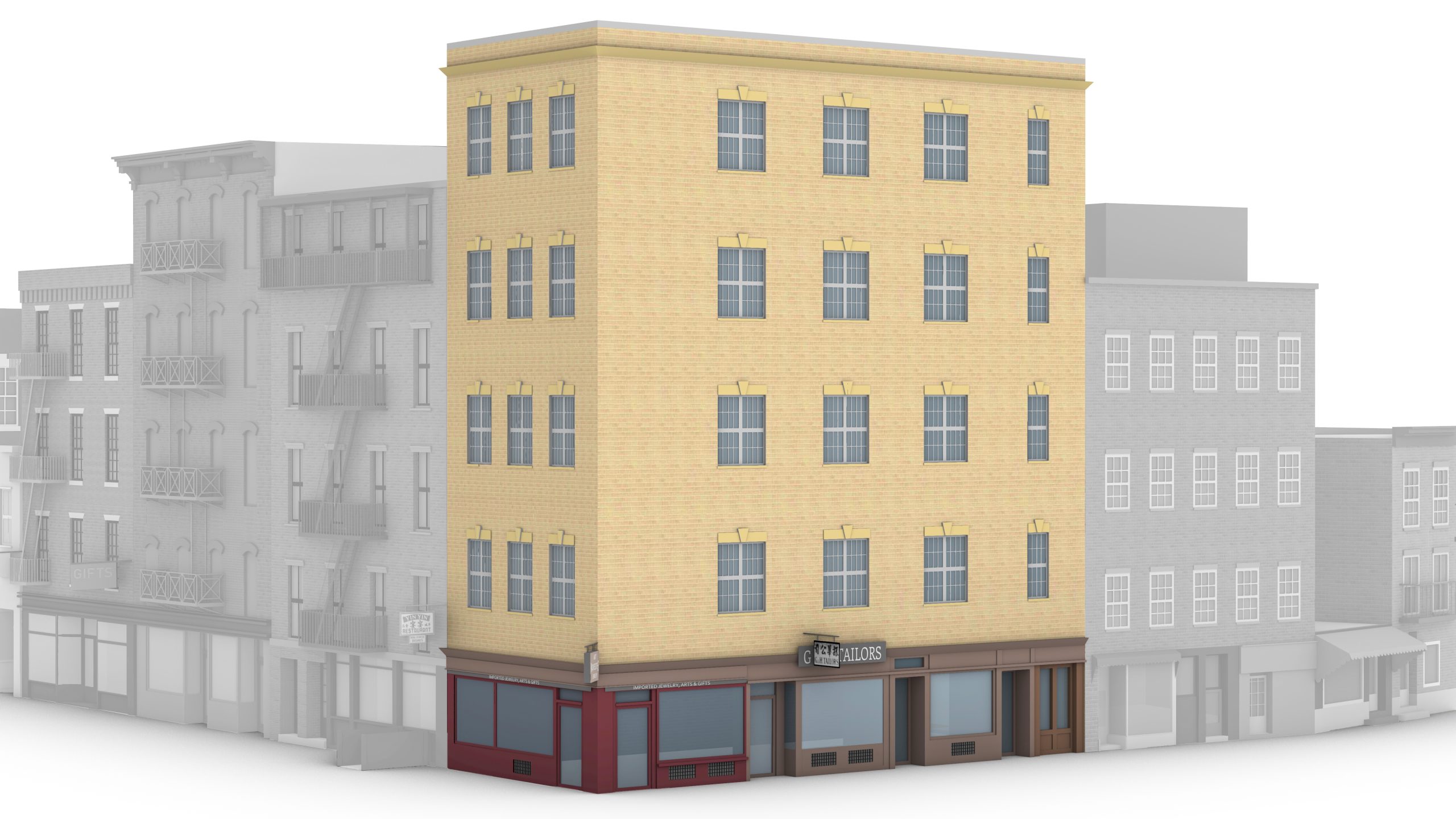
18 Doyers / 17 Pell
Unnamed art & novelty shop / G&H Tailors
Architect: Patrick Murray
Built in 1928
1940s
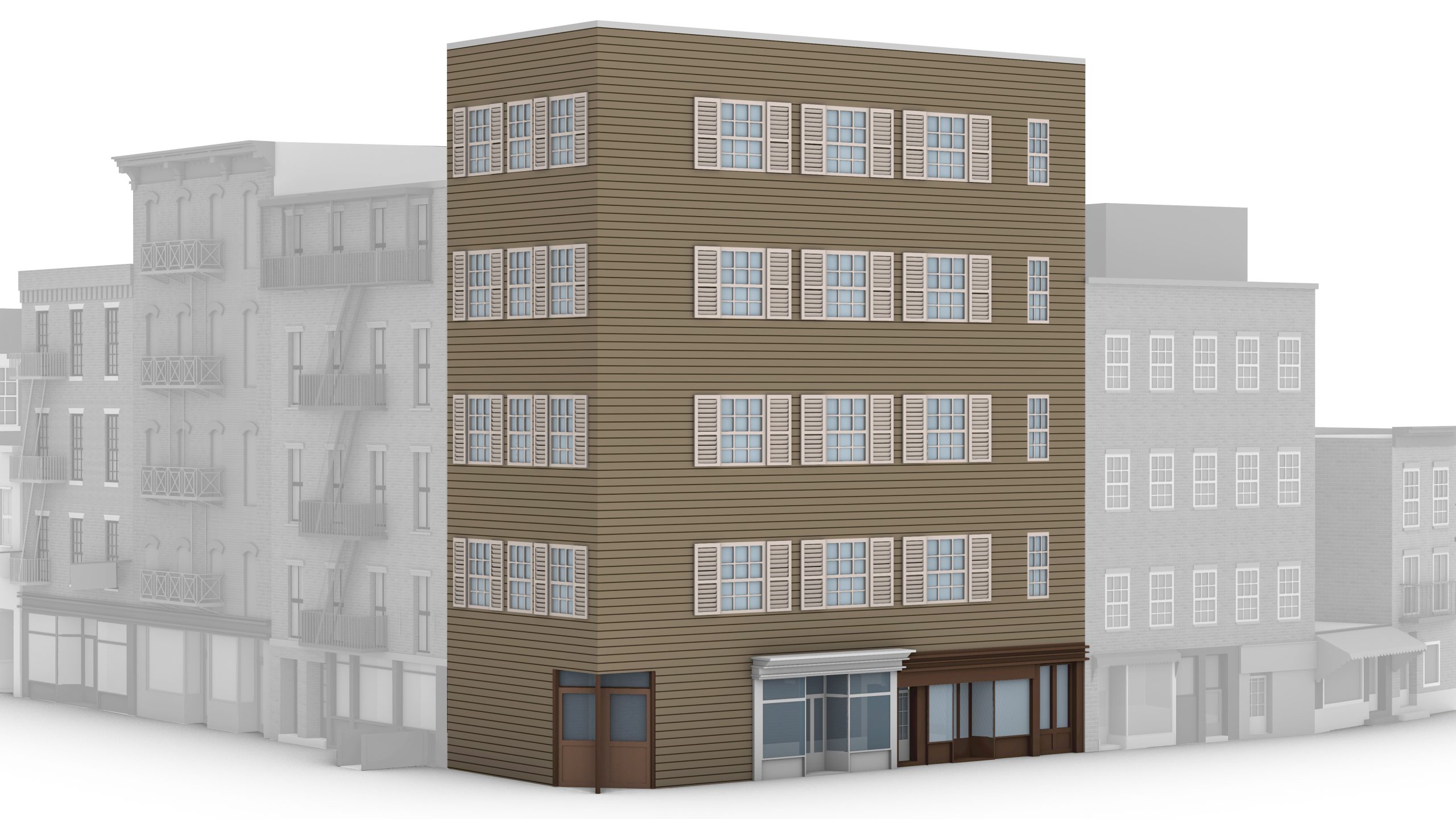
18 Doyers / 17 Pell
Architect: Patrick Murray
Built in 1928
1900s
Interview
WITH ELEANOR AND LILIAN TING (CHINATOWN RESIDENTS AND OWNERS OF TING'S GIFT SHOP)
Interview conducted in May 2022.
Ting’s Gift Shop closed its doors in the summer of 2024.
+ Would you give me a brief introduction of yourself? How long have you been working in / around Chinatown?
How did you come to be connected to Chinatown?
Lilian: We are the children of immigrants who came to New York.
Eleanor: Dad came in 1949; Mom came in 1958.
Lilian: Dad worked in a club called China Doll in midtown on 51st Street and Broadway— it was a club that only Asians worked in, but catered to white Americans. Dad was a busboy and he lived on Broome Street. My mom used to say that even the girls who worked at China Doll – they knew where my parents had a gift shop so they would come by and visit.
Eleanor: We grew up in Chinatown at Pell and Doyers. We grew up in the store. I started working at the store before the age of 3.
Lilian: I was there at the store since birth; my mom used to put a playpen in the backroom.
Eleanor: We had a door with a mirror. She [Lilian] would be in her stroller. And mom would park her right where the mirror was. And what does the child know? There’s another baby – she would be playing with that baby all day long.
Lilian: We have another sister who lives in Jersey. She left to go to school outside of New York City; she’s integrated into the American corporate world. She didn’t hang out at the store much. She was more academic and a bookworm.
+ What was it like growing up in Chinatown? Tell me about your daily routines.
Lilian: Growing up in Chinatown, we were insulated because we really didn’t need to leave Chinatown for any necessity. There was a little grocery store (American and Chinese), fish market, butchers, clothing… if we really needed clothing, we’d go to Macy’s. That was a big trip. Growing up, it was really us and the outside world — that’s what it felt like as a child. It wasn’t gentrified at the time in the late 1960s, early 1970s. By the mid-1970s you started seeing more mixed marriages.
Eleanor: Everything was more like a melting pot.
I started school in PS23 but then we went to St. Joseph’s at the corner of Monroe and Catherine, which is no longer there.
We lived a couple of blocks away from the store. We’d always walk to the store. We spent more time here at the store than anywhere else. My dad would open the store at 8AM and do the cleaning and window washing. He was always on top of things. My mom would come at 11AM and they would yum cha and then be back in the store around 12:30/1PM… and then it would be open until midnight. In the midst of that, my mother would go for afternoon tea with her girlfriends and they would close up the shop for a half hour or so.
We would go next door to Mee Sum (on Pell Street) and Mee Sum Mee on Mott Street – different places completely. The pharmacy on Mott Street between Pell & Bayard is where Mee Sum Mee is.
Lilian: We didn’t have extracurricular activities. We didn’t do things like that. Because back in the day, it wasn’t big to go swimming at the Y or to bring your child bike-riding. We did activities in school, and that was it. We were always there and it was a fun place to be. I remember, as a five-year old, a woman came in [to the store] with her husband. It was in the early evening, and she said, “Oh, I’m trying to find a gift for a child”. Instead of saying, “How old is the child?”
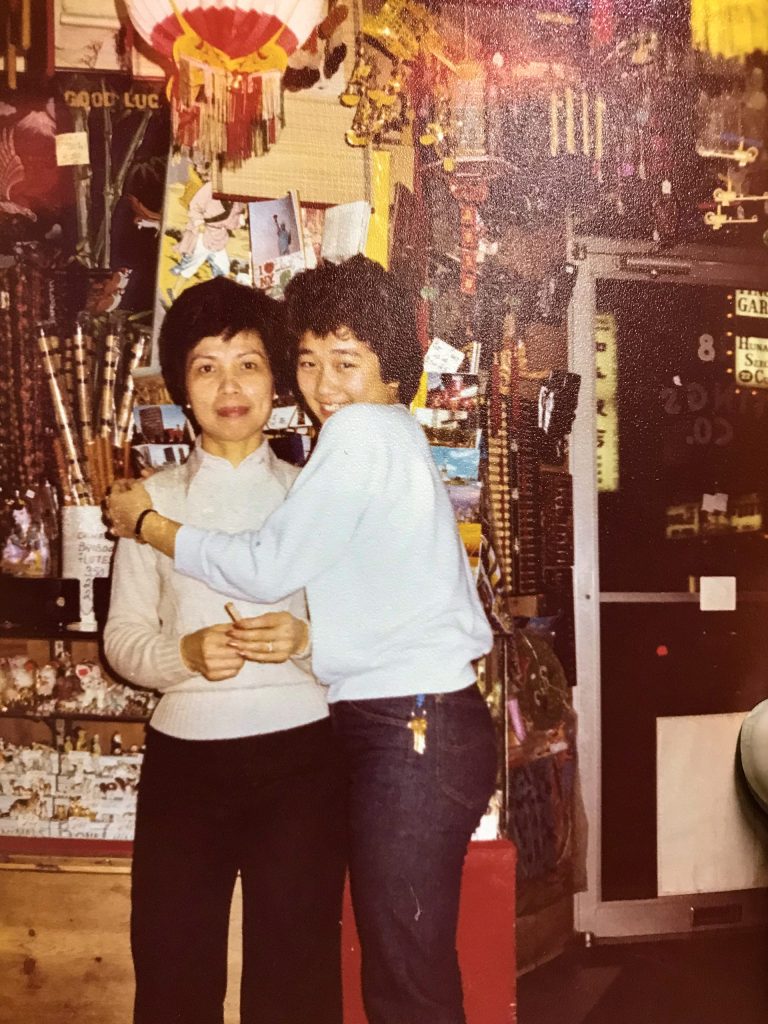
Tam Ting and Lilian Ting in the store, early 1980s.
Photograph courtesy of the Ting Family.
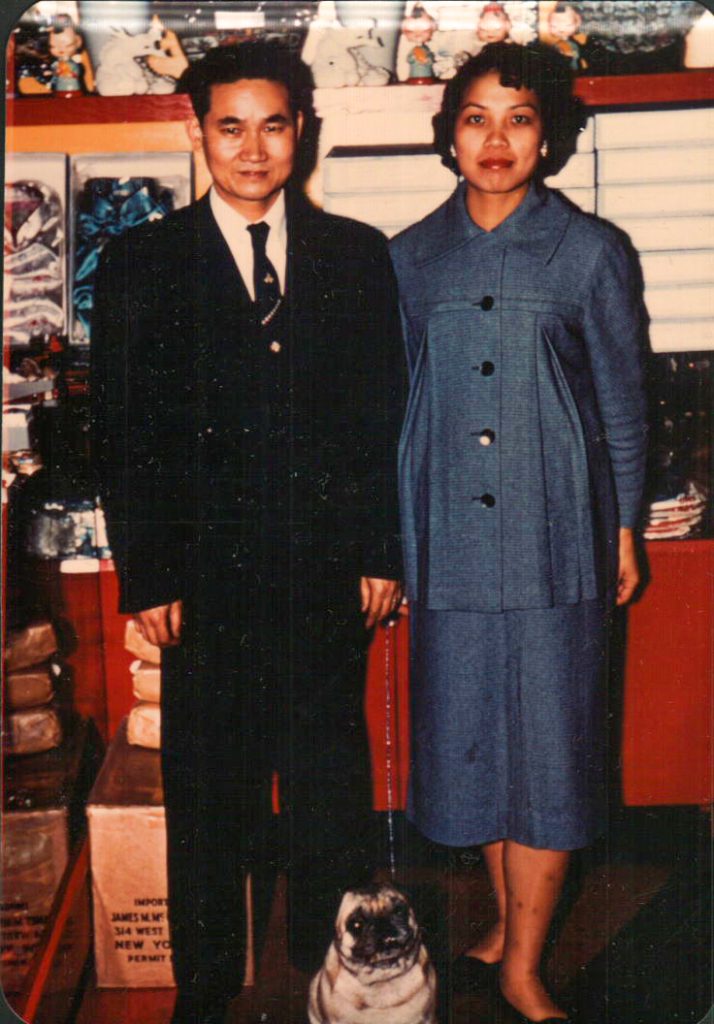
Yu Hong Ting, Tam Ting and family dog, Tommy, in the early days of the store’s establishment, early 1958. Photograph courtesy of the Ting Family.
Eleanor: We were always at the store. I would have people around the block, next door, checking in on me. If I was really good, my mother would give me a penny and I would go across the street to where Artbean is now (which used to be a pool hall) and I would get a handful of pistachios from the penny machine. I would stand there and stare at the door, willing it to open… I had no hands to open the door. You’d look up and you see this tiny thing by the door, willing to open. So they would come over and ask, “Would you like me to open a door for you?” I’m like, “Yes, please! I want to go home and eat my pistachios.” Someone would always take pity on me and open the door for me. I would thank them and then bounce down the stairs to go back to the store. So it was my red pistachios… it had to be red pistachios!
People knew you — you didn’t have to worry. The joke always was: You don’t need to say anything. You could wiggle your nose the wrong way and people would know. I mean, that’s how well they knew you. We all grew up in Chinatown. You weren’t scared. You didn’t know what scared meant. The only thing you’d be scared of were winos. We had a lot of bars on Bowery. So you would be a little nervous because they would sleep wherever they’d find the space. You’d have to literally climb over them to get to where you needed to go. It could be a little nerve wracking, but you didn’t know what scared was like. You weren’t worried that someone would be coming down the block knocking you down, grabbing your bag or breaking you or anything like that. You weren’t scared of that.
There were a couple of gentlemen who would come and sit and check up on me — they would come by the store to chat with me, see how I was doing, whether everything was OK. Mom and Dad might be walking somewhere and I’d be here, minding the store.
I wasn’t nervous. Now, I am.
+ How long has Ting’s been in this building? Tell me about your parents’ story of establishing this shop.
Lilian: My dad was here in the early 1950s. He was introduced to my mom who was in Hong Kong; he went back to meet her. They hit it off really well and the rest is history. They got married and my mom came and my dad had asked her what she would like to do when she came to America. And she told him she wanted to be a little partner in a gift shop. So my dad said, “OK, we could do that.” That’s what they did.
Prior to us taking over, our store used to also be a medicine shop, an herbalist—that’s why when you look, there are the little cubbies, shelves. They were actually drawers and my mom cut off some of the side paneling and left most of it.
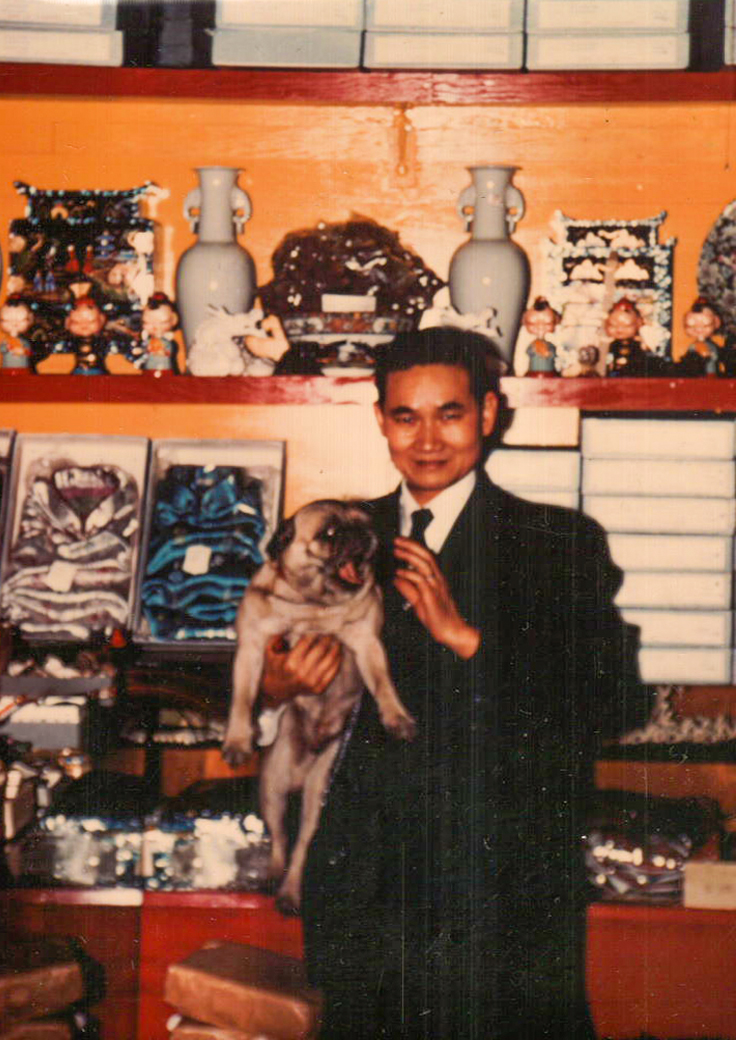
(Left) Yu Hong Ting and family dog, Tommy, in the early days of the store’s establishment, early 1958.
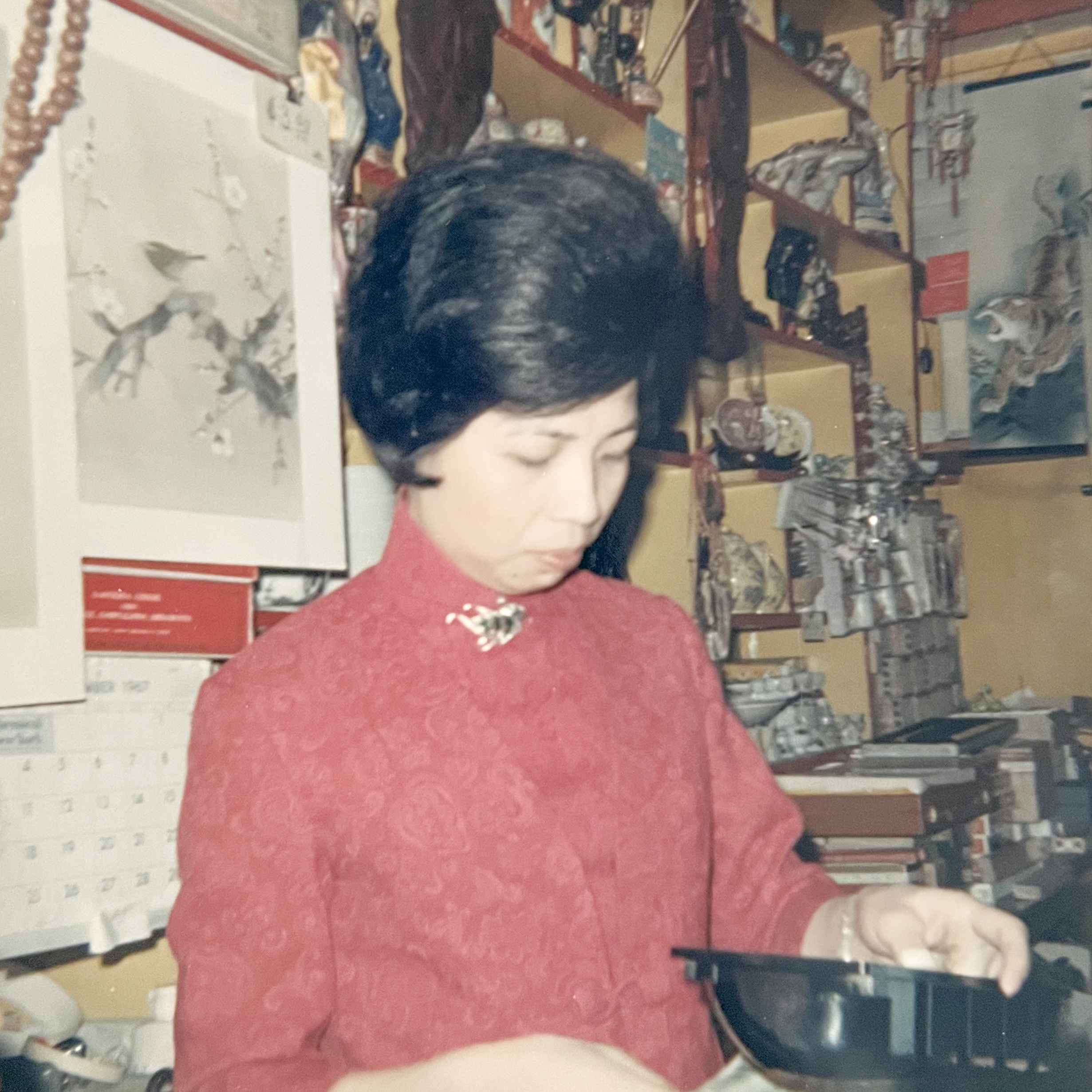
(Right) Tam Ting working in the store in her signature style cheongsam and beehive hairdo, January 1968.
Photographs courtesy of the Ting Family.
Eleanor: The herbalist was getting on an age and wanted to retire. My dad was looking for a space and that was available, so we took it over. When Mom came, she had some of the drawers taken out and she sawed down the shelvings a bit to her liking.
Mom had an eye for things. Things would call out to her and she would buy them. She would travel with her friends and wherever she went – whether it was Europe or Asia or anywhere – she would buy little things back for the store to sell.
+ Tell me about your family’s story.
We grew up in Chinatown, where we lived at Chong Him and Arline Poon’s home. In 1967 we moved to the NW because the James Short School was slated for closure in the late 1960’s — so everyone started leaving Chinatown and moving out. Although we didn’t, most people moved up Centre Street where the bus route could still take them back to Chinatown easily. We still came to Chinatown every day until the early 1970s. We went to regular public school in the NW, then Chinese school in Chinatown every school day. Then we ate dinner with Grandma, Grandpa, aunts, uncles, and cousins. After dinner we went back to our house. On weekends, we came down for church at the Chinese United Church. Our Aunt Jo drove us down every day.
My dad’s father (Bak Mee Poon) was the #7 son. He came to Canada on August 9, 1918 on the Empress of Japan. Because of the Canadian immigration laws, he could not bring a wife to Canada so he went back to China to get married and had a son.
Nowadays if you walk on Mott Street, everyone has those little furry backpacks, or the octopus you can turn inside out… Mom would say, “everybody is doing that – let’s do something different.” I’ve a lot of customers coming in saying also, “I miss stores like this because it’s a traditional gift shop.” And they would come not because it’s Ting’s gift shop, but because we carry things that they tried to find that they can’t find anywhere else. There’s some things that they look for that I don’t sell and I try to send them to other places that I’ve seen.
That’s Mom, our mom. Mom was the curator of the objects. Dad did whatever Mom said — he was a smart man. It was always whatever Mommy said.
The Tings have been in the building since January 1958. We’ve been open for 64 years.
+ What items does Ting’s sell? Has this changed over time?
What do you remember about past products?
Eleanor: We go from toys to decorative objects to figurines. We do sell some pajamas and I also have some slippers.
I used to break things just so I could put it back together; like if a child broke it, could they do something about it? My mother used to yell at me for this… I would take something apart, sit there and examine it. The worst part was when you try to put something back together and you have one piece left over… and you have to take it apart again to make sure the parts fit where they’re supposed to. Unfortunately, things don’t fit together like this anymore because they’re plastic or glued.
We used to sell something called the “Water Flower” — it was a shell with paper flowers in it — when you put it in a glass of water, the flowers would float up and it would last for a week.
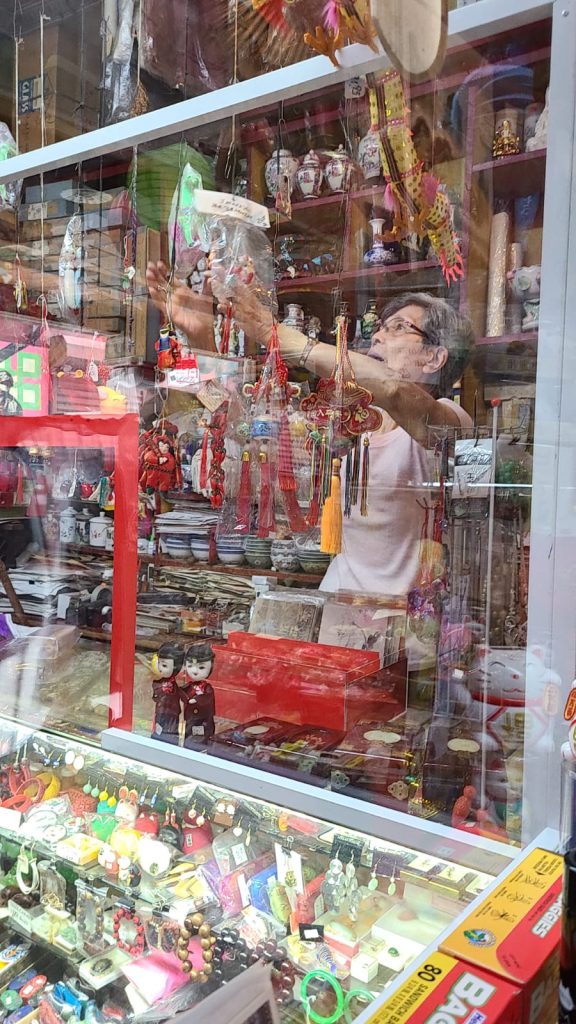
Tam Ting working behind the newly installed plexi-glass partition on the first day of reopening Ting’s after the COVID-19 pandemic, September 16, 2020. Photograph courtesy of the Ting Family.
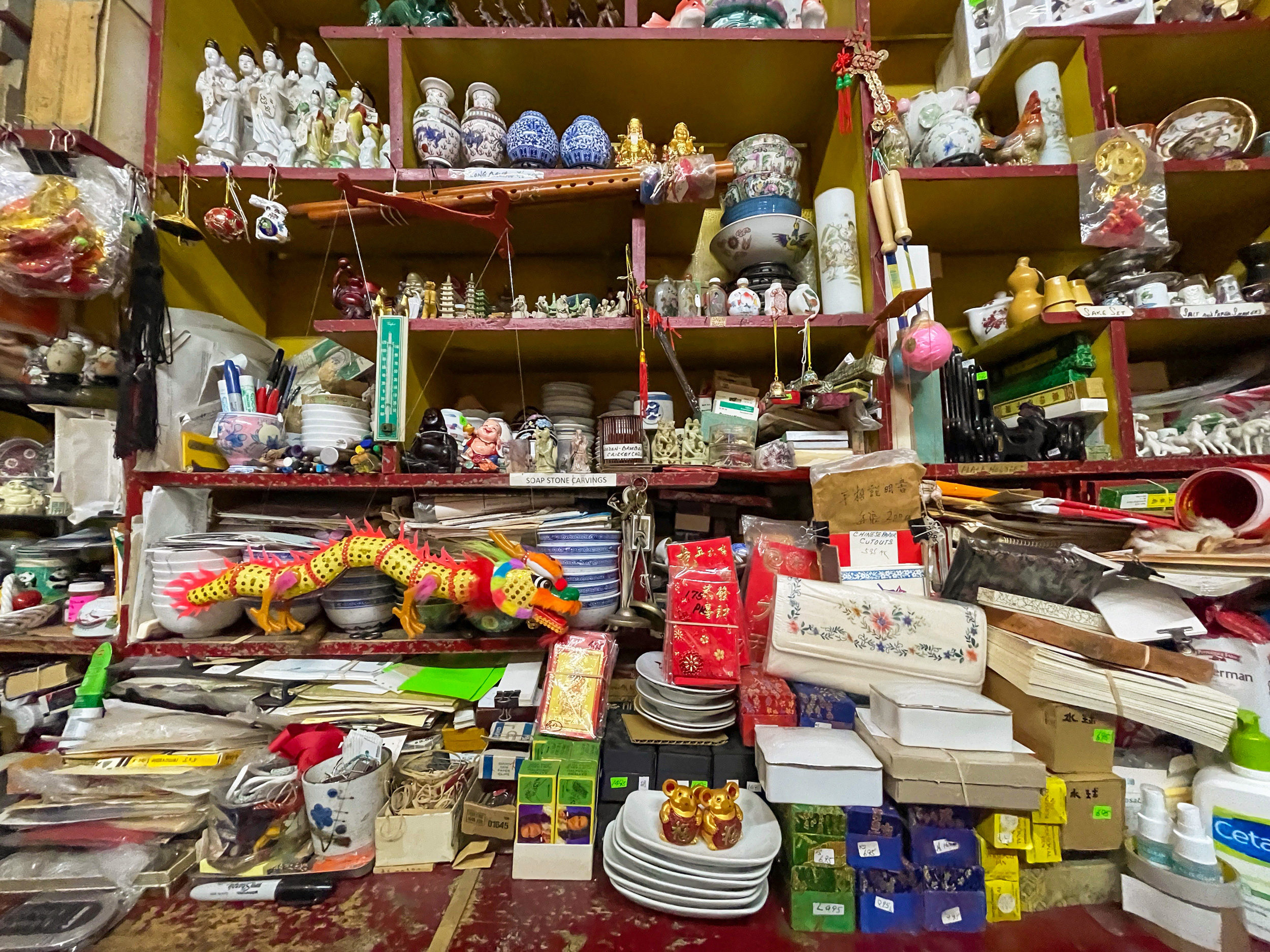
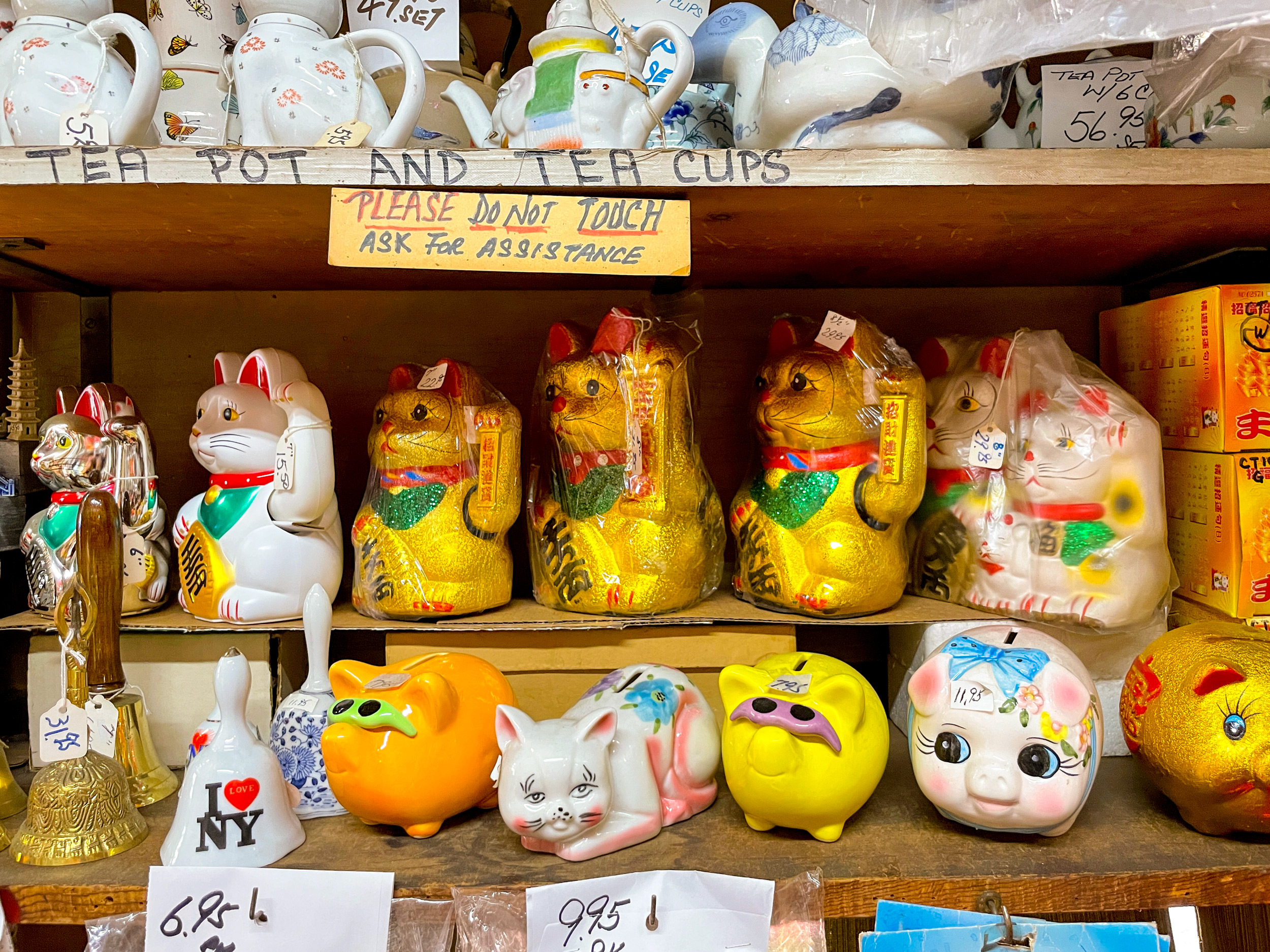
And then there’s another thing called “Coin Magic”. It’s a rectangular item that had a little piece that goes into it. But there’s two sides to it and you would put a coin there, you would turn it around and the coin would disappear, like a magic trick. That was originally made in Japan. China tried to copy both and it didn’t work. It became an extinct item. The running joke is that if you still have it, hold on to it because you can’t find it anymore.
There’s also something called the “Trick Box” that has different movements to open it and once you open it, you can hide some trick. I had a customer that thought it was a cute item, bought a box, put an engagement ring in to give to his girlfriend. He wanted her to open the box. She got so frustrated, she hammered it and it came to pieces. She got the ring though, but he had to come back to buy another box. There’s only one person on the west coast who sells it, but it’s not ornate like the ones in Japan.
+ Who owns the building?
Eleanor: The Sun Wei Association. They’ve owned the building since the mid to late 1940s.
During the pandemic, they were willing to cut the rent in half. I heard about a lot of the landlords who weren’t willing to work with them, so that was very, very nice.
They’ve been our landlords since the 1950s, since we took over the store. Naturally, the people we used to deal with aren’t around anymore; but the new people know we have a history with them and are willing to work with us.
+ Can you tell me a little bit about any renovations or changes to the building since your family first took over the space?
Lilian: There are pictures of Pell and Doyers in black and white. It was funny because they actually had siding – wood siding – on the side of the building at one point. And there were two doors to our shop: the door that we use now and the door on Pell Street. So you can see the difference. This door (on Pell) was always closed.
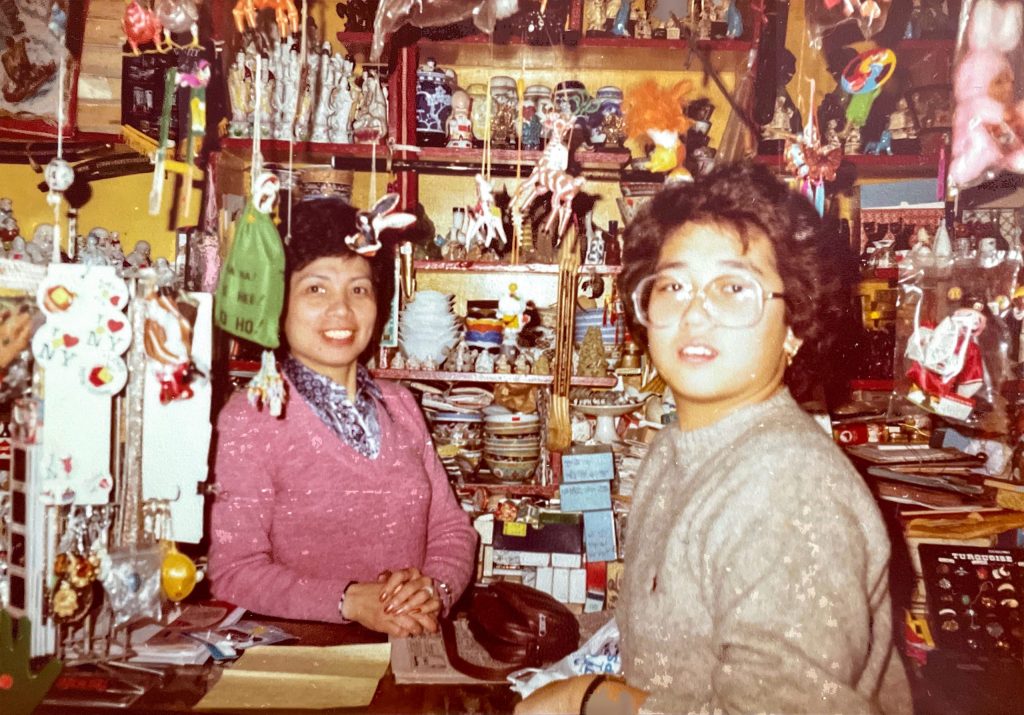
Tam Ting and Lilian Ting in store, late 1970s.
Photograph courtesy of the Ting Family.
The restaurant downstairs on Doyers Street used to have a dumbwaiter that would go up and down for it [on Pell]. Next door to the stairwell going down used to be a tailor shop.The narrow stairwell used to be a restaurant called King Wu.
This window used to be glass and underneath used to be an elevator for the downstairs restaurant. This elevator would take them all the way down to the restaurant. The hatches used to be open, but they decided to not use this hatch anymore. I don’t know who did it, but they put the chimney events there and then they put a grid on top of it and they broke the glass… so the landlord put a board or aluminum over it and then all of a sudden somebody put a sign there. What’s there now? Nothing. It used to be the foot massage place that used to have their sign there and then they closed, so that’s no longer used as a sign. But that’s where the grating is, if you’re walking on Pell Street.
The store has been more or less the same since the late 1950s.
The only thing is we used to have an awning on both sides — it deteriorated and no one does the old awnings anymore so we left it.
Eleanor: The only problem is that we can’t put one of those standard warnings because when cars turn or trucks turn right, they knock right into it.
That’s why we decided not to even put another one on. If you look at the corner of Pell and Doyers and you look at my store, that side is bent out of shape because of being banged up. That’s why I get very, very nervous when that barricade is where it shouldn’t be on Doyers street. I’ve asked for the barricade to be placed at all times. People turn in and they don’t know how to back up – they come straight up to my door!
Wear and tear… people slam into things and over time, it fell apart. Years ago, we didn’t have gates. I have gates now, but years ago, all of the glass was left open. You’d lock the doors, but the windows were wide open – you could literally window shop at 3AM. Now, we’re afraid to do that because people have nothing better to do except go and break things.
Everything is the same except for the plexiglass that we set up in September 2020 because of the pandemic. I had to remove chairs because it was inviting people to sit [during the pandemic.] I used to have two chairs in the store because my dad and mom used to work in the store and they could sit and relax. We used to have a TV so Dad and Mom could watch — but because of the pandemic we had to get rid of the chairs and the TV because again, it would be inviting people to loiter.
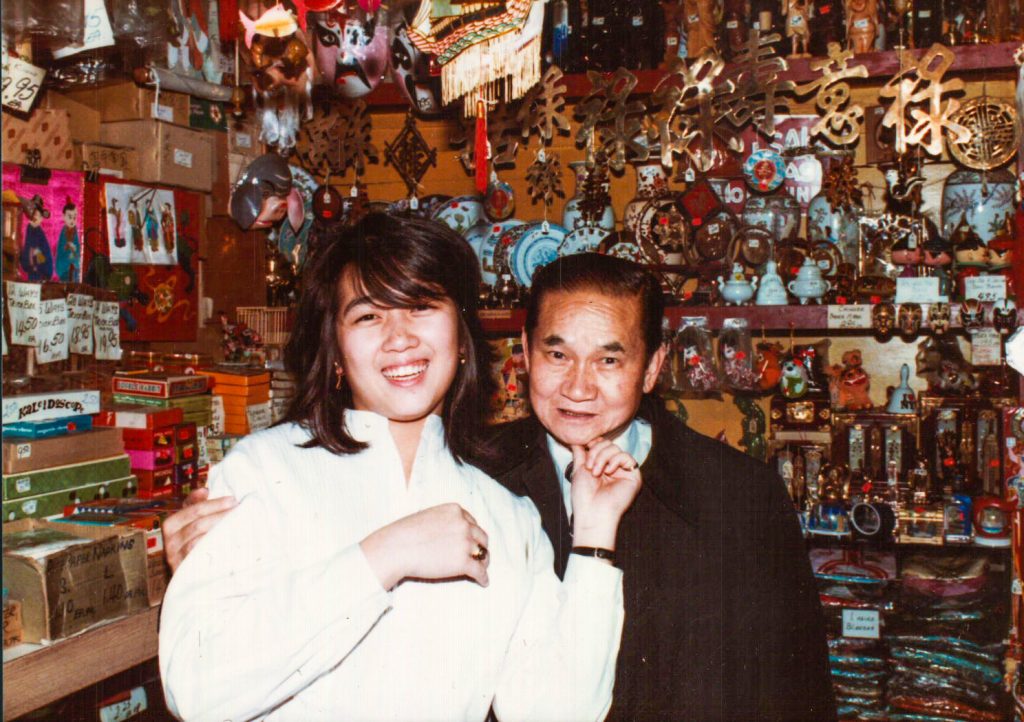
Yu Hong Ting and Lilian Ting in the store, mid 1980s
+ What about signage – has the signage changed at Ting’s?
Eleanor: Yes. It used to be “Ting’s Company” or “Ting’s Gift Shop” on the glass itself and the only reason why we don’t have it anymore is that the glass broke and no one does this old hand-painted with gold leaf lettering anymore. It’s an art form that’s dead. Nobody does it anymore.
+ What are your fondest memories of this building / shop?
Eleanor: Just hanging out in the shop, being with my parents… having customers come in and being able to assist in their purchases.
My dad had broken English but people understood him. My mom spoke a little bit of English and what she didn’t know she would look up in a dictionary to try to communicate with people.
What I didn’t know, Mom would know and vice versa. They would tell you very slowly so my mom could understand though. Television was a big thing. In the 1960s and 1970s — black and white TV! I would like to watch my cartoons and I still like watching cartoons… they didn’t have Sesame Street then and I wasn’t much of a Mr. Rogers fan, but I liked my cartoons.
The funniest thing was – do you remember Soupy Sales? He had a show. I loved to watch that show. He would do a lot of his own acts and tricks and have guests come on. When I was a child, maybe 6 years old, the TV was behind the counter and I would sit in my chair and watch the television. I felt someone annoyingly hitting my hand… someone was being very annoying and kept on hitting my hand. I turned and I looked up. I was speechless— I looked up at the guy over the showcase and turned my head to look at the television — and it was Soupy Sales. He was standing right there [in person]… When you’re a little child you don’t think that everything is recorded; you think that they’re inside the TV. I was just shocked. I think he was a little surprised I was sitting there watching him. That was the highlight. I learned that if there is an actor or someone coming into the store, don’t gawk over them, because a lot of people don’t like it. I treat them like another Tom and Jerry coming into the store. I was in seventh heaven because he was in our store!
Do you remember the show Fantasy Island? There was a little actor – I can’t remember his last name. He came into the store. He had his bodyguards and everything outside. And he came in with a beautiful woman who must have been six feet tall… and he’s like, six – I didn’t need to stare, so I turned my head and I would look at him from behind. This is the guy from Fantasy Island! I would gawk over them internally but I’d treat them like a regular customer.
I was walking up the street one day and Paul Newman was walking with his wife Joanne. There was a fan who ran up to him and he said: “It’s my day off. I want to spend it with my wife. Can you please not?” I think it’s probably because of that [memory] in the back of my head that people don’t like it. Then I was working at the airport about ten years ago (I had another job aside from the store!) and Susan Sarandon was walking to pick up her luggage. She had luggage and purses and I helped her carry it. She said thank you and she walked off.
(Left) Yu Hong Ting in the store, late 1980s/ early 1990s.
(Right) Yu Hong Ting in store, November 25, 2002. Photographs courtesy of the Ting Family.
+ Are there any other places that stick out in your memory as important during your childhood?
Lilian: I think for Eleanor what sticks out for her would be Bobo’s because as a child, she used to go in there and get the mushroom shrimp dumpling and would tell them: I don’t want the shrimp dumpling, I just want the mushroom. But that was one of her major favorites and then the pool hall.
Eleanor: Bobo’s also had these fantastic sponge cakes. They had a small counter with two or three stools. I would sit there and spin and I would order my cupcake and milk. To get me to eat the shrimp dumpling, they would put a mushroom on top and on the bottom. And I would eat the shrimp dumpling. Bobo’s was a chop suey place but in the early afternoons, it was yum cha.
King Sun Coffee Shop [Where Taiwan Bear currently is on Pell Street] was open 24 hours a day. You were able to go there and get pastrami over rice, short ribs over rice, oxtail stew, ham and eggs, corned beef over rice and it was fantastic. Everybody went in over there. It was a coffee shop with spinning stools and tables… At midnight, it would be all the sanitation workers sitting there eating.
Lilian: Everybody knew of that place. You could get a good meal for a decent price… over rice or a sandwich. You could go in there for everything.
Eleanor: It was like Katz’s, Chinese-style. It closed down in the 1980s.
+ Do you think Chinatown has a strong community?
How have you seen Chinatown change over the past decades?
Lilian: People are adapting.You know, it’s funny, because if you look around the room, I will not be the youngest person here, sitting here [in House of Joy] having dim sum. But I am sure one of the oldest, middle-aged people has been in this restaurant because a lot of my contemporaries have left Chinatown. Most of them because their parents had pushed them to get a better job, leave Chinatown, you know, this is where we first started, you need to go somewhere else. There’s a bigger and better life out there. All of a sudden now, you’re seeing many people wanting to come back but now you can’t afford to.
Eleanor: Every time a store closes, either a beauty salon opens up or a restaurant opens up.
Well, there was Mandarin Court on Pell Street. Temple Garden. Esther Eng’s, Bobo’s…There used to be a local restaurant right where Joe’s Shanghai [used to be on Pell Street] and it was called Chef something or another. That was the place to go when you didn’t want dim sum, but I don’t remember the name of it.
There have always been a lot of barbershops. There used to be about 35 of them. I used to count them, it’s hysterical. Between restaurants and barber shops – that was what Pell and Doyers Street was really famous for.
Lilian: Through the years, a lot more immigrants have come in… whereas in the beginning, they all used to be from Guangzhou (Canton), then you started to get folks from the North of China and other provinces and villages, who spoke different dialects. With that, came different types of restaurants and different cuisines were introduced.
When you look at Chinatown, by commerce, what is Chinatown really famous for? Eyeglass stores, restaurants, barbershops and bubble tea shops. After that, there is the sprinkle of specialty shops: dessert shops, maybe one or two candy stores, and there’s a lot of generic gift stores that came about. You also have a lot more medical offices popping up and more specialty offices. Almost every hospital has an outpatient or a doctor’s office here. Mount Sinai and Columbia all have something down here. There’s more for the community now.
And banks. We have a lot more banks.
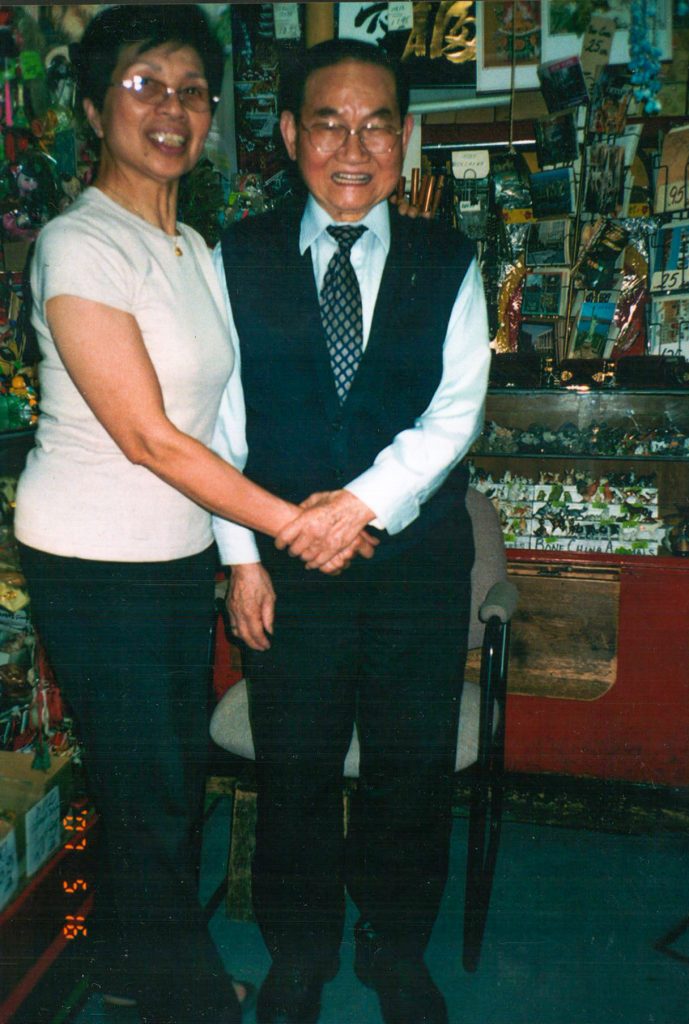
Tam Ting and Yu Hong Ting holding hands in the store, May 16, 2007. Photograph courtesy of the Ting Family.
+ How have you seen Chinatown impacted since the pandemic started?
Lilian: A lot more anti-Asian crimes. There are definitely a lot of businesses closing down.
Tourism is coming back. Whether or not they’re actually spending money here is another thing… but there are a lot more tourists now. It’s difficult for businesses to come back because landlords are having a hard time. You do see a lot of empty spaces.
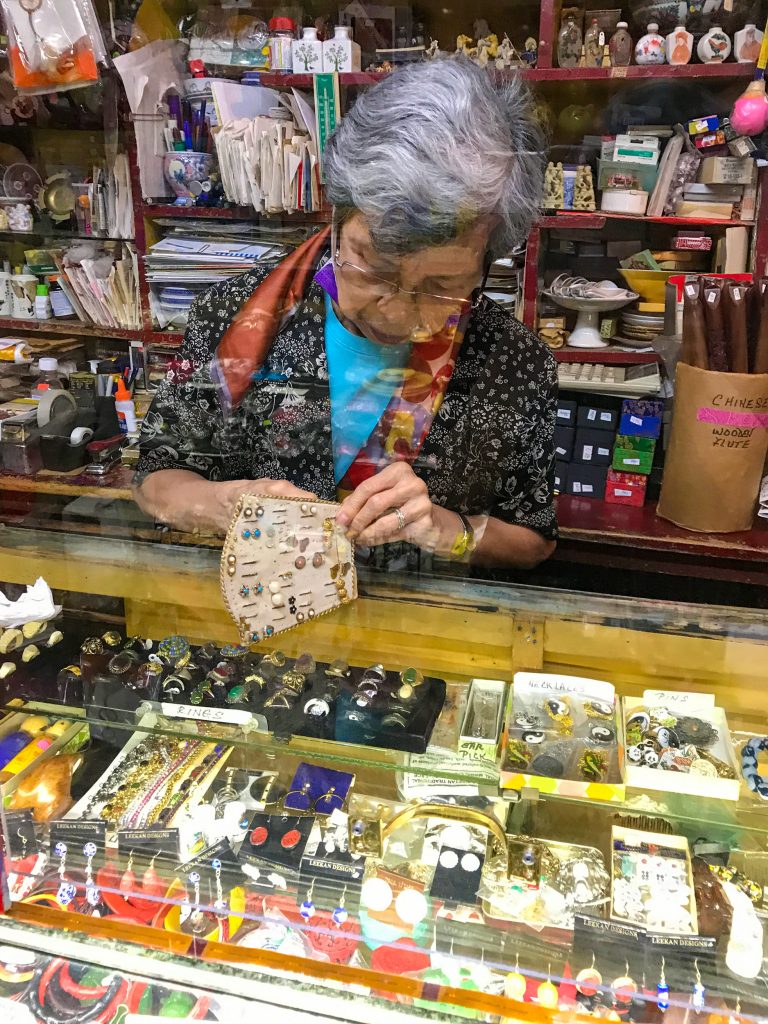
Tam Ting working behind the newly installed plexi-glass partition on the first day of reopening Ting’s after the COVID-19 pandemic, September 16, 2020. Photograph courtesy of the Ting Family.
+ Have you felt more nervous or afraid with the rise in anti-Asian rhetoric and hate crimes?
Lilian: I’ve actually become very vigilant. It’s gotten to the point where, really, I’m home before the sun goes down. I don’t roam the streets by myself. If I’m not with my husband, I don’t go out at night. Even if we go out during the day, I ask Eleanor to come with me. It’s hard. I won’t go on the subway. I tell her not to go on the subway. You don’t have enough eyes. I don’t walk as much as I used to; I drive more.
Now that we know that this is happening to us to all Asians randomly, whether it’s by a homeless person that has mental illness, or just somebody that just is ignorant — you really have to have all of your defenses up all of the time. If somebody walks up to you, you have to have that stance like, either I’m going to fight you or I’m going to run.
Recently, there was an individual and he had a pizza box in his hand. I was standing there on Broadway, waiting for my husband to pick me up. I was up against the building, because I didn’t want anybody walking behind me.
The guy walks by, stops, stares. At that point, I had my keys. I don’t know, maybe I just exuded this energy that was like: Just try. Let’s go. I’m ready. Because one of us is not getting off. I don’t care who, but I am not letting you beat me without a fight. And he just looked at me and he walked away… but he was trying to start something with anybody.
We’ll go grocery shopping together most of the time… or Eleanor stays in this compound of four blocks.
+ What do you think Ting’s means for our Chinatown community?
Lilian: Currently, Ting’s is one of the few originally owned gift shops from the 1950s still open in Chinatown. There is another gift shop at 32 Mott Street – Quong Yuen Shing – and the owner of the building took over the shop… This has been an ongoing shop since the 1930s or the 1940s I think. Our friend’s grandfather started it, though he’s passed away. Paul Lee was the last living relative of the shop. Paul didn’t have any children. I think MOCA did something on them. But the last living relative of it was Paul Lee, and he passed away. He was great, he was a big advocate for Chinatown. There’s also Wing On Wo, which is still owned by the family.
I don’t know if it’s for Chinatown, but I do know, just for our clientele — we have a lot of Chinese Americans in their 40s, 50s, 60s who bring their children or grandchildren to come down to get a haircut on Doyers… and they say, “my dad used to bring me in here to get a haircut when I was a kid…” It’s sort of a mini institution. My mom used to say — “we’re not a grocery store, so the stuff we sell isn’t going to rot… it’s stuff that you don’t need, but that you want.” That was the whole thing.
If we close up, I think people will be sad. It’s more nostalgia.
I think a lot of the older generation have come to be really philosophical. To me, it would be – “oh my god, that store closed; it’s very very sad.” But to the older generation: “Times change, things happen.” I think it’s a mechanism for them because look around: everyone around here is an immigrant. Some of them are refugees from their own country. They’ve had to adapt; move on; survive — being nostalgic for a lot of these people is fanciful. I think that’s really what it is.
Thinking about impact: We have a lot of people – and they’re not just the Chinese Americans that come in and say this – but we have a lot of tourists from all over that remember our shop and the restaurant downstairs… They would say: “we used to come up here because we had a dollar, because our parents gave us a dollar. And we came in here and bought finger traps. Do you still have those things?” And we’re like, “yeah, come on in!” We have people who come in and say, “There used to be a little old man. He was sometimes really nice and sometimes really mean.” I would laugh and say: “That’s my dad. You must have been touching everything.”
We used to have a teacher who would bring her class. Once a year they would do a class visit to Chinatown and they would come to Ting’s Gift Shop. They would call Eleanor and make an arrangement. Eleanor would take a half a day off of work at that time and be in the store. The kids would be all over, loving and touching everything. Those are the great memories we have of being in the community and being able to cater to little people coming in… being able to find that special gift for someone. I guess if we closed and a generic bubble tea shop opened up in the space, it would really be sad.
It’s a multifaceted question because, just thinking about it, even speaking about it, I have a lot of emotion.
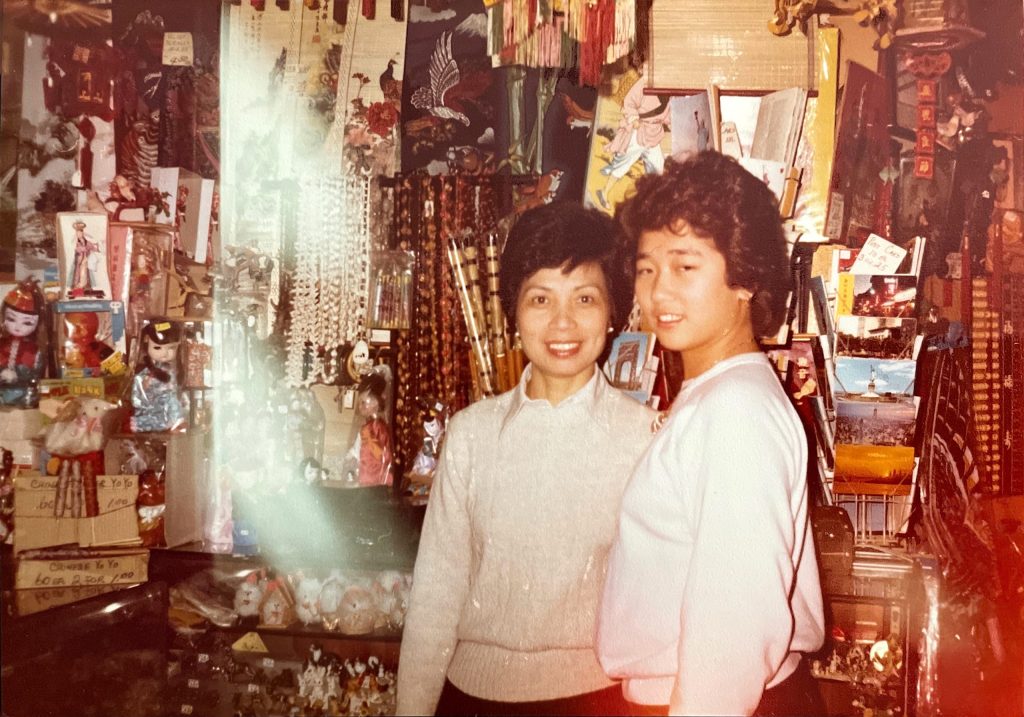
Tam Ting and Lilian Ting in store, early 1980s.
Photograph courtesy of the Ting Family.
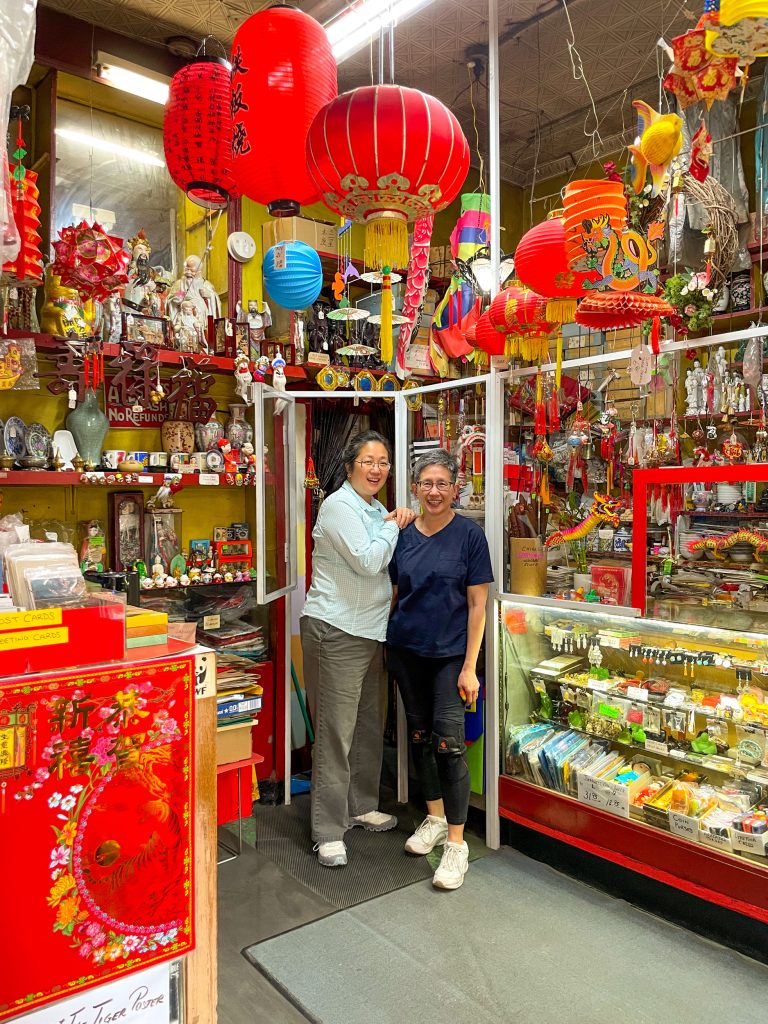
Portrait of Eleanor and Lilian Ting in the store.
Photograph taken during our interview, May 2022.
+ How do you envision the future of Ting’s?
Eleanor: Number one — everyone is telling me I should start accepting credit cards. I’m still very old school. I like cash.
Other than accepting credit cards, people say you should sell online.
Lilian: Ting’s Gift Shop is a love affair — really, you love it and you hate it. We love it because we were brought up here; it’s our home. When people ask where’s your home, we say Pell Street, on the corner. But we hate it also because: is there a future for it? In any small business, you are attached at the hip. You have to spend all your waking hours trying to figure out something new – what will you bring into the shop to attract people? – but keeping the feel of the store. When you go down to Mott Street, all of these stores are generic. They sell handbags, they sell tchotchkes and they all look the same.
My mom’s legacy was: she didn’t want to be the run of the mill. She always put a different twist in her own little shop. She didn’t want to be like that. You didn’t need another gift shop like that. She always wanted it to be her own space, and that’s what makes it special. I think that’s what makes people want to come back more.
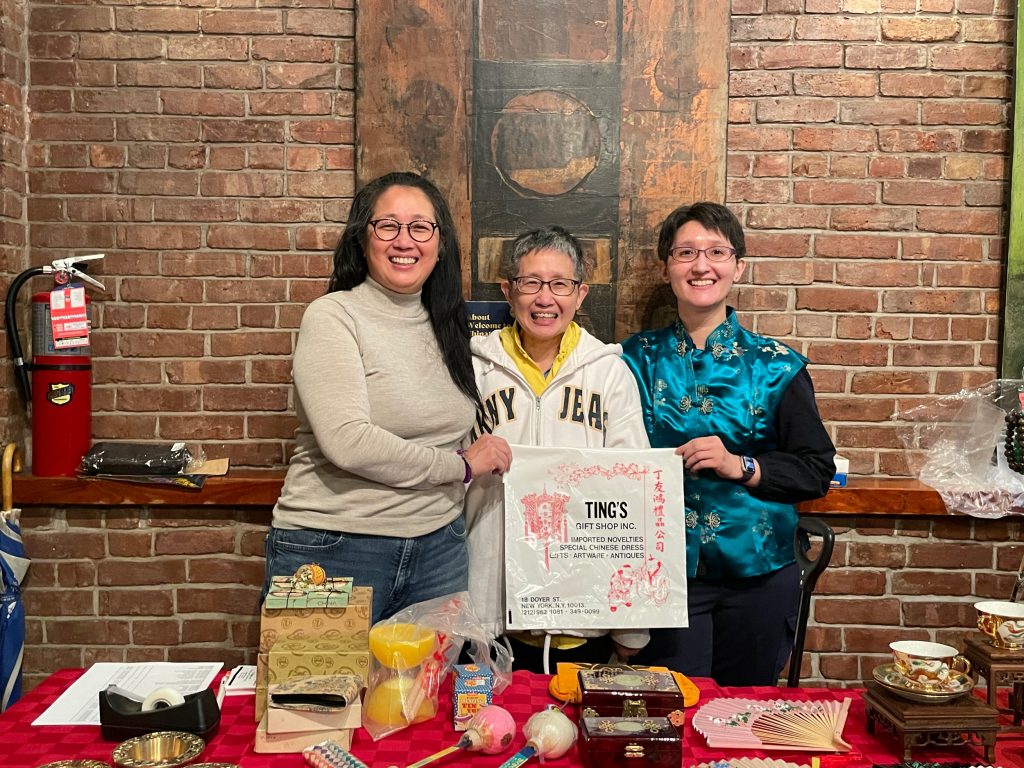
Lilian, Eleanor and Jona, hosting a pop-up selling objects from Ting’s Gift Shop, May 2024. Photograph taken by Cheryl Wing-Zi Wong.
TING'S GIFT SHOP - BUILDING PHOTOGRAPHS
Photographs taken between 2022-2024.
DOYERS + PELL - HISTORIC IMAGES
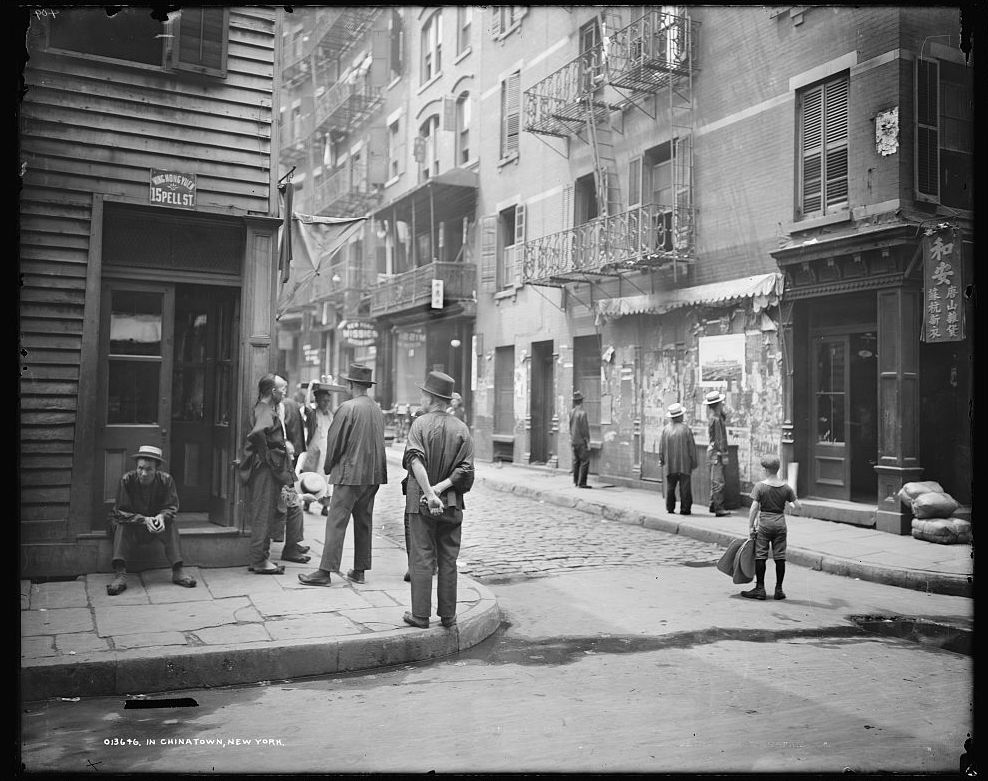
Detroit Publishing Co, P., Byron, photographer. (ca. 1900) In Chinatown, New York. United States New York New York State, ca. 1900. [Photograph] Retrieved from the Library of Congress, https://www.loc.gov/item/2016808740/.
18 PELL / 17 PELL - BUILDING PHOTOGRAPHS
Photographs taken between 2022 – 2024.
OBJECTS FROM TING'S GIFT SHOP - PHOTOGRAPHS BY THE CHINATOWN B.I.D.
Photographs taken in July 2023, courtesy of the Chinatown B.I.D.